
Thursday, June 3, 2010

The 2007 Vintage in Roero and Barbaresco

As I was saying yesterday, the large scale, focused format of the blind tastings at Nebbiolo Prima provided some definite insights into the qualities of vintage — with 2007 being the primary focus in Roero and Barbaresco — and of the broad sense of terroir associated with the various communes/municipalities of production.

Day one was devoted entirely to Nebbioli from the Roero as well as from the Alba, Treiso and Barbaresco municipalities within the Barbaresco production zone. We tasted sixteen wines from the 2007 vintage in Roero and fourteen 2006 Roero Riservas, followed by forty-eight Barbaresco from 2007 and five 2005 Barbaresco Riservas.

The second day of the event was split between Barbaresco and Barolo. We'll get to the Barolo on another day. This time it was all about Neive, with thirty-two Barbaresco "normale" from the 2007 vintage and three Riserva bottlings hailing from 2005 lined up on the big tasting table.

Getting straight to the fine details, here's the short list of wines that grabbed me.

Roero (commune):
  • Roero, Cornarea 2007 (Canale) – spicy, ripe, integrated
  • Roero "Bric Valdiana," Giovanni Almondo 2007 (Montà) – high-toned, minty, muscular
  • Roero "Bricco Medica," Cascina Val del Prete 2007 (Priocca) – ripe yet solid vintage expression
  • Roero Riserva "S. Francesco," Negro Lorenzo 2006 (Monteu Roero) – judicious wood; forward, pretty fruit

Of the wines that inspired me on the first day of blind tasting at Nebbiolo Prima, Giovanni and Domenico Almondo's Roero "Bric Valdiana" was the only one that I'd already been a regular admirer of in the past — unblinded and at home, albeit in earlier vintages.


Barbaresco (commune):
  • Barbaresco "Vallegrande," Fratelli Grasso 2007 (Treiso) – dark but well done
  • Barbaresco "Tre Stelle," Cascina delle Rose 2007 (Barbaresco) – classic, delicate, floral
  • Barbaresco "Campo Quadro," Punset 2007 (Neive) – burly but complete, balanced

The 2007 Barbaresco "Tre Stelle" from Cascina delle Rose was a real stand-out for me, while the "Campo Quadro" from Punset pleasantly surprised.


Barbaresco Riserva (commune):
  • Barbaresco Riserva "Nervo Vigna Giaia," Piazzo Armando 2005 (Treiso) – fine structure, elegant
  • Barbaresco Riserva "Serraboella," Massimo Rivetti 2005 (Neive) – prettiest nose of the day


Not a bad little list, one that offered up some nice discoveries for me. When you look at what it took to cull it, though, those are some pretty slim pickings.

I didn't invite you here to put you through basic arithmetic exercises, so I'll crunch the numbers for you. That list represents a meager selection of nine wines out of the 118 tasted. It looks even starker when you break it down. Four out of thirty wines in Roero; actually, that's not all that bad. But that leaves only five wines from Barbaresco out of 88 wines tasted. And only three of those five were from 2007, which was the main vintage we were invited to Alba to taste, at least in terms of Roero and Barbaresco.

The translation? The 2007 vintage was presented to us, in day one's opening presentation by Enzo Brezza, current president of the Albeisa producer's consortium, as a year that started with a mild winter and early budding, followed by a dry, hot growing season and a relatively early harvest. Not as extreme as 2003 but still a hot, dry year that produced higher alcohol levels and lower acidity than typical.

In the Roero, generally speaking, I didn't find the difficulties of the vintage to be a tremendous issue. Most of the 2007's I tasted were fruitier, slightly more alcoholic and, indeed, lower in acid and more softly structured than their 2006 counterparts. But overall, the wines fared reasonably well, as reflected in my findings with our sample population.

My general experience in Barbaresco, however, is that 2007 proved, as shown in the large number of wines tasted, to be quite a difficult vintage.

Over and over again, particularly in Treiso and Barbaresco, I encountered wines that displayed very ripe, flamboyant fruit along with sweet, herbal and weedy aromatics and flavors. My impression was that sugar content had surged to levels that required harvesting before the other aspects of the grapes had a chance to catch up and create any possibility of completion and harmony. When asked of my experiences, at our dinners or during winery visits, I shared this interpretation with several producers, none of whom came right out and agreed but none of whom said much if anything to dispel the idea, either. What I did hear repeatedly, from producers throughout the various regions, is that 2007 was a great vintage for Barbera (a variety that is more naturally inclined to thrive in such climatic conditions).

Moving ahead to day two and the wines of the Neive commune of Barbaresco, I can't say that I found the big picture any more to my liking. Though the sweet-and-sour signature I'd found in so many of the wines from Treiso and, to a slightly lesser extent, Barbaresco wasn't quite as obvious, there was a much higher prevalence of over-extraction, heavy oak treatment and high alcohol. Again and again, words like "jammy," "bourbon," "sweet," "overripe" and "forced" appear in my notes.

I'll be curious to see how the mainstream press reacts to the 2007 vintage in Barbaresco, as I expect it stands a good chance of being well-received in a manner similar to other ripe, hot vintages in recent history, such as 1997, 2000 and 2003. For me, based at least on our rapid-fire albeit extensive tasting, 2007 will be a vintage where knowing your producer and selecting with care will be of utmost importance.

Fast-forwarding a year, it should also prove interesting to see how the same vintage characteristics affected the wines of Barolo. In the shorter term, stay tuned for my thoughts on the 2006 vintage in Barolo.

Wednesday, June 2, 2010

Nebbiolo Prima: My Thoughts on the Blind Tastings

In case the name doesn't make it crystal clear, Nebbiolo Prima was devoted at heart to rolling out the most recent vintages of Nebbiolo, specifically from the Albeisi zones of Barolo, Barbaresco and the Roero. Though the participating wineries all grow other wines, from Dolcetto to Freisa, Arneis to Nascetta, and were able to show such wines during estate visits, at walk-around tastings and/or over dinner, the big blind tastings that constituted the prime focus of each day were devoted exclusively to the Nebbiolo. Nothing but Nebbiolo.


With 189 participating wineries and over 320 wines in the mix, that meant that we on the press side of the event were in for some serious oral pain to begin each day. Four hours (or less, for those fleet of palate) of blind tasting, four days in a row, with an average of just over 80 high acid, high tannin wines per sitting. It was highly educational in a broad sense, but fun it was not. This was work, my friends, no matter how you sliced it.

As you can see from my shot above, the tasting was not 100% blind. We were provided with a basic spreadsheet indicating where and from what vintage each bottling originated. Tasting order was broken up by commune, with Riserva bottlings always saved for last within each major regional grouping. I must say whoever put together the order did a fine job of ensuring both a sensible progression and, equally important, an unpredictable curve in terms of style and quality.

There was nothing sensible, however, about pouring 80+ wines at a sitting. Even the most battle practiced tasters in the room, as well as the most enthusiastic, concurred that those numbers, and their cumulative effect on one's palate, were simply daunting. Adding a fifth day, something the promoters have already promised to do starting next year (and something I understand had been the norm in past editions of the Alba Wine Exhibition), would go a long way to easing the pain and to creating the possibility of enough time in the day for journalists to get a little on-site "live blogging" or correspondence done.


All of that tasting – 80 wines a day for 70 people spread throughout three rooms – could never have come together as well as it did if not for the fine and quietly anonymous work done by the participating members of the Associazione Italiana Sommeliers. These guys and gals, just a few of whom are pictured above, managed to make sense of my weak attempts to speak Italian, to pour by the numbers, to work on their feet for hours at a time each morning, and to do it all while wearing smiles (albeit subtle ones).

I've said it here before but it bears repeating: tasting this many wines at one sitting is no way to really get to know any one wine. A system of basic check marks and quick, concise notes are about the best I could realistically put into practice. For me, that meant recording my honest, immediate impressions of each wine, and placing a star next to the wines that really captured my attention so that I could return for a second look to ensure my first impressions carried through.

What I was looking for really shouldn't surprise any of you. Not power and opulence, not ferocious tannins that theoretically promise longevity, but rather finesse, balance, drinkability (whether now or later) and voice. If the wine spoke to me and I enjoyed what I heard, great. If not, then on to the next wine I went.

Does that mean I missed some good wines? Absolutely. I can promise that's the case for every taster in attendance, regardless of their personal preferences or the thoroughness of their note taking.

What large scale, rapid-fire blind tasting is good for, especially in a focused format such as this, is getting a handle on vintage characteristics and the commonalities of expression (if any) from area to area. I'm generally not one to pronounce on vintage, as I find the influence of the producer to be much more important – and vintage proclamations to be a crutch used by the major wine press and major marketing organizations to help sell units, be they wine or magazine subscriptions. Of course, vintage does play a role in defining the qualities of honestly made wine and, tasting dozens of wines from the same place and vintage in one sitting is a sure way for vintage and terroir to make their qualities known.

What's my point? I find it important to lay down groundwork, to make my approach clear, so that when I do post notes and/or general observations about specific wines, vintages or regions, readers here — newcomers and veterans alike — will have as full a sense as possible of where I'm coming from.

I'd originally intended for this post to include my thoughts on the wines tasted during day one of Nebbiolo Prima; however, given the length of my prelude, I think it best to save those impressions for a separate post. So, please forgive me my ramblings and consider this the introduction to what's to come in the next couple of articles: my reactions to 2007 in Roero and Barbaresco, and 2006 in Barolo.

(PS: I'd love to be able to attach names to the faces of the sommeliers pictured above. If anyone out there knows or can identify any of them, please do let me know.)

Tuesday, June 1, 2010

Nebbiolo Prima 2010: An Overview

It's been a little over a week now since I returned stateside from my adventures in Piedmont. With the better part of that week devoted to recovering, digesting and mulling over of all the finer points of the trip, it's about time that I get down to the business of sharing some details.

Outside the entrance to Alba's Palazzo Mostre e Congressi, which served as the base site for Nebbiolo Prima 2010.

The impetus for the trip was an invitation to attend an event called Nebbiolo Prima as a member of the press. I have to say I was psyched to be invited and, in the end, even a little proud to have been included among the group of international journalists who'd been invited to participate. Hell, I was actually surprised at first, so much so that when the invitation originally showed up in my email box, its full import didn't really register. I thought it was just a press release notifying me of the event. Like most of my comrades in wine and/or food blogging, I get dozens of such notices on a daily basis. It wasn't until the event organizers followed up with me that I realized I was being invited to attend.

"Hell yeah, man, I'm going to Piedmont." The invitation provided me with the opportunity to return to a region I'd been dying to revisit since my first and only time there in early 2006. To be clear, I should reiterate that the invitation included airfare as well as a hotel room and meals for the duration of the four-day Nebbiolo Prima. As with my similar trip to Paso Robles earlier this year, I hold myself accountable, and to a high standard I'd like to think, for editorial integrity. All expenses prior to and following the event were my own responsibility; in other words, I took the opportunity of being there to add on a few days to do my own thing. We'll get to that part of the trip in due course but, for now, I'd finally like to tell you a little about Nebbiolo Prima itself.

Enzo Brezza, current President of the Albeisa producers' consortium.

The 2010 Nebbiolo Prima was in one sense a first-time event but in the larger sense a rechristening and repackaging of the 14 year-old Alba Wine Exhibition. Under the aegis of Albeisa, the producers union for the Langa and Roero regions, and its new president, Enzo Brezza, this year brought a shift to a new PR/organizing firm for the first time in 15 years and, with that shift, a subtle reimagining of the scope of the event. Much was being made and spoken behind the scenes of this shift in organizers. Not having attended in the past, though, I really can't comment on the politics or qualitative aspects of the move. The new organizers, a Veneto-based PR firm called Gheusis, did what seemed to me a fine job. Communications leading up to and through the event could have been more thorough but, in the end, everything came off without a hitch, so I really can't complain.

This year's event was broken into two separate and distinct programs, one for journalists (of which about 70 were in attendance) and one for buyers (40-50 attendees). The event spanned four days, with each day on the press side of the camp broken out according to a simple if fully packed program, which looked something like this:

  • 8:30 AM to 9:00 AM — opening comments
  • 9:00 AM to 1:00 PM — blind tasting
  • 1:00 PM to 2:00 PM — buffet lunch
  • 2:00 PM to 4:30 PM — visits with local producers/wineries
  • 5:00 PM to 7:00 PM — walkaround tastings with producers
  • 8:00 PM to 11:30 PM — dinner with producers at a regional restaurant

What little spare time might appear in the couple of 30-60 minute gaps in that schedule were essentially taken up by transportation needs, or simply by taking a moment or two to breathe. Blogging: forget about it. Checking email: barely, especially given the spotty Internet access at the event site and my hotel. Finding time to grab a beer, something that's much needed after tasting 100+ Nebbioli per/day: rarely and barely.

Things actually kicked off on Sunday night the 16th of May with an opening reception in Alba's Piazza Savona, and closed on Thursday the 20th with an evening party at the newly constructed Castello di Barolo in Barolo. I opted to miss both of those affairs in favor of opportunities to take on extra producer visits. Otherwise, though, I did my best to stick with the official schedule, especially when it came to the morning blind tastings and the afternoon producer visits, by far the two most important and educational parts of the event from my perspective.

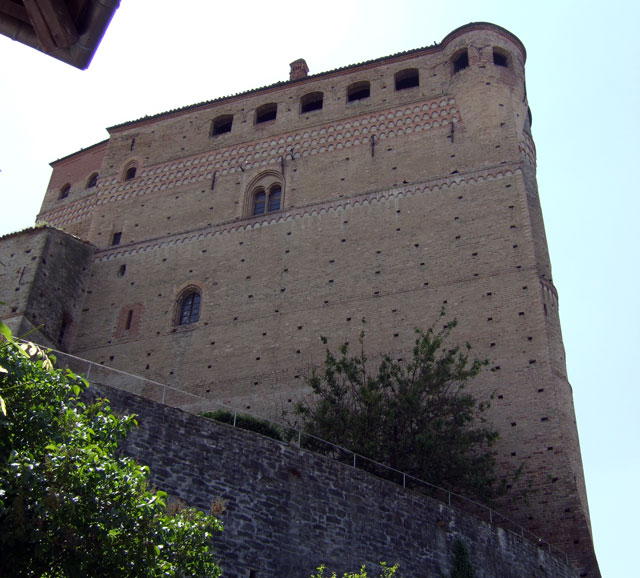
The new Castello di Barolo, as seen from the municipal parking area in the town of Barolo (above) and from the rooftop observation deck at Borgogno (below).


In the next few days, I'll cover the ins and outs of the big blind tastings at Nebbiolo Prima, as well as provide a few highlights from each day's lineup. From there, it'll be hunkering down to the more intense business of putting together producer profiles from the nearly 20 wineries I visited during my stay. Wish me luck (and grant me patience), my friends. And thanks as always for reading.

Sunday, May 30, 2010

Veni, Vidi... Giri?

The 2010 edition of the Giro d'Italia came to its end today, with Liquigas rider Ivan Basso riding to overall victory through the streets of Verona.

Ivan Basso grabs the final maglia rosa.
(Image courtesy of
La Gazzetta dello Sport.)

This year's edition of the Giro ran from May 8-30, its 21 daily stages taking it on its annual tour around the Italian boot. My recent trip to Piedmont ran from May 13-22, putting me in Italy right in the middle of the Giro's three-week course. Those that know me well, who know how long cycling has been an important part of my life, have been surprised to hear that I didn't make it to a single stage of the race while in Italy. Didn't even manage to catch any of it on the tube, not even in my hotel room, much less in a local bar.

Aside from passing the Rabobank team cars on the highway en route from the Torino airport to Alba on the morning of my arrival, the closest I came to the Giro during my nine-day stay was an occasional perusal of the results in the Italian sporting daily, "La Gazzetta dello Sport." In this case, it was over a glass of Pelaverga, just after grabbing a quick lunch at Enoclub, located on Alba's Piazza Savona.

Maybe things would have been different had I arrived a day earlier, in time to catch the team time trial stage in Cuneo, a scant half-hour from my starting base in Serralunga. Perhaps if there had been some spare time in my schedule, I could have found a cycling-crazy bar — there must be one somewhere in Alba, it can't be all about football — in which to catch a stage or two. Or if American television didn't completely ignore the race, I could have at least caught the early and late stages of the race from the comfort of home.

The fact is, though, my passion for the sport of cycling, as an observer that is, seems to have waned over the last couple of years. I still love the sport, don't get me wrong. I just can't summon the enthusiasm or find the time it takes to follow its results, its rising and falling stars, the way I once did. Part of that is no doubt a simple change in my life, an ebb and flow in the cycle of what it is that occupies me.

But I can't help but chalk part of it up to a growing disillusionment with the sport. With at least two of the riders finishing in the Giro's overall top ten (winner Basso and sixth place Alexandre Vinokourov) just having returned to the sport after recent multi-year suspensions for doping violations, one can't help but wonder. Are they really clean and really that strong? Or have they just found newer, better doctors and sports physiologists who know how to keep them a few steps ahead of the current drug testing parameters?

Come Tour de France time in July, I'm going to try to put these concerns aside. Just enjoy the sport for what it is, not for what its participants may or may not be doing behind the scenes. I love cycling, like I said, and I really love the Tour. For three years now, ever since I started this blog, I've been wanting to do a daily feature that follows the path of Le Tour via the wine and food culture of the various towns and regions through which it passes. This is the year in which I'm finally going to do my best to make it happen.

I missed the Giro. I don't want to miss the Tour.

Saturday, May 29, 2010

A Master of the Dark Arts Dies, Darkly

Dennis Hopper died today, just a few weeks past his 74th birthday, losing his battle with prostate cancer. From early roles in Giant and Rebel Without a Cause, to his breakthrough role acting in and directing Easy Rider and on through what became typical roles such as that he played in Apocalypse Now, Hopper was one of the great dark-part actors of our time. And unarguably one of the most memorable.

For me, the Dennis Hopper role that will always come first to mind is one of his darkest, playing the savagely creepy psychopath Frank in David Lynch's Blue Velvet. I can't imagine there are too many regular readers here who haven't seen Blue Velvet, most likely on multiple occasions. For all of you, and for those few who may not have experienced it, here's a clip.

Fair warning: you'll hear more f-bombs uttered in every 30 seconds of this short than have ever appeared, or are are ever likely to appear again, here at MFWT. But that's exactly the word that first passed my lips when I heard the news earlier today. Grab a PBR, raise a toast to the man, and watch it.

Thursday, May 27, 2010

It's in the Details

Words have been escaping me today — as is time tonight, all too rapidly. So I thought I'd share one more of the 700+ photos (trust me, they're not all good) I took during my travels in Piemonte last week. Coming soon will be highlights and observations from the four days of Nebbiolo Prima, followed by a slew of winery reports from my visits with producers in Barolo, Dogliani and Roero throughout the trip. So please stay tuned, and thank you for your patience. (And no, we only looked....)

Wednesday, May 26, 2010

A Switchback Moment

I kept offering my Punto in trade but for some reason they weren't going for it.

Tuesday, May 25, 2010

Vinoteca Centro Storico

There's something afoot in Serralunga. In this tranquil hilltop town of only 300 or so inhabitants, there's a sudden surge in renovations, perhaps the result of in influx of new money or maybe just of a revived thirst for renewal. Adjacent to the town's main square and its scenic overlook, major construction is underway at Azienda Agricola Vigna Rionda, where owners/winemakers Franco and Roberto Massolino are adding a floor and a rooftop terrace to create updated, separate accommodations for their winery's trade and public visitors. And not more than three or four hundred meters from there, a short walk down the winding cobbled streets through the town center to the base of Serralunga's old tower, there's something else afoot.

Just past the dog – he actually lives a couple of kilometers away, I'm told, but he's always there – and just through that door lies one of the most lively, inviting café/wine bar combos one could imagine, whether in Serralunga or elsewhere.

That place is Vinoteca Centro Storico. The name couldn't be much more straightforward: a wine bar in the center of the old historic town. Nor could the mission be much simpler.

Owners Alessio Cighetti and his wife/partner Stefania turn out what is an essential Piemontese experience, combining the simple pleasures of food and wine and making the pairing accessible to any and all who walk through their doors.

Stefania's food is the essence of simplicity. Think of it as home cooking — consistently good, hearty, classic Northern Italian home cooking — and you're on the right track.

Aside from a couple of hapless grissini, carne cruda pretty much had to be the first dish to meet my gullet on arrival in the Langhe on my recent trip, and Stefania and Alessio were only too happy to oblige. Ravioli in a sage-butter sauce — another Piedmont classic — rounded out my entry lunch.

Balancing the simple soulfulness emanating from Stefania's cucina, Alessio has put together a pretty damn satisfying wine list. The local offerings aren't anything to snub a nose at, with verticals of Monfortino and other top Baroli offered alongside more humble options in Langhe Nebbiolo, Langhe Bianco and, yes, even French wine. Actually, it's French wine, and a very particular sort of French wine, upon which Centro Storico has really built its equally particular reputation.

In this town of less than 300 residents, Alessio sells over 1500 bottles of Champagne a year. He's put together a list that rivals if not betters any I've seen here in the US, with big names such as Salon and Krug resting alongside gravitas-laden options from the likes of Philipponat (a vertical of Clos des Goisses, anyone?) and Diebolt-Vallois, all peppered with hipster-chic offerings from producers such as Cédric Bouchard, Ulysse Colin and Jérôme Prévost. And it's all priced more than fairly, about the same if not a tad less than what you'd pay at retail here in the States. Poured by the glass during my visit(s) was Champagne Doyard's "Cuvée Vendémiaire" Extra Brut, a sumptuously rich Blanc de Blancs from Vertus that displayed the breadth of aroma and body brought on by extended lees-aging. Lovely stuff and, ironically, more or less the first wine to whet my whistle in Nebbiolo-land.

There are a mere four or five tables on the ground floor and about the same upstairs, a few more outside when weather permits. Just enough space to accommodate the mix of wine loving locals, travelers and regional producers who frequent the place. Don't miss it if you're ever (or when you're next) in the area. I came pretty damn close to calling it home base during my stay... and I'm already missing that carne cruda and Champagne combo.


Vinoteca Centro Storico
Via Roma, 6
Serralunga d'Alba (CN)
ITALY
+39 0173.613203

Beer Dinner at Midatlantic Restaurant Tomorrow Night

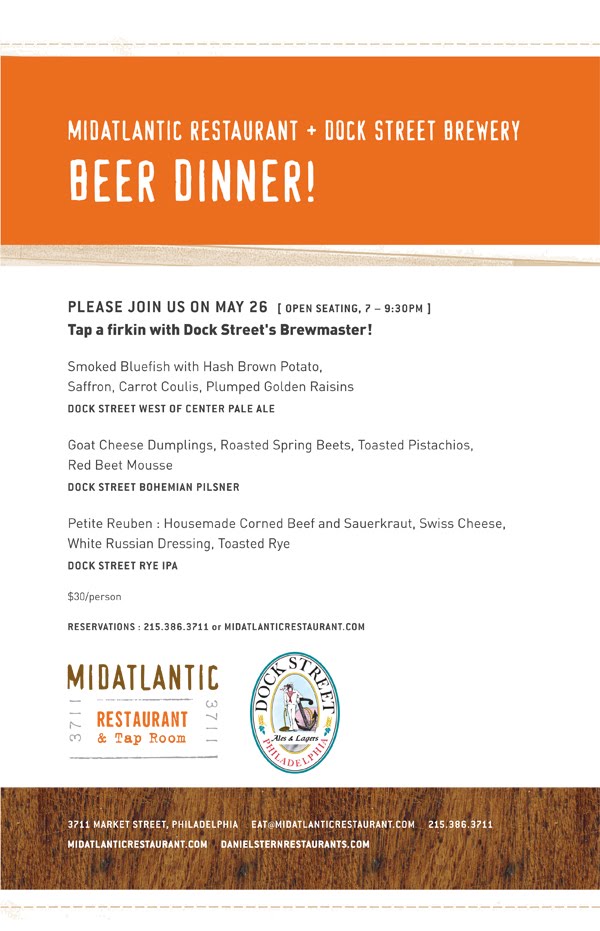
It's only ten days now until the start of the 10-day long Philly Beer Week. (Where else but Philly does a "week" built around beer last ten days?) For those who can't wait, or for those who can but are nevertheless always thirsty and hungry, there's an event in town tomorrow night that offers everyone a chance to get their warm-up on.

The crew in the kitchen at Midatlantic Restaurant will be teaming up with the fermenting squad from Dock Street Brewing Company to deliver a three-course menu, with each dish paired to a Dock Street brew. The event runs from 7:00 - 9:30 PM tomorrow, May 26, 2010. The cost: a mid-week savvy $30/person. The place: Midatlantic Restaurant, 3711 Market Street, Philadelphia, PA. Click on the flier below to see the full details.
Personally, I'm particularly jazzed to check out Dock Street's Rye IPA poured from a freshly tapped firkin, and to see what new energy and touches Chef Bryan Sikora (full disclosure: Bryan is an old friend) has brought to the table since recently joining Daniel Stern's team at Midatlantic.

Monday, May 24, 2010

A Few Seats Still Available for this Friday's Chocolate and Bubbly Tasting at Éclat

As a reminder, this Friday, May 28, 2010, I'll be teaming up with Master Chocolatier Christopher Curtin of Éclat Chocolate to espouse the possibilities and pleasures of pairing fine chocolates with wines that sparkle.

Honestly, I've long been a firm believer that chocolate and wine are not a match made in heaven. But Sir Curtin's chocolates are uncommonly savory. And I'm always up for a challenge, especially when it comes to difficult food and wine pairings.

Here's a sneak peak at what I'll most likely be pouring:
  • Prosecco Montello e Colli Asolani, Bele Casel NV (always a great way to start)

  • "Cravantine," Domaine Fabrice Gasnier NV (a rosé sparkler produced from Cabernet Franc in the Loire Valley town of Chinon)

  • Champagne Brut Réserve, Béreche et Fils NV (yes, only one actual Champagne, but it's wicked good)

  • Lambrusco Grasparossa di Castelvetro "Rive dei Ciliegi," Francesco Vezzelli 2009 (dry, fizzy red from Emilia-Romagna)

  • Moscato d'Asti, GD Vajra 2009 (I've just returned from Piemonte and a visit with the Vajra family, so I'm all set to regale you with tales of the trip)
Our chocolate and bubbly mash-up will be set in Chris' shop, Éclat Chocolate, in West Chester, PA, where the storefront by day becomes a tasting room by night. Cost for the event is $50 per/person, all inclusive. The first seating has already sold out but there are still a few spots left for session two, from 8:30 to 10:00 PM.

Please call Éclat at 610-692-5206 for reservations or further information. Come on out, dang it! Deliciousness promises.
Blog Widget by LinkWithin