
Showing posts with label Champagne. Show all posts

Thursday, October 28, 2010

Laherte Frères et Les Vignes d'Autrefois

Of the dozen or so trade events I managed to attend during the heart of the fall portfolio tasting season in New York, and of the scores of excellent wines I tasted (and the hundreds of not-so-excellent ones), there was one producer whose lineup truly stood out for me, precise and delicious from end to end. That producer is the Champagne house of Laherte Frères, whose wines were featured at the Selection Pas Mal portfolio tasting back in September.

From Laherte's Brut "Tradition," which showed broad, creamy texture and some sponti aromatic characteristics, to their Brut Rosé, a true rosé de répas made from a blend of 60% Pinot Meunier and 30% Pinot Noir with the 10% addition of red wine made from Meunier, and on to the Brut Blanc de Blancs, which displayed serious acidity and structure allied with a deep sense of aromatic grace and elegance, the wines were truly lovely. There were two other wines shown that day that also stood out. As luck would have it, I happened to have a bottle of each at home. And when the occasion called for it earlier this week, I decided it was time for a revisit.

Champagne Extra-Brut "Les Vignes d'Autrefois" (Pinot Meunier), Laherte Frères 2005
$50. 12% alcohol. DIAM. Importer: Triage Wines, Seattle, WA.
The Pas Mal crew poured both the 2004 — the first vintage ever for this wine — and the 2005 at their tasting and my notes remind me that I preferred the '04 on that day. Under more favorable circumstances, though, meaning at the table, with food, with friends, and in a relaxed setting, the 2005 was a thing of beauty. Lush, deep, vibrating with energy and purity of fruit, the wine paired fantastically with our first couple of courses, leading the bottle's contents to disappear all too soon. Made purely with Pinot Meunier from vines planted in 1947 and 1964 in clay and limestone rich soils in the villages of Chavot and Mancy in the Vallée de la Marne, the base wines for "Les Vignes d'Autrefois" are fermented entirely in barrel and do not undergo malolactic fermentation. Needless to say, I was very pleased with the results.

A reasonable memory of high school French should be enough to remind you that "Les Vignes d'Autrefois" means "vines of the past" or "vines from another time." While first and formeost I expect that is the Laherte family's more poetic way of saying "vieilles vignes," I can't help but wonder if it's not also a nod to the fact that Pinot Meunier has become an all but forgotten stepchild, at least in commercial terms, when it comes to the three primary varieties grown in the Champagne region. In any event, I borrowed upon the name for the title of today's post as I think it holds equal relevance to the second wine we drank.

Champagne Extra-Brut "Les Clos," Laherte Frères NV
$60. 12.5% alcohol. DIAM. Importer: Triage Wines, Seattle, WA.
My immediate experience with "Les Clos" on this night was converse to that which I'd had with the "Autrefois." At the Pas Mal tasting, it was the standout of a shining lineup; suffice it to say that, in addition to some more technical details, my notes read something along the lines of, "Fantastic wine... I'm drinking this one." Sandwiched between the forward beauty of the '05 "Les Vignes d'Autrefois" and much anticipated bottles of 1964 Barbaresco and Barolo from Oddero, it was, I fear, not given its proper chance to shine. Such is the danger when opening multiple great wines in one sitting. Nonetheless, I'm confident in saying that the wine was showing great promise and interest — not as immediate in its appeal as "Autrefois" but more mineral, arguably more detailed, and definitely less open-knit. I look forward to trying it again, in a light that will let it fully shine.

"Les Clos," by the way, is another newish wine from Laherte. It's not a vintage-dated wine but to my knowledge there have been only two or, at most, three bottlings of the wine since its first inception. "Les Clos" takes its name from a single, one-hectare vineyard in the town of Chavot, where Laherte Frères is based. The vineyard was planted in only 2003 to all seven of the Champagne varieties: the big three — Chardonnay (18%), Pinot Noir (14%) and Pinot Meunier (18%) — along with the four "heritage" varieties of Champagne, "les vignes d'autrefois," if you will — Fromenteau (10%), Arbanne (8%), Petit Meslier (15%), and Pinot Blanc (17%). All seven varieties are co-harvested and co-fermented.

It gets more complicated than that, though. First, as Peter Liem points out at his worth-every-penny, subscription-only site, ChampagneGuide.net, "Note... that this is the composition of the vineyard—the wine itself doesn’t necessarily correspond to these percentages, since the yields of the varieties are not consistently the same." Second, and bearing the same idea in mind when it comes to ratios, "Les Clos" is a solera method Champagne, a "perpetual blend" to borrow again from Peter's words. The wine will be an example of constant evolution over the years, one meant first and foremost to express terroir, as each new vintage is added to the first (2005) and all subsequent years, in the old Burgundy barrels in which "Les Clos" is aged. (For a little more information on Champagne made in the solera method, you may wish to (re)visit my post on Anselme Selosse's "Substance".) In addition to multiple bottlings, Laherte has actually released two different stylistic versions of "Les Clos," one as a zero-dosage Brut Nature and this, the Extra-Brut, which sees a modest four gram/liter dosage.

Finally, here's a little Laherte family history before I bring things to a Clos[e]. (Sorry, just had to do it.) Founded in 1889, Laherte Frères was ushered into the modern era as well as into the business of estate bottling by Michel Laherte, followed by his sons, Thierry and Christian Laherte (thus, Laherte "Frères"). While Thierry and Christian continue as heads of the estate, it is Thierry's son, Aurélien Laherte, who is now responsible for both viticulture and vinification. Representing the seventh-generation of vine growers at Laherte, Aurélien, now only 27, has brought the estate another step forward. All of the family's vineyards — 75 distinct parcels, totaling ten hectares and spread across ten different villages — are now cultivated organically, with about half of those farmed using biodynamic practices. Along with his friend and peer Raphaël Bérèche, Aurélien is also one of the founding members and organizers of Terres et Vins de Champagne.

There's little question in my mind, even less after drinking these beauties, that Aurélien is in the top rank of young Champenois vignerons producing wines worthy of both contemplation and pure, unadulterated enjoyment. You can follow Aurélien and the rest of the Laherte family in action through the seasons at their blog, Nouvelles de Chavot.

And truly finally, just in case the doubling-up of importer information (Pas Mal at the tasting, Triage at dinner) seemed confusing or contradictory, allow me to clarify. The Champagnes of Laherte Frères are imported and distributed by Selection Pas Mal in the NY/NJ market (shipped for them by USA Wine Imports) and by Triage Wines in the Pacific Northwest.

Thursday, July 8, 2010

TDF 2010 Stage 5: Épernay to Montargis

I'm getting a rather late start on today's Tour report, just having watched the prime time coverage of today's stage. Continuing the inevitable march southward toward the Alps, the riders departed from the heart of Champagne this morning, riding roughly parallel to the Côte de Sézanne on a SSW path toward the stage finish in Montargis, birthplace of the praline as I learned tonight, in the Loiret Department. Today's relatively flat stage profile seemed tailor made for another field sprint finish, which indeed turned out to be the case.


The beginning kilometers of today's race saw the peloton roll down the beautiful Avenue de Champagne in the heart of Épernay. If we're lucky, we may just have a bit more detail on that leg of today's stage in the days to come. For now, though, just a pretty photo (below, courtesy of communes.com.)


As obviously adrenalin pumping and exciting as a sprint finish can be to watch, there are many other aspects of Tour spectating that I'm sure prove befuddling to many. Six hours spent in the saddle, sometimes seemingly just riding along in a pack until that final 5k throw down, is only part of it. There's a ton of strategy and teamwork that's quite difficult to understand until you've actually participated in the sport. Then, there are also certain unwritten rules of conduct that can be unique to cycling. Take the entire pack's agreement not to contest the finish at the end of the crash-riddled Stage 2 — not something you're likely to witness in too many other sports, at least not that I can think of.

Another such gesture of sportsmanship occurred on today's stage, one of a simpler nature and one that will continue to occur throughout the race, as Épernay resident John Gadret, riding for the French Ag2r squad, was given the freedom to roll ahead of the pack on the way out of town to stop and visit his family, who were out spectating along the race route. It's always a touching moment, one that shows there's still an old-school, gentlemanly side to the sport.

As I alluded to yesterday and in my race preview, there's really no such thing as too much Champagne. Perhaps Gadret's family celebrated the passage of the race with bottle or two of something like this.

Champagne Brut Réserve, Bérèche et Fils NV
$45. 12% alcohol. Cork. Importer: Petit Pois, Moorestown, NJ.
I must agree with Peter, at least within my somewhat limited experience with the range of Champagnes produced by Raphael Bérèche, that it's the Extra Brut Réserve that is the most expressive, complex and complete. That said, it's Bérèche's regular Brut Réserve in which I take easier and more regular pleasure. Part of that is price point, of course, but it also has more than a little to do with the enchanting, engaging fruit richness combined with a clear sense of soil expression that bursts forth from this wine. An unmistakable streak of red fruit, backed by notes of brioche and crunchy minerality, all of it in a fresh, very easy to drink style.

The current release is based primarily on fruit from the 2007 vintage: a blend of 25% Pinot Meunier, 25% Chardonnay and 20% Pinot Noir, along with 30% reserve wines from 2006 and 2005. About 20% of the wine is barrel fermented, with the balance done in enamel lined tanks, all of it undergoing its primary fermentation on native yeasts. There's plenty more information to be found on Bérèche's newly redesigned website, should you desire it.

I noticed for the first time in several years of enjoying this wine that a recent shipment included disgorgement data on the rear label. Actually, that's the bottom portion of the rear label used in France, allowed to show beneath the American importer's label that was pasted over the remaining body of the French rear étiquette. The stamped style is a little tough to read — you may have to click on the above pic for an enlarged view in order to see it clearly — but I make this batch out to be L71209, which I take to mean disgorged on the 7th of December, 2009.

Tough to decipher or not, I hope it's a trend in the making as I'd love to see this info appear on all of Raphael's wines, on all Champagne for that matter. Is that really too much to ask?

Up next: today Champagne, tomorrow the Loire... or is it Burgundy?

Wednesday, July 7, 2010

TDF 2010 Stage 4: Cambrai to Reims

After three straight days of utter chaos on the roads of Holland, Belgium and Northern France, would Stage 4, from Cambrai in the Nord Pas de Calais to Reims in the Marne, finally prove safe passage for the riders of the professional peloton?

I don't want to break my own rule, to divulge the name of the winner to anyone who's not yet had the chance to watch today's race coverage, so I'll only answer my own question. Yes. One or two men hit the deck, of course. I wonder if there's ever been an entirely crash-free stage of Le Tour...? But it was overall a day of clear sailing, in spite of a tricky run in to the city center of Reims, a day that finished in a classic bunch gallop to the line and proved the resurgence of the old guard is no joke.

I could devote today's post to the coronation of kings, to Jeanne d'Arc, to brioche and game tarts, to the history of gothic architecture and stained glass. But I'm guessing you all know what's coming, for Reims is home to more than just one of France's most impressive cathedrals; it's the mercantile capital of the Champagne region.

I'm also guessing that today's stage victor celebrated on the podium by taking a swig and then spraying the crowd with something from one of the Reims-based négoce houses or co-ops. I celebrated for him with Champagne of a different ilk, paired with that most untraditional of Champenoise delicacies: veggie pizza.

Champagne Brut Nature "Les Béguines," La Closerie (Jérôme Prévost) (2005)
$80. 12.5% alcohol. Cork. Importer: Potomac Selections, Landover, MD.
As is often the case with unusual and/or profound wines (and, in this case), the last few drops in the glass were the most aromatic, the most compelling, the most revealing. Caramel dipped apples, marzipan, Lopez de Heredia blanco, golden wheat, peach compote, coffee crumb cake.... I kind of hate to go on like that but this is the kind of wine that easily compels one to conjure such lists. There was just a ton going on, constantly shifting and morphing from beginning to end.

Like the wines of his friend and mentor, Anselme Selosse, Prévost's Champagnes are fermented and aged in small- to medium-sized oak barrels. Though the wood combined with the intense physiological ripeness of Prévost's fruit adds unmistakable roundness, color and vinosity to the wine, the wood itself seemed otherwise transparent. Right down to the last sip, that is, when my nose picked up an aroma reminiscent of walking into the barrel aging room at a winery, a soulful smell if ever there was one.

By the way, "Les Béguines," though not vintage dated, is always a single vintage wine, in this case from the 2005 harvest as indicated by the "LC05" lot number that appears on the lower part of the front label. It's also produced almost entirely from Pinot Meunier, as all but two-tenths of a hectare of Prévost's 2.2 hectares are planted exclusively to 40 year-old Meunier vines.

Deliciously different stuff. And yes, it was a good match.

Tomorrow: would anyone refuse another visit to Champagne?

Monday, June 21, 2010

Diebolt-Vallois Brut "Tradition"

When last I wrote about one of the wines of Jacques Diebolt, I brought attention to something I'd only recently taken notice of: a lot number of sorts that now appears in the lower right corner of the front label on all of the cuvées sans années that Jacques produces at his Cramant-based estate, Diebolt-Vallois. (You'll find another example in the picture at right.) At the time, I hypothesized that the code was most likely a reference either to the primary vintage included in the blend or to the year in which the bottle was disgorged.

This time around I didn't want to take a guess, so I went straight to the source. Not to Monsieur Diebolt, no my French just isn't that good and I hate to rely on Google Translate unless I really have to, but rather to Peter Liem.

In addition to authoring the invaluable site ChampagneGuide.net, Peter is a big fan of Diebolt-Vallois and, I believe, a good friend of Jacques. My gut didn't let me down (even though both of my guesses turned out to be wrong), as Peter responded to my query post-haste, letting me know that the code in fact refers to the date of tirage — when the finished still wine is placed in bottle, along with the addition of the liqueur de tirage, for commencement of its in-bottle second fermentation. Using just a year for the code may seem a bit vague but, in this case, it's enough to indicate that the wine in the bottle is most likely based primarily on the previous year's vintage. I'd still love to see a disgorgement date printed on the label as well, but the tirage info is certainly better than none at all.

Champagne Brut "Tradition," Diebolt-Vallois NV
$43. 12% alcohol. Cork. Importer: Petit Pois, Moorestown, NJ.
Delicately creamy and bursting with fresh red fruits (cherry, raspberry and plum). As with all of the wines from Diebolt-Vallois, this bottle was defined by its elegance, focus and, above all, drinkability. Even though its price has crept into the $40s in the last few years, it still represents excellent value.

My notes from a 2004 visit at Diebolt-Vallois indicate that the cuvée "Tradition" we tasted from vat at that time was a black fruit dominated blend of 40% Pinot Noir, 40% Pinot Meunier and 20% Chardonnay. The wine had a distinct richness and creaminess of texture, perhaps unsurprising given that the wine we tasted from tank on that trip was based largely on the hot, dry 2003 growing season. That creaminess has been a continuous hallmark of the wine, even in many of the subsequent releases that contained a more "typical" blend featuring a higher percentage of Chardonnay and lower quantity of Meunier.

As it happens, the '07 tirage that I enjoyed recently actually marked a return of sorts to a blend like that I'd tasted in 2004, as it is only 25% Chardonnay against 75% Pinots N and M. Thanks to Peter's site (Thanks, Peter!), I can also tell you that the '07 tirage was based entirely on wine from the 2006 vintage. The '08 tirage, which is already available on the European market, apparently marks a return to a more typical blend of grapes (approximately 50PN/40C/10PM) and utilization of reserve wines from vintages in addition to the 2007 base.

The real reason I'm loading you up with all of this technical detail and incantation of encépagement is to point out that I was wrong. And that I am happy to have found myself wrong. When I wrote up that 2004 trip to see Diebolt (it was among the first posts I wrote here at MFWT), I had this to say:
Like at the big Champagne houses, the non-vintage cuvées at Diebolt are made according to a house style. Consistency of flavor is sought from year to year, from bottling to bottling, making the job of the master blender – Jacques himself in this case – of utmost importance.

I'd already been a wine connoisseur for the better part of two decades, and worked in the trade for the better part of one, and I still believed in this widely held principle, one that I now know to be very much not the case. Producers like Diebolt may and do indeed strive to maintain consistency of quality and expression of terroir, but there's no question that their non-vintage cuvées change and morph over time in respect to their unspoken contents.

One of the great joys of wine is that its exploration represents a continuous learning process. There's always a beginning to the journey but, unless you choose to stop it intentionally, there's never an end, at least not short of the grave. One of my coworkers likes to say, and I heartily concur, "There's no such thing as a wine expert. Only beginners and amateurs."

Tuesday, May 25, 2010

Vinoteca Centro Storico

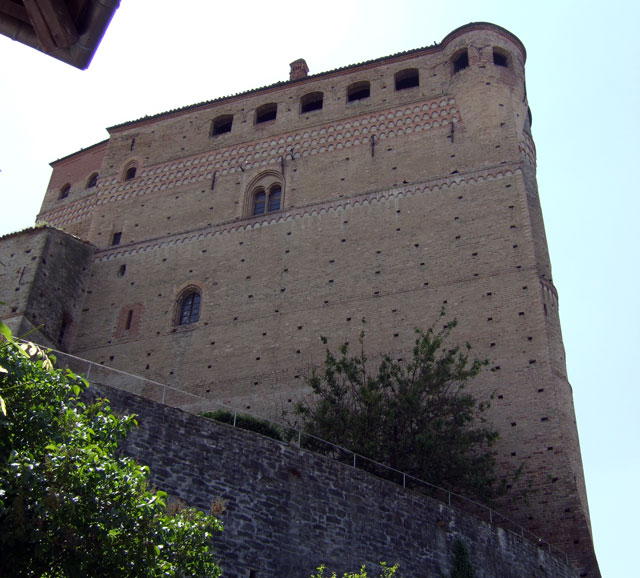
There's something afoot in Serralunga. In this tranquil hilltop town of only 300 or so inhabitants, there's a sudden surge in renovations, perhaps the result of in influx of new money or maybe just of a revived thirst for renewal. Adjacent to the town's main square and its scenic overlook, major construction is underway at Azienda Agricola Vigna Rionda, where owners/winemakers Franco and Roberto Massolino are adding a floor and a rooftop terrace to create updated, separate accommodations for their winery's trade and public visitors. And not more than three or four hundred meters from there, a short walk down the winding cobbled streets through the town center to the base of Serralunga's old tower, there's something else afoot.

Just past the dog – he actually lives a couple of kilometers away, I'm told, but he's always there – and just through that door lies one of the most lively, inviting café/wine bar combos one could imagine, whether in Serralunga or elsewhere.

That place is Vinoteca Centro Storico. The name couldn't be much more straightforward: a wine bar in the center of the old historic town. Nor could the mission be much simpler.

Owners Alessio Cighetti and his wife/partner Stefania turn out what is an essential Piemontese experience, combining the simple pleasures of food and wine and making the pairing accessible to any and all who walk through their doors.

Stefania's food is the essence of simplicity. Think of it as home cooking — consistently good, hearty, classic Northern Italian home cooking — and you're on the right track.

Aside from a couple of hapless grissini, carne cruda pretty much had to be the first dish to meet my gullet on arrival in the Langhe on my recent trip, and Stefania and Alessio were only too happy to oblige. Ravioli in a sage-butter sauce — another Piedmont classic — rounded out my entry lunch.

Balancing the simple soulfulness emanating from Stefania's cucina, Alessio has put together a pretty damn satisfying wine list. The local offerings aren't anything to snub a nose at, with verticals of Monfortino and other top Baroli offered alongside more humble options in Langhe Nebbiolo, Langhe Bianco and, yes, even French wine. Actually, it's French wine, and a very particular sort of French wine, upon which Centro Storico has really built its equally particular reputation.

In this town of less than 300 residents, Alessio sells over 1500 bottles of Champagne a year. He's put together a list that rivals if not betters any I've seen here in the US, with big names such as Salon and Krug resting alongside gravitas-laden options from the likes of Philipponat (a vertical of Clos des Goisses, anyone?) and Diebolt-Vallois, all peppered with hipster-chic offerings from producers such as Cédric Bouchard, Ulysse Colin and Jérôme Prévost. And it's all priced more than fairly, about the same if not a tad less than what you'd pay at retail here in the States. Poured by the glass during my visit(s) was Champagne Doyard's "Cuvée Vendémiaire" Extra Brut, a sumptuously rich Blanc de Blancs from Vertus that displayed the breadth of aroma and body brought on by extended lees-aging. Lovely stuff and, ironically, more or less the first wine to whet my whistle in Nebbiolo-land.

There are a mere four or five tables on the ground floor and about the same upstairs, a few more outside when weather permits. Just enough space to accommodate the mix of wine loving locals, travelers and regional producers who frequent the place. Don't miss it if you're ever (or when you're next) in the area. I came pretty damn close to calling it home base during my stay... and I'm already missing that carne cruda and Champagne combo.


Vinoteca Centro Storico
Via Roma, 6
Serralunga d'Alba (CN)
ITALY
+39 0173.613203

Monday, April 26, 2010

A Visitor from the Luberon

When I visited Domaine de la Citadelle back in the fall of 2000, I viewed it at the time as simply a happy coincidence. I was staying for a few days in the Luberon, and our home base was in a B&B located in the valley below the hilltop village of Ménerbes. There just happened to be a winery, a handsome one at that, within easy walking distance. We kind of had to check it out, non? As luck would have it, the wines we sampled in the Domaine's tasting room were pretty damn tasty so, after taking a spin through their Musée du Tire-Bouchon, we left with an armful of bottles to enjoy with our lunches (and afternoon snacks) over the next few days.

That happy coincidence turned into a more surprising one when, three or four years later, the wines of Domaine de la Citadelle showed up at the shop where I work. They've remained in steady rotation there ever since. As with wines from other estates I've had the chance to visit, I enjoy a certain comfort in selling them, as first-hand experience always makes what's in the bottle more personally meaningful — and correspondingly easier to recommend.

Over the ensuing years, I've met Alexis-Rousset Rouard on a few occasions. Alexis' father, Yves Rousset-Rouard, essentially created the Domaine de la Citadelle when he bought the property — a farmhouse and eight hectares of vineyards at the time — in 1989. Alexis joined his father at the estate in 1995 — it's now expanded to include approximately 40 hectares under vine — and has since taken an ever increasing role in both farming and winemaking responsibilities. Saturday just past, I got to know Alexis a good deal better, spending the better part of the day helping him pour and present his wines for the steady stream of customers that came by the shop to taste with him.

When the clock struck closing time at the tasting table, I posed a simple question to Alexis: shall we head to a local restaurant, or accept an invitation to dine with friends? His quick answer: chez amis.

Sometimes staying in really does trump going out, especially after a long day at the office. That's Alexis above, relaxing at the kitchen island in the home of our gracious hosts, Bill and Kelly, with my friend and coworker Eric resting it out in the background.

Since our hosts hadn't made it to the tasting, we carried along a bottle of Domaine de la Citadelle's 2008 Luberon blanc "Le Châtaignier" (pictured way up above) to enjoy with dinner. It's a blend of Clairette, Grenache Blanc, Ugni Blanc and Bourboulenc, fermented and aged solely in tank. As with all of Alexis' wines in the "Le Châtaignier" ("the chestnut tree") line — there's a red and rosé as well — it's produced from a parcel-by-parcel selection of young vine fruit and vinified with the intention of producing a bright, fruit-driven, relatively simple yet characterful wine for everyday enjoyment. Like all of the estate's wines, it's also marked by refreshing acidity; Alexis likes to call it tension. We're not talking tongue-twisting action for all you acid freaks out there, but we are talking about brighter acidity than typical in most of the Southern Rhône. That acidity is a direct side effect of the cool nights and moderate elevation (about 300 meters) in the Luberon vignobles, where harvest typically starts 8-15 days later than in other parts of the Southern Rhône.

The crisp yet ripe texture, orchard fruit flavors, and delicately mineral finish of "Le Châtaignier" blanc made for a delicious pairing with Bill's pan-seared scallops and crunchy "green linguine."

Alexis' vin blanc was a no-brainer, but there was a big question facing us for the rest of the night. Just what do you pour when a winemaker comes over for dinner?

I'd considered bringing along an older Domaine de la Citadelle bottle from the home cellar (something like this, perhaps), but then I figured that Alexis can drink his own wines pretty much whenever he wants. Hmmm...

I think we were all in accord that one can rarely go wrong with Champagne. Bill had actually figured that one out ahead of time, as he had a bottle of José Michel's 1997 Champagne "Spécial Club" lightly chilled and ready to be popped when we arrived. Michel's "Club" bottling is consistently delicious wine. While the '97 may not have quite the elegance and fine structure of the 1996 (that I wrote about as a guest Chez Brooklynguy quite some time ago), it was still vibrantly youthful, showing all of the richness, opulence and ready-and-raring-to-go qualities of the '97 vintage.

What else, though? So many options... but is Burgundy really a bad way to go? We thought not.

We paired Robert Ampeau's 1994 Puligny-Montrachet 1er Cru "Combettes" with Bill's franco-american spin on spaghetti carbonara. The sauce featured quail's eggs in place of the traditional hen's eggs; pork belly that Bill had smuggled back from Paris in the stead of pancetta; and sautéed ramp greens in lieu of the oft-tossed fistful of chopped flat-leaf parsley. The caramel depth of the wine's tertiary fruit and its stony finish turned out to be a surprisingly decent match to the subtly smoky yet delicate flavors of the pasta. It wasn't the most vibrant bottle of the '94 Combettes I've had but it was still in great shape, an admirable showing.

The 2007 Chassagne-Montrachet 1er Cru "Morgeot" of Henri Germain wasn't too shabby a match with our next course, either. Bill's really been dialing it in at the stove-top of late. His butter-braised grouper cheeks, each one about as big around as a standard muffin-top (guess I should have included something in the photo to give a sense of scale), were absolutely scrumptious. I really dig Henri Germain's wines, too. They're hard to resist when they're young, like this bottle so painfully was — all nervy and wound up like a spring but with vibrant, focused fruit intensity and great length. I've yet to taste any mature examples of his whites but there's a bottle of the 2002 version of this very wine waiting in the cellar for that certain moment. Just keeping my fingers crossed that there won't be any prem-ox issues....

Just to be fair, we threw in a little red wine between courses.... The 2005 Montefalco Rosso "Vigna San Valentino" from Paolo Bea — a blend of 70% Sangiovese along with 15% each of Montepulciano and Sagrantino — was snappy, fresh and vibrant. Way too easy to drink and a beautiful example of just how approachable and versatile Sangiovese-based reds can be at the table.

While we obviously opted for an all-Euro entourage of wines, we didn't want to leave Alexis without a taste of home — our home, that is. I'd missed the morning's ramp romp (yes, working on Saturdays is not without its downsides) but Bill and some friends had gone a-foraging and the ramps pictured above were fresh and tasty as could be, lending their springtime fragrance and savor to all three of the dishes we enjoyed on Saturday night.

Looking back at last year's edition of the ramp fest, it seems we broke out a remarkably similar range of dishes and even some coincidentally (and happily) similar wine selections this year. Turns out there's comfort to be found in both the familiarity of home and the reassurance of consistency.

We'll expect you back again next year, Alexis.

Friday, April 23, 2010

The Passion of the Fish

This could have been an Earth Day post. Passionfish, located at one end of the precious heart of Lighthouse Avenue in Pacific Grove, CA, was the first restaurant in Monterey County to receive "Green" certification. Chef/owner Ted Walter works extensively with local, organically farmed produce and selects only sustainable fish for his seafood-dominated menu. One-half of the restaurant's $20 corkage fee is donated to the Tag-A-Giant Foundation, a non-profit organization committed to rebuilding and preserving the Bluefin Tuna population in both the Pacific and Atlantic Oceans.

Yep, this could have been about Earth Day if I weren't a day late. But timeliness is not the point of today's post, which is actually about a meal I enjoyed over a month ago while in the Monterey area for my friends Steve and Stacy's nuptial festivities. My wife and I took advantage of the one free night of the trip to sneak in a special dinner. Given the glowing recommendations from Stevie, Passionfish it was — and yes, this post is at least a little bit about the food...


We started with one of the day's specials, Hog Island Oysters, farm-raised in nearby Tomales Bay, topped with carrot-ginger granita; followed by a South Asian-inspired salad of Malaysian pole caught squid with spicy cilantro-citrus sauce and mango; and a salad of warm brussel sprouts and grapes with pancetta and ricotta salata.


Though the "Entrees from the Land" on the menu sounded delicious enough, we hadn't traveled 3,000 miles and opted to dine at a place called Passionfish to eat braised beef or gnocchi. Oil-poaching is the specialty of the house — four of the six fish entrees on offer during our visit were prepared in said manner. I opted for the striped bass with crispy sweet potatoes, romesco, caramelized onions and chard (below, at left), while my dining companion chose what turned out to be the favorite dish of the night for us both, sturgeon with lemongrass-jasmine rice, lemongrass slaw and spicy red curry vinaigrette.


The desserts were no slouch either. We tried to share a single plate — I'm a sucker for bread pudding and Passionfish's pear bread pudding with Madeira-caramel sauce was delicious — but our server was having nothing of it. She insisted on bringing us an order of bruléed bananas served with coconut mousse and lime curd, her favorite of the house-made desserts, which was plated in a playful riff on bacon and eggs.


As much as I enjoyed our meal at Passionfish, what I really wanted to write about, what still has me thinking about our experience there over a month later, is the restaurant's fantastic wine program. Sommeliere (I'll call her that even if she doesn't like the term) Jannae Lizza has put together an extremely diverse, thoughtful list. Sure, there's the occasional red that seems too big for the fish flesh-driven fare – this is California after all – but just look at her list!

Cantina del Pino Dolcetto d'Alba for $20. Domaine de la Tournelle "L'Uva Arbosiana" at $25. Clos Rougeard Saumur-Champigny for $50. Domaine du Closel Savennières "La Jalousie" at $35. Jean Manciat's "Franclieu" for $25. I mean, come on!

The wines by the bottle are priced at or just barely above what would equate to standard retail price in most markets. That's pretty unheard of in most necks of the woods, and it's a great way to ensure that a bottle ends up on just about every table.

Being that we were just the two of us, I fought the temptation to order three or four bottles and instead opted to splurge on something special. Actually, we did go for two bottles, as I couldn't say no to the thought of Champagne with our oysters and René Geoffroy's "Cuvée l'Empreinte" was calling my name from Jannae's more than respectable list of options by the half-bottle. The slighty more rapid development of Champers in half-bottle combined with a disgorgement date of April 2007 (thanks for the data, Mr. Theise) to yield a wine that was, to my preferences, more mature than ideal with our brisk, briny bivalves. Nevertheless, it was a compelling drink – slightly oxidative, with very apple-y fruit and toasty palate characteristics, fronted by an even more apple-y nose (red apple skins, to be exact).

And that special bottle? Unless you're reclining while someone else reads this to you aloud, you've already spotted the picture at right/above. It's something I'd always wanted to drink but for which I'd never been able to bring myself to plunk down the necessary cash. In a nice restaurant, on vacation and at a price equal to or better than what I'd pay in a retail shop back in the Philly area, though, I had to go for it. The 2007 Pouilly-Fumé "Silex" from Didier Dagueneau (RIP) was immensely vinous and penetrating. Its unmistakable Sauvignon Blanc character was backed by a mineral pungency more reminiscent of a fine Nahe Riesling, while its wood influence was totally enveloped in fruit richness and grapefruit oil aromatics. Most of all, its namesake flint drove through on both the nose and the mineral-laden finish. Am I going to rush out for a case of it at ~$120 a pop? Nope, but I'm glad we went for it at Passionfish.

Passionfish
701 Lighthouse Avenue
Pacific Grove, CA 93950-2501
(831) 655-3311
Passionfish on Urbanspoon

Monday, April 19, 2010

Champagne Tarlant

Aye, if there's a place in the wine world I'd most like to have been today, though getting there might have been tough given the current airspace restrictions in Europe, it's Aÿ. (Never could resist leading off with a horrible pun....)

Aÿ was indeed the place to be today for the 2nd annual tasting conducted by Terres et Vins de Champagne, a group of young, natural-leaning Champagne growers that was first conceptualized and organized by Raphaël Bérèche and Aurélien Laherte. I won't go into any more detail about it here, as you can read all about last year's inaugural event at Peter Liem's now defunct blog, Besotted Ramblings.

What I will do is take today's event, even if it was 3,000+ miles away, as impetus to finally share some of my impressions from a relatively recent event much closer to home – the Boutique Wine Collection national portfolio tasting, held back in early March in Center City Philly. The lineup at this year's tasting was quite similar to last year's, with one notable exception that was, at least for this taster, an exciting new entry in the Boutique portfolio.

It didn't take long for me to find it, as two steps into the room I was greeted by Mélanie Tarlant, who asked if I'd like to taste through what turned out to be pretty close to the full range of wines produced at her family's estate, Champagne Tarlant. Mélanie's brother Benoit just happens to be one of the seventeen participating members of Terres et Vins de Champagne, so there's today's tie-in (just in case you were wondering).

Mélanie has only recently entered the family business, taking on the role of communications director for Champagne Tarlant. This was her first time visiting the city of brotherly love, and she seemed to have survived her Saturday night indoctrination into the world of Philly cheesesteaks with flying colors.

Though Tarlant's wines have theoretically been available in the Pennsylvania market in the past, actual appearances in shops or restaurants have been less than few and far between. While their Champagnes are most likely still destined to be special liquor order (SLO, in PLCB parlance) items, I'm hoping that the estate's recent leap into the Boutique camp will at least land their wines on a few of the better restaurant wine lists around town.

Champagne Tarlant's history dates back to 1687. Representing the 12th generation of the family business, Melanie's brother Benoit recently joined his father Jean-Mary at the winemaking helm. Benoit has already established his mark, adding two non-dosage bottlings as well as two terroir-driven cuvées to an otherwise more traditional yet already low-dosage (averaging about 6g) house style.

The family's holdings comprise 14 hectares, with 55 separate parcels of vines located in the villages of Oeuilly, Boursault, St-Agnan and Celles-les-Condé, all in the Vallée de la Marne. Plantings include Pinot Noir, Meunier and Chardonnay, along with small amounts of Arbanne, Petit Meslier and Pinot Blanc. Across the entire range, Benoit and Jean-Mary conduct approximately 60% of their base fermentations in barrel, with the other 40% fermented in small steel tanks. None of the wines go through malolactic fermentation, sulfur use is kept to a bare minimum and, as I mentioned above, all of the wines see very low (if any) dosage.

Benoit's Brut Nature "Zéro," the first pour in the lineup, was regrettably suffering from low-level cork taint (Mélanie mentioned that she'd had a bad run of subtly TCA-affected bottles on this trip). It's an equal part blend of Pinot Noir, Meunier and Chardonnay, by the way, the current release being based primarily on the 2005 harvest with a small addition of reserve wines.

The Brut Nature "Zéro" Rosé was suffering no such problems and was indeed delicious, bracingly dry and mineral, full of bright, wild red-fruit aromas. Mélanie explained that non-dosage rosés are quite rare, as it can be tough to balance the tannins that come from the red wine (this is a rosé d'assemblage, 85% Chardonnay with a 15% addition of still, red Pinot Noir) without the aid of a few grams of sugar in the final bottling. Benoit has achieved balance nonetheless, working hard in the vineyards to ensure ample ripeness and selecting only the best vintages of the family's own red wine, again with ample ripeness, for blending.

Can you say "cu-vée"? The "QV Discobitch" bottling is another of Benoit's special projects, made at the request of Paris-based DJs Laurent Konrad and Kylian Mash. Again, there's a detailed write-up of its origins at Besotted, so I won't belabor things by repeating the details. I will say, though, that while Mr. Liem reports that Discobitch is an early disgorgement of the "Cuvée Louis," Mélanie told me that it is actually the same as the Brut Nature "Zéro," but with the addition of a six-gram dosage, just enough to nudge it into Brut designation territory. It very well could be that both are correct if the recipe Mélanie referred to is a change that occurred between the original bottling and the current release. I'll see if I can't entice Benoit to provide full elucidation of the details.... Assuming Mélanie is correct, I'm curious as to how the wine manages to find its balance in both versions.

Last poured among the "Classic" entries in the Tarland portfolio was the "Tradition," a blend of 55% Pinot Noir, 35% Meunier and 10% Chardonnay. Based primarily on wines from the 2002 vintage and aged sur-latte for five years prior to release, the resulting wine was broader and more richly structured than the Brut Nature offerings. Quite delicious, too. And at $37 retail in PA, $10 less per/bottle than what Big Yellow fetches in the Keystone State, a really solid value.


On to bin number two, Mélanie again poured from our right to left, beginning with the 1998 Prestige Extra Brut. From a blend of 65% Chardonnay and 35% Pinot Noir planted in chalk and limestone rich terroirs, the '98 was drinking well, still taut, fresh and well-defined, and still showing the potential for further development in the cellar.

The 1999 Prestige Rosé, on the other hand, had reached what struck me as its full maturity and potential, showing pretty, dried red floral characteristics and orange-peel fruit along with an ever-so-slightly oxidative character. 85% Chardonnay blended with 15% red wine of Pinot Noir, from two single plots of sand and limestone based soils.

As should be the case, the show stoppers were saved for last. "La Vigne d'Antan" Extra Brut Non-greffée Chardonnay was intensely soil expressive, the most compelling of the wines for the individuality and minerality of its palate impact. Though not vintage dated, "La Vigne d'Antan" ("the vine of yesteryear") was produced entirely from the 2000 harvest and based entirely on Chardonnay planted on its native rootstock ("non-greffée" means ungrafted) in a single plot of sandy soil called, if I'm not mistaken, "Îlot des Sables," located in Oeuilly. The wine was aged sur latte for six-and-a-half years before being hand-disgorged in October 2007 and was finished with a very modest two-gram dosage. It ain't cheap – Boutique specs it at around $150 retail – and it's not even available as a special order item in PA, so I was happy for the opportunity to taste it, something I'll look forward to doing again. Not surprisingly, it's also among the wines Benoit was scheduled to pour at Terres et Vins today.

"Cuvée Louis," the tête de cuvée at Champagne Tarlant, is named in homage to Louis Tarlant, the great-great-grandfather of Benoit and Mélanie who was the first member of the family to estate bottle Champagne under the Tarlant name. A 50/50 blend of Chardonnay and Pinot Noir from 60-year-old vines in the "Les Crayons" vineyard in Oeuilly, the wine was sublime – not as muscular and earthy as "d'Antan" but long, delicate yet full-flavored and very, very fine. We tasted the current release, based primarily on the 1998 harvest with reserve wines from both 1997 and 1996.

In closing, I leave you with a little something for your listening and viewing pleasure. To paraphrase my buddy Neil, disco may suck... but at least Benoit can have a little fun while making some excellent Champagnes.


Champagne Tarlant
51480 Oeuilly / Epernay
FRANCE

Tuesday, December 29, 2009

Diebolt-Vallois Rosé

It's been the better part of two decades now since the Champagnes of Diebolt-Vallois initially grabbed my attention, and they've not let go since. They were the first wines to really open my eyes to the possibilities of great Champagne from small growers, the first to turn my head away from the usual grand marque suspects. There was a time when a bottle (or a magnum) of Jacques Diebolt's non-vintage Blanc de Blancs graced my table for just about any special occasion, whether a major holiday or Tuesday night sushi takeout. Nearly six years ago now, I had the opportunity to visit the Diebolt family in situ at their estate in Cramant, on an afternoon that remains etched in my mind as one of the most memorable of many, many winery visits.

Yet in all those years, at home and even at the winery, I'd never tasted a rosé Champagne from Diebolt-Vallois. When I learned just a few months back that a small shipment of Diebolt rosé was scheduled for arrival in the States, I wondered how and why I'd never crossed paths with it before. The answer, as it turns out, is quite simple. Jacques Diebolt last made a rosé in 1985. If any of it found its way to the US market, it came and went before my Diebolt awakening. And in the unlikely event that there was any of that 1985 rosé remaining at the winery during our 2004 visit, it wasn't something Jacques chose to include in our tasting lineup. So yes, in spite of consuming far more than my share of Diebolt's wines over the years, never had a drop of his rosé crossed my lips... until now.


Champagne Brut Rosé, Diebolt-Vallois NV
$55. 12.5% alcohol. Cork. Importer: Petit Pois, Moorestown, NJ.
As a result of my self-imposed ban on the primary blogging activities of writing and photography over the holiday weekend, you'll have to use your imagination to picture the lovely hue that once filled Diebolt's clear glass bottle. Thinking back to the heart of summer might help. Take a generous slice of drippingly juicy, ripe watermelon, then eat about half-way down toward the rind and you've got it. Like its color, the wine is beckoning and forward, brimming with clear, light raspberry and strawberry fruit. The yeast influence is present but delicate, somewhere near the fresh white bread end of the autolytic spectrum. Finely balanced, gracious and delicately dosed, at least to my palate, the wine may not be the most complex of rosés but it's a real pleasure to drink.

Produced entirely from fruit grown in 2006 though labeled sans année, the wine is a blend of 63% Pinot Noir, 27% Chardonnay and 10% Pinot Meunier grown primarily in Jacques Diebolt's holdings in "Les Toulettes" in Epernay; the Chardonnay comes from Cuis. It is a rosé d'assemblage, made pink by the addition of Bouzy Rouge (still, red Pinot Noir) that Diebolt purchased from Bernard Tornay, and is finished with a modest seven grams/liter dosage.

As you'll see in the picture at right, Diebolt has recently begun to include lot numbers on most of his bottlings. When I first glanced at the number stamped into this bottle's label, my aging eyes saw "06," which I took to be a reference to the fact that the wine was made entirely from 2006 fruit. At second glance, though, and with the help of digital magnification, it's clearly "08," which I in turn assume to be a reference to the Champagne's disgorgement date. If that's indeed the case, it's definitely a piece of information I'm happy to see shared; down the road, I'd love to see Jacques add the month as well.

Though I referred to Diebolt as a grower-producer in the opening of this post, the pictures above will reveal to the hawk-eyed among you that Diebolt is in fact a Négociant-Manipulant producer. Jacques first made the switch from RM to NM status in 2004, at least partially in response to the dangerously meager yields of the hot, dry 2003 growing season. Hardly making him a coopted member of the evil corporate empire, Diebolt's négoce license has simply allowed him to purhase fruit from other growers, something he's done primarily with his own father-in-law, Guy Vallois. And something he's done, for the first time in over twenty years and with a little help from Bouzy's Monsieur Tornay in this case, to again make Diebolt-Vallois rosé a possibility.

Wednesday, June 24, 2009

Fleur de Passion

It’s what keeps you going, what keeps the passions flamed. Every once in a while, you still run across something that makes your pupils dilate, makes you tingle, makes you say "wow" (or at least think it). When it comes to wine, that “something” is often as simple as an inexpensive bottle from an off the beaten track area or an unknown producer that surprises you, certainly from its quality but also, it sometimes seems, helped along by its very nature as an unknown quantity. It seems far rarer for that “something” to be a special bottle, a top wine from a top producer, as one’s expectations often are set so high as to leave little chance for surprise. So when a top bottling does manage to provoke that spark of sensual excitement, it’s all the more surprising… and welcome.


Champagne “Fleur de Passion” Brut Blanc de Blancs, Diebolt-Vallois 1996
~$70 on release. 12.5% alcohol. Cork. Importer: Petit Pois, Moorestown, NJ.
Shared among good friends, the level of anticipation – and concomitant dread – was further heightened in this case by the certain knowledge that we were sacrificing the sole bottle of Diebolt’s 1996 “Fleur de Passion” in any of our cellars.

Our noses were rewarded by our choice of white wine glasses, as the wine’s aromatics were simply beautiful. Pastry cream, marzipan, sweet butter, lavender and apple blossoms…. I could have spent the better part of the evening just smelling the wine and, come to think of it, I probably did. It was drinking great, too. Expectations were met in the ‘96’s extreme youthfulness yet exceeded in all other capacities.

Jacques Diebolt’s wines are not powerful; not deep dark and brooding. They’re just pure embodiments of grace, elegance and finesse… like a completely unostentatious yet classically designed and perfectly tailored wedding dress – the house style is unquestionably feminine – worn by the most beautiful of brides on her happiest of days. That’s not exactly what I was thinking when I was drinking the wine; then it was more stepping back and saying – yes, saying – "wow." But I’d like to think I’m not now waxing overly poetic. The wine was grippy and vinous yet absolutely elegant; sweet in disposition yet deeply serious. It was crystalline, shimmering and luminous from its nose to its exquisite finish.

Jacques Diebolt has only been producing “Fleur de Passion” since the 1995 vintage, making 1996 only his second release. However, he traces the wine’s inspiration back to 1953 when, working under his grandfather’s tutelage, he first made a wine of similar nature. “Fleur de Passion” is produced only in better vintages, from fruit grown in seven or eight plots centered on the hilly area known as “Les Buzons” in the 100% Grand Cru village of Cramant. Yields from the 40-60+ year-old vines are naturally low, no doubt helping to give the wine its fine concentration and expression of the Côte des Blancs’ chalk and limestone-rich terroir. The base wines for “Fleur de Passion” are fermented and aged in small barrels purchased after one-year of use by white Burgundy producers. Malolactic fermentation is suppressed, and both fining and filtering are avoided. “Fleur” ages sur-lie for approximately five years before disgorgement, followed by a modest dosage of 6-8 grams and further bottle aging at the estate prior to release. The 2002, which is the current vintage on the market, sells for approximately $150 per/bottle; at around half that price when released, the 1996 was a tremendous value.

I don’t think the '96 will ever taste quite like any of the three bottles of 1953 that Jacques opened for me and my traveling companions a few years back; he disgorged those bottles à la volée, as they were still on their lees after nearly fifty years. But I do think the 1996, if kept in a cold, dark cellar, has similar potential for life ahead of it.

I can think of few other wines I’d rather have the chance to revisit forty years from now. Of course, that would require another bottle… and that I be as alive and kicking as I expect the wine to be.

Monday, April 27, 2009

On Selosse, Substance and Sensuality

Mr. Asimov has written eloquently on several occasions, both in The Times and at his blog The Pour, about the rarefied pleasure of experiencing the Champagnes of Anselme Selosse. Foolishly having passed on an opportunity to drink Selosse last year, I finally rectified the situation just a few nights ago. It was the kindness of strangers that made it possible. My clients, for whom Selosse’s “Substance” served as an aperitif, were generous enough to send me home with the remaining half-bottle or so at the end of a long night spent serving many big name wines. For that I am indebted to them, as I cannot and therefore do not buy $200+ bottles of wine. Were I to, though, this might be the one.


Champagne Grand Cru Blanc de Blancs Brut “Substance,” Jacques Selosse (Anselme Selosse) NV
$225-250. 12.5% alcohol. Cork. Importer: Rare Wine Company, Sonoma, CA.

If I’d had my druthers, I would have decanted “Substance” at that dinner party. Pouring it straight into flutes didn’t give the wine enough chance to come out from under its bottle aromas or to show its full breadth. That is not to say it wasn’t immediately enticing – it was – but rather that it immediately hinted at greater stuff to come. First impressions were of richness and maturity, a partly oxidative nose backed up by scents and flavors of deeply yeasty bread and ripe orchard fruits. Between my work and the wines to come, it passed by far too quickly.

It was on the second day that I really got the chance to experience more of the wine’s full spectrum. Poured in a white wine glass, it appeared well on its way to tranquility, though appearances deceived as its fine mousse never dissipated over the course of the next three hours. The larger glass made it much easier to appreciate the wine’s color as well, not so much the burnished golden tone of mature Champagne as it was the radiant hue of light peach or apricot flesh. There was still an oxidative aromatic note, one that bolstered rather than diminished the wine’s complexity. Brioche, mocha, lightly roasted coffee and hazelnut scents wafted from the glass. Incredibly youthful and fresh on the palate, the wine’s finish lasted for minutes, starting at the tip of the tongue and leaving a lasting impression all the way down the gullet.

Given my mentions of maturity above, it’s important to note that this was actually a recently disgorged bottle. “Substance” takes on its mature notes not so much via bottle aging (at least not in this case) as via its production methods. It is a solera method Champagne, made up of a constantly evolving and growing blend of wines from every vintage since 1986, when Anselme Selosse first started his solera system. The picture above (borrowed from The Rare Wine Company’s website) is Selosse’s own 2004 schematic of the Substance solera system. In Anselme’s view, this method of blending wines from multiple years, the good with the theoretically not so good, wipes away the vagaries of vintage and instead focuses entirely on the terroir of his Chardonnay vineyards in Avize.


With time in the glass and the approach of cellar temperature, the wine just got prettier and prettier, more and more detailed, calling into focus the fact that Selosse works first and foremost with great fruit. The wine’s minerality and vinosity, too, became more apparent. Chamomile, orange zest, toasted almonds, peach butter and spicy minerality – it was all there. Just smelling the empty glass between pours there was a lingering aroma of white sands, gentle surf and seashells. Pour a touch more and there was tarte tatin, nutmeg and yet more profound minerality.

What I liked most about the wine, as if all the above weren’t enough, was its texture. Simultaneously delicate, powerful and amazingly deft, it was voluptuous and creamy at first feel, chewy and edgy at the next, yet all along I could sense every nuance. Nothing was glossed over or wiped away by undue opulence. Even the wine’s wood influence was subtle and elegant, lending an undercurrent of buttered toast to the whole experience.

This was as profound a tasting experience as I’ve had in a long time. The wine just kept improving over the course of three+ hours. The always-curious, pseudo-scientific side of me wishes I’d saved a glass for day three. The hedonist in me, though, was having none of that.


I’m guessing that this bottle, disgorged on March 3, 2008, contained base wines from no more recently than 2004. As the label notes indicate, the wine’s structure suggests a long life ahead for those willing to wait.

Update: With a little research, along with some thoughtful help from Peter and Sharon, it turns out that Selosse usually ages "Substance" for four-to-five years in bottle prior to disgorgement (I'd taken an educated guess at a three-to-four year regime). So, it's likely that the most recent wine included in this bottle was from 2003, maybe even 2002. It turns out that Anselme also includes a significant amount of solids each time he replenishes the solera, making for an extended lees aging regime even before the wine is bottled.


* * *

In addition to the pieces from Eric Asimov mentioned above, there’s other good information about Selosse at Rare Wine Company’s website and at Château Loisel. Not surpsingly, Peter Liem also has a thing or three to say about Selosse’s terroir as well as, in more general terms, the use of soleras in Champagne.
Blog Widget by LinkWithin