
Showing posts with label François Chidaine. Show all posts

Wednesday, November 3, 2010

Two Bruts from the Touraine

There will be no intensely detailed tasting notes here today. Friends and I recently drank these two sparkling Loire Chenin Blancs. We were having a good time, I didn't take detailed notes, and the intricacies are no longer fresh in my mind, just the overall impressions, the broad strokes.

I'm intentionally writing them up in reverse order: oldest to youngest, pricier to less so, opposite to how we experienced them. You'll see why soon enough.

Montlouis-sur-Loire "Almendra" Brut, François Chidaine 1996
$42. 12.5% alcohol. Cork. Importer: Polaner Selections, Mount Kisco, NY.
It's kind of funny, you know, in that way that makes you say, "What the hell...?" I've visited the Chidaine estate in Montlouis, formerly sold their wines for several years, and have been enjoying drinking them for well over a decade. Yet it was only recently that I learned that François makes a sparkling wine called "Almendra," only in the best vintages or so I'm told, that spends 10+ years on its lees before disgorgement. This was my first time trying it. One of my favorite wine blogging buddies, as it turns out, drank and wrote-up the very same vintage of "Almendra" well nigh on three years ago. Turns out our reactions were very much the same, despite the three year and 3000 mile distance between them.

There was an intense mineral character, along with the mushroomy, toasty character that often accompanies sparkling wines that have seen extended lees-aging. The developed Chenin character of the wine sang loud and clear — wool, quince, dried honey, again, some pretty concentrated mineral character. It's that intense Chinin-ness that made appreciating the wine a complicated venture for me, almost as if the sparkling character was sitting off to one side, the Montlouis/Chenin character to another, not quite harmoniously joined. I enjoyed it in the general sense, but not as much as I normally do Chidaine's non-sparkling examples of Montlouis.

The experience made me think about something I hadn't considered in a while. As much as I enjoy sparkling Vouvray and Montlouis from producers such as François Pinon, Foreau, yes, Chidaine, even Poniatowski back in the day, and, more recently, Jacky Blot, I sometimes wonder whether there's any real benefit to be gained from producing Méthode Traditionelle examples of Loire Chenin, other than to satisfy market demand or to yield a product from slightly under-ripe fruit.

Then I drink this and the question again recedes...

Vouvray Pétillant Brut, Domaine Huet 2005
$26. 12% alcohol. Cork. Importer: The Rare Wine Company, Sonoma, CA.
Technically speaking, Huet's Vouvray Pétillant is not made according to the Méthode Traditionelle but rather via the Méthode Ancestrale, in which primary fermentation is stopped before completion (usually by dropping the temperature to a point where the yeast go dormant) and the wine is placed in bottle where fermentation will continue to completion, trapping CO2 in solution (bubbles!) along the way. I'm given to understand that Huet's winemaker, Noël Pinguet, adds a dab of yeast at bottling to ensure that the bottle fermentation goes smoothly, and that he finishes the wine with an small addition of one of the estate's off-day wines in place of the typical dosage used in the traditional method. For the 2005 Pétillant, that finish came courtesy of a soupcon of Huet's 2002 Le Mont Première Trie. (Check out The Wine Doctor's exceptional report on Huet for more details on this and the rest of the wines produced at the estate.)

Technical stuff aside, the Vouvray Pétillant Brut from Huet is consistently delicious wine. As much as I do like the others I mentioned above, I'm really not sure that Huet has a true peer in this context. The 2005 is still a baby, showing nowhere near the nuance of the best bottles of the 2002 I've drunk over the last few years but, like I said, it's still a baby. The wine is showing beautiful fruit, balance and structure, and complete integration between the sparkling and serious Vouvray sides of its personality. Given its balance and purity, I expect the wine to develop quite nicely over the next several years and will certainly enjoy exploring its evolution. I'll be sure to tell you if I was wrong....

Saturday, July 3, 2010

TDF 2010 Prologue: Rotterdam

It's 9:00 PM here on the East Coast. It's tomorrow in France. I'm just now sitting down to watch the prime time coverage of today's Tour de France prologue. Don't tell me who won, please. I still don't know. For years now, I've struggled not to learn the results until I've had a chance to actually watch the race. Such is my situation at the moment.

So, for tonight you'll just get a teaser of a post. It's actually rather fitting, as the prologue essentially serves as the amuse bouche of the Tour, the appetizer before the twenty course meal to follow.


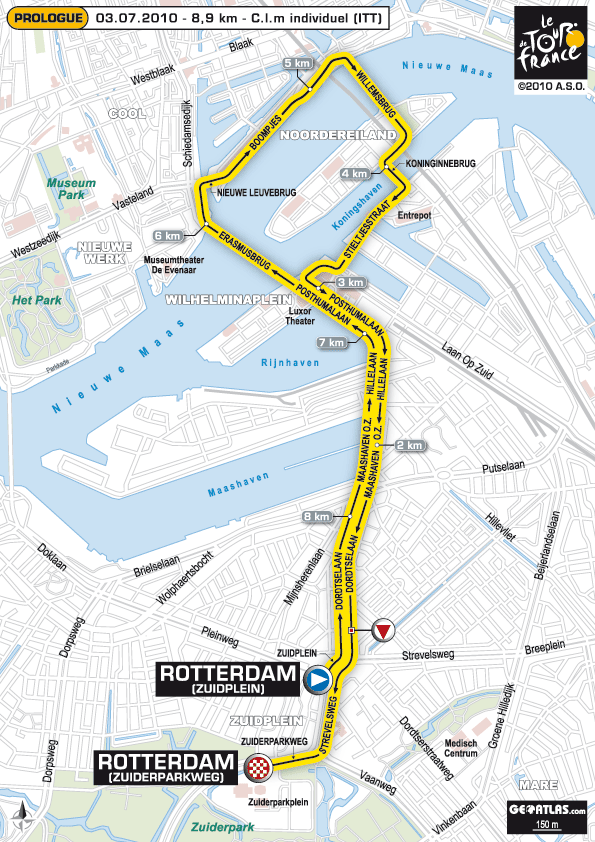
This year's course, through inner-city Rotterdam (click on the map above for an enlarged view of the course), is long by prologue standards at just under 9km. It's rare that the prologue has proved to be a meaningful stage in the overall picture but it's still an incredibly prestigious stage. It's a chance for the fast men, the bike handlers, the powerhouses and the anaerobic performers to stencil their names into the list of stage winners. More importantly, it's a chance, in just a few minutes, to stake an early claim to the leader's yellow jersey. The maillot jaune. The symbol, almost universally recognized now, of Tour leadership.

I don't know the results yet, but I have watched enough to know that the conditions for a fast, technical stage like this are far from ideal. Rain. Inner city streets. Oil. Painted stripes and sharp corners. A recipe for road rash and disappointing finishing times. All of that said, my call for the stage still goes out to Fabian Cancellara, one of the true strong men of the professional peloton who's made a specialty of stages like this over the last several years. Time has already told, but I will see over the course of the next hour or so....

In the coming days, I hope to provide content that covers both the Tour and the wine and food culture of the areas through which it passes. For today, not so much. Remember, this is just a teaser stage. I could tell you that Rotterdam is one of the ten largest cities in Europe. But I've never been there....

So I'd rather tell you that I celebrated the opening of the race with friends over dinner tonight at an excellent little Japanese restaurant, Masamoto, in the strip mall suburbs of the Brandywine Valley. A pair of 2007's – Keller's Westhofener Kirchspiel Riesling Spätlese "R" and François Chidaine's Montlouis "Les Tuffeaux" – provided most excellent pairing experiences.

And I'll tell you that in the days to come there will be much, much more action. So, thanks as always for reading, for watching, and for not telling me who won.

Friday, April 30, 2010

Josh George: Straight Outta Richmond

For today's post, I'm handing over the reins to a guest blogger: Josh George. A regular reader and semi-regular commenter here at MFWT, Josh is a guy I think of as a friend even though we've met only via the blogosphere. By way of intro, I asked him to write a few words about himself. Take it away, Josh.


My wife and I left New York six months ago to head south to the small town of Richmond, Virginia. I wanted space to paint big and she wanted peace and quiet to focus on her writing. We started a blog — Who's Afraid of Virginia? — to document our new life and new changes. We want to show the rest of the world how pretty and vibrant Richmond is, with its historic neighborhoods and the local art and food scene. After a few posts my wife became too busy with her writing but I try to keep it alive by posting photos of food and wine porn.


As Josh hinted at only modestly above, he's an accomplished painter, who shows regularly in New York and has done album cover art for jazz guitarist Pat Metheny — yet another of our common interests.

Please check out Josh's portfolio at his official website, JoshGeorge.com, and follow his news and works in progress at his painterly blog, joshgeorge.blogspot.com.

Though I wasn't able to make it to New York last week for the annual Louis/Dressner portfolio tasting and Euro-invasion extravaganza, Josh jetted up to NYC for the day just to be there. Here's his report....


We sat in the airport terminal, reluctantly eating a greasy, overly-processed breakfast from one of the vendors. Suffering through a soggy "panino," I knew I'd soon redeem my crappy meal by tasting a portfolio of all natural, honest expressions of earth.

I work a few shifts a week and hang-out part time at J. Emerson Fine Wine down in Richmond, Virginia. On April 22, my manager and I joined forces with the natural wine guys from Williams Corner to take a quick day trip up to New York for the Louis/Dressner tasting. Though excited to taste some of my hero's wines, I wondered how bittersweet the visit would be for me, having just left New York after living there for ten years. I got over any sentimentality after sitting in traffic for an hour on the Williamsburg bridge.


We were greeted by a geeky sign coded for those in the wine business. Out of 29 vignerons, only 16 could escape the eruption of the unpronounceable Eyjafjallajokull that interrupted European air travel. Along with rain, sleet, snow and drought, the volcano was just another element that the winemakers had to deal with and made for some fun conversations.


Lost between three distributors, the wines of Roagna got their own sealed off Luca Lounge. Polaner will still handle the wines in New York and New Jersey and not be a part of the move to David Bowler. Nationally they will sell through Louis/Dressner, or something like that. Anyway, the whole lineup was there from the '05 Bianca Solea, little Dolcetto and Barbera, the '03 Langhe Rosso, the 'what's in it?' Opera Prima XVII and bottlings from both Barbaresco and Barolo.


A man on a mission. Franck Peillot of Franck Peillot raced to escape the volcanic cloud by driving 800 miles from Bugey to Madrid to catch a flight to get to New York. His non-vintage Montagnieu Brut was bottled, bubbly herbs that can take on anything from Champagne. The '08 Roussette de Bugey Altesse tart and nutty, and the '08 Mondeuse was like warm wool in the mouth. What's not to love?


Manuela & François Chidaine of Vouvray and the stones throw Montlouis had maybe the prettiest wines in the room. Maybe a little riper than other current releases from that part of the Loire, easily enjoyable in their youth.


The wines of Clos du Tue-Boeuf are always a favorite. From the lean, crystal scented Le P'tit Blanc, the wonderfully raspy '09 La Butte, to the mysterious cloudy colored, crushed violet scented '09 Cheverny Rouge.


Pierrot Bonhomme, Thierry Puzelat's business partner, has vines of his own. His unfortunately named '08 Touraine Rouge "KO In Cot We Trust" was a show stopper, proving that Malbec is just a grape, not a flavor in itself but more a communication device to show off some really distinct dirt. I could have this on the dinner table every night.


Cascina degli Ulivi was one of the volcano victims. Alessandra Bera of Bera Vittorio & Figli was around to see us all marvel at their '09 Moscato d'Asti.


Here's Scott Bridi overseeing animals in all forms. He runs the charcuterie program at Marlowe & Daughters. Before that he headed the kitchen at the rustic Lot 2 in Brooklyn and also did meat at the famous Gramercy Tavern for two years. We were in good hands.


My biggest surprise of the day were the wines of Radikon. I was prepared to dislike these mythical monstrosities, thinking they were unobtainable, super sexed up, oxidized trophies. I was so wrong, they were super cool. Maybe it was the context with all the other wines of the day but they were so bizarre, so different, lush and vibrant with bulletproof zip.


Sasa Radikon was on hand to explain the farming, vinification and their approach to bottling. The farming like most of the other vignerons on hand is biodynamic and natural, hand harvested, low yields, all that. What is interesting is the 90 days of skin maceration and the 3 years in large Slavonian oak that make them somewhat indestructible. The 500 ml bottles are used to house the skinny little corks they have specially made, which they feel ages the wine at just the right pace.


These beautiful cider and tea colored wines can justify the high prices.


Natural wine enthusiast Alice Feiring chatting up Olivier Riviere about his un-Rioja-like wines. The '09 Rayos Uva and the '07-08 Ganko and the '08 Gabacho had a bright red freshness that contrasted the oaky, roasted norm.


The man himself keeping everything under control.


The crew from Williams Corner Wine getting the V.I.P. treatment with Luca Roagna.


Even with all the spitting, trying to taste one hundred wines can take a toll on one's constitution. I made a turbo escape for Gimme! Coffee down in Soho. One of the things I miss about New York is good espresso, though outstanding coffee didn't exist in New York until 2001. I'm hoping it is just a matter of time before it trickles down to Richmond. Gimme! does it right.


The crime scene that was Matthieu Baudry. Les Granges was delicious in its youth; the '08 Clos Guillot and the '08 Croix Boisée were like buried treasure.


Francesca Padovani of Campi di Fonterenza was on hand with pink wine, a vertical of little Sangiovese, up through the '07 Rosso di Montalcino and a surprisingly elegant and restrained but mouth drying '04 Brunello. I had to run back to the meat table in between pours.


Also on hand was Jean-Paul Brun of Terre Dorées in Beaujolais. I was too intimidated to take his picture. It was a pleasure, though, shaking his meaty farmer hand. His wines might have been the day's winner. The place was nuts over superstar Eric Texier; he was pouring flavors from Côte-Rôtie and Châteauneuf-du-Pape, and of course his greatest discovery of Brézème.


Our last stop before flying home was Peking Duck House Midtown. We were able to sneak in a bunch of Dressner wines to see how they could handle two whole ducks. Afterward our palates were beat... we finished off the night with a $9 Peroni at the airport.

Thank you Louis/Dressner for doing what you do.

Thursday, January 14, 2010

Checking in with Chidaine

Maybe I was wrong....

When I first started to drink the Montlouis wines of François Chidaine with regularity, beginning with the vintages of the late 90s, I was taken with their precision and focus, their expression of terroir, and with their downright forward deliciousness. I also expected them to age well, especially the demi-sec "Clos Habert" and the top sec cuvée "Les Choisilles." Everything seemed to be in place: balance and richness in the one, brilliant acidity and the physiological extract to back it up in the other. I drank plenty but also made sure to sock away a few bottles of each, plus a smattering of François' other cuvées, across several vintages.

After a co-worker of mine mentioned that a bottle of 2004 "Les Tuffeaux," usually a sec-tendre expression of Montlouis, that he'd opened over New Year's weekend was much more evolved than he'd expected, I figured it was about time to check in with a Chidaine myself. Thing is, I've actually had the same reaction to several of François' wines over the last few years. Darker color, more oxidative character and less primary fruit than I'd expected relative to their age.

Montlouis-sur-Loire "Les Choisilles," François Chidaine 2002
$18.50 on release. 12% alcohol. Cork. Importer: (was) Petit Pois, Moorestown, NJ.

Sure enough, the '02 "Les Choisilles" turned out to be little darker than I'd expect from a 7-8 year-old (Chidaine recommends keeping it from 10-15 years). Think of the color of clover honey but with an amber edge to it and you'll be on the right track. An initially oxidative, slightly briny nose quickly led to big aromas of waxy apples, bosc pear and quince, all flavors which were echoed on the palate. Its round, stony up-front mouthfeel was in stark contrast to a nervy, tongue-twistingly acidic finish, all of which lead to pretty damn good length on a finish full of tangy, limestone minerality. If it sounds to you that I liked it, you're right, though I will say it was definitely on the complicated side. It also evolved and changed quickly in the glass, showing the return, after an hour, of oxidative notes reminiscent of Oloroso Seco Sherry. By the next day, what was left in the bottle (nearly half) had lost almost all of its nerve and liveliness, going over to the round, ripe but flat flavors of baked apples.

Granted, the wine above from the 2002 vintage is theoretically not all that old in the context of Loire Chenin Blanc, and I'm not so "worried" (or scientifically intrigued) that I'm going to rush to open my remaining bottles, but my evolving experiences with Chidaine's wines make me wonder if they'll reward being kept for much longer than their ten-year mark.

Is it a question of a simple terroir difference between Montlouis and nearby Vouvray or slightly more distant Savennières, both regions known for producing long-lived Chenins? Certainly, the difference between sec and moelleux cuvées figures in there, as a well balanced moelleux (or demi-sec) has an ace in the hole in the form of residual sugar when it comes to some guarantee of longevity. Or perhaps it's a question of sulfur dioxide, with the extremely low levels used by Chidaine having an impact on the longevity of his wines in bottle.

I'm going to go way out on a limb and say that it's most likely some combination of all of the above. And that's not even getting into the question of vintage character.... In any case, I'd love to hear from anyone out there regarding your thoughts on the age worthiness of Chidaine's Montlouis, or regarding your first hand experiences with older bottles of "Les Choisilles" or any of François' other cuvées.

Wednesday, September 30, 2009

NorCal 2009, Day Three: or Yes, I Went to Monterey for Rosh Hashanah

The irony doesn’t escape me. I’d gone from the suburbs of Philadelphia to, well, the suburbs of Monterey to celebrate Rosh Hashanah. At least it seems ironic to me. Perhaps I’m just ignorant of the depth of Judaic culture in the Monterey bay area. In any event, it was pure coincidence that my trip happened to coincide with the beginning of the Jewish New Year. I’d gone for vacation, to relax, drink and eat of course, and, more importantly, to visit friends, some of whom just happen to take their high holidays pretty seriously.

While most of our day on Friday would be spent shopping and prepping for the evening’s feast, we did manage to keep the morning free to explore some of the natural beauty in the environs of Monterey. Images of the breathtaking vistas and windy roads of the California coastline tend to be conjured first when thinking of this part of the world, but there’s a different kind of beauty, perhaps even more pacific (yes, the pun’s intended), to the arid interior of the northern Central Coast. During a loping, two-hour hike that criss-crossed Fort Ord and adjoining acreage overseen by the US Bureau of Land Management, only a bobcat (far too quick for my camera yet very cool to spot), the occasional jay and scampering lizard, and a few other nature lovers shared the landscape with us.


Clockwise, from top left: California oaks more than dot the landscape, looking old and wise yet lacy and fragile, their beauty enhanced yet their health undermined by adornments of hanging moss. Recently abandoned cliff swallow nests, built under the eaves and ceiling of a decaying pagoda, part of an abandoned military picnic ground on Fort Ord. A playground of another type, built and showing the signs of regular use by the local BMX crowd. From flat and wide open to hilly and twisting, the trails here are great for both hiking and fast, relatively non-technical mountain biking.


Smart enough, at least I’d like to think so, not to shop hungry, we sated our hike-driven hunger with a lunch of fish tacos and shrimp burritos in downtown Monterey, followed by a stroll around the marina.


A classic local scene: California sea lions have made a permanent sun worshipping station of the breakwater along the Monterey pier. Less common were the swarms of jellyfish, not little guys, mind you, but big suckers, the size of basketballs and sporting waist-length dreadlocks of potential nastiness.


Lunching and tourism done for the day, we finally buckled down to the biz of preparing din-din. Dinner would start with a loaf of round challah (not raisin, all sold-out) served with honey, the shape of the loaf and sweetness of the accompaniment both symbolic of health and happiness in the new year to come. The rest of the meal would be less traditional, perhaps, but still very much in keeping with the spirit of the holiday and the observance of culinary customs.


My pals had gone off to visit Dashe Cellars after reading my interview with Michael Dashe a while back and had come back with a cache of 2008 L'Enfant Terrible, a bottle of which we happily dispatched while working in the kitchen.

As seriously as my pal Steve takes his holidays, his observance (happily) doesn’t extend to diving into the depths of Kosher wine, so we were able to put together a pretty decent little line-up to accompany the meal. In spite of my general distaste for grocery store wine shopping, I did find wine worth drinking at the local Whole Foods, including something I’d been meaning to try anyway, the Touraine Sauvignon from François Chidaine, one of the products of his recent expansion into the négociant end of the wine biz. Mind bending juice, no, but at $12 a bottle it’s a solid value and made for a nice pairing with roasted tomato and pecorino bruschetta. The star of the night, wine-wise that is, was undoubtedly the 2008 Bandol Rosé from Domaine de Terrebrune, one of the little gems I’d picked up at Kermit Lynch’s shop the day before. Firm and herbal, I’d love to check in on it a few years down the road but it was hard to say no to now. Spot on with Stevie’s orange-braised artichokes and the fillet of halibut I grilled up and topped with olive tapenade.

The evening's dead soldiers.

So, happy belated new year to those of you who observe. And stay tuned for more CA adventures to come.

Friday, March 13, 2009

François Chidaine's Montlouis "Les Bournais"

During a visit with François Chidaine in February 2004, we passed by what was then the newest part of his property in Montlouis, a site called “Les Bournais” located on the hilltop/plateau overlooking the Loire. The soil in the vineyard has a higher percentage of clay than in most of Montlouis, along with a particular type of limestone called “Les Bournais” that lends its name to both the vineyard and the wine that is now being produced from the site.

At that time, the vines in “Les Bournais,” planted between 1997-99 if my notes are correct, were in only their first few years of production. When we tasted barrel samples with François later that day, we did not get a look at the ’03 base wine from the site, which eventually found its way into one or more of François’ other wines. By coincidence, that year, 2004, though the vines were still completely dormant during our stay, would turn out to be the first vintage in which François would deem the vines mature enough to merit their own vineyard designated bottling.

When the 2004 “Les Bournais” was first released, I managed to get my hands on just a few bottles. Based on my most recent tasting, I wish I’d bought more.

Montlouis-sur-Loire “Les Bournais,” François Chidaine 2004
$30 on release. 12% alcohol. Cork. Importer: (then) Petit Pois, Moorestown, NJ; (now) Louis/Dressner, New York, NY.
This has taken on substantial color since I last opened a bottle the better part of two years ago; it’s now approaching the hue of fresh apricot flesh in the glass. A lovely nose of lavender and wildflower honey is accompanied by fantastic persistence on the palate, where a brief suggestion of sweetness is quickly wiped away by the wine’s mouthwatering acidity. Very pure, this bottle was really singing. Flavors of both bosc pears and freshly pressed apple cider developed after 30 minutes or so, followed not much later with richer flavors of fig compote. I could have kept drinking it all night. The only thing that could have made me happier – well, maybe not the only thing – would have been a log of good Saint-Maure de Touraine to pair with the wine.

My last bottle is getting stashed for a rainy day a few years down the road.

Monday, December 29, 2008

Xmas Eve Loire-apalooza

The big holiday feast this year was on Christmas Eve, thanks to the hospitality of our dear friends Bill and Kelly. Is there a better way to come together with loved ones than by sharing in some great food and wine?

Montlouis-sur-Loire Brut, François Chidaine NV. $23. 13% alcohol. Cork. Importer: Louis/Dressner, New York, NY.
Over the last few years, I’ve noticed some pretty distinct bottle variation with Chidaine’s Montlouis Brut. I’m not sure what to chalk it up to, though my gut is that it’s mainly a function of disgorgement date vs. consumption date. As the bottle is not marked, at least not obviously, with any lot or disgorgement information, I can base this only on my non-scientific observations of cork behavior. I tend to have preferred the bottles with some spring left in their stoppers – suggesting a younger wine with less time on the cork. Whatever the case may be, this was a particularly good bottle. Signature Chenin aromas of clover honey and green fig were in force, accentuated by scents of freshly toasted white bread. Bone dry but with an enchantingly soft, lingering mouthfeel.

Muscadet Sèvre et Maine Sur Lie, Domaine des Trois Toits (Hubert Rousseau) 2007. $16. 12% alcohol. Nomacorc. Importer: Rosenthal Wine Merchants, New York, NY.
This was my first encounter with the Muscadet of Hubert Rousseau, a relatively new addition to importer Neal Rosenthal’s portfolio. The Domaine des Trois Toits (“house of the three roofs”) is located in La Nicollière, just south of the city of Nantes. This is flinty yet fleshy, yeast enriched Muscadet that finishes with a mouthwatering twist of bitter lemon oil. Young and tasty, with exceptional length. It not only paired beautifully with oysters but also revealed an extra layer of salinity and savor when matched with a simple appetizer of oil-poached Spanish tuna belly.

Sancerre “Clos la Néore,” Edmond Vatan 2007. $55. 13% alcohol. Cork. Importer: Wine Cellars Ltd., Briarcliff Manor, NY.
The answer to Saturday's bonus point question. Pungently mineral and painfully young Sancerre, brimming with lime pith and chalky aromas. Maybe the most complete bottle of Vatan’s “Clos la Néore” I’ve yet to drink, displaying really fine flavor and structural delineation with less funk and greater purity than in the past few vintages. I’d love to revisit it in five and ten years (and two, seven, three, eight…). Wines that provide this clear an expression of place, of terroir, are all too few and far between.


A little East Coast/West Coast Oyster Mash-Up. Which wine worked best…? Sometimes there’s merit to a cliché. All of the first four wines worked in their own way but the Muscadet stole the day. A phenomenal pairing.


Champagne Brut “Réserve,” Bérèche et Fils NV. $45. 12% alcohol. Cork. Importer: Petit Pois, Moorestown, NJ.
We now interrupt this broadcast for a brief Champagne interlude. I’ve really been digging the Champagnes of Bérèche et Fils of late. The 10-hectare estate is based near Ludes, on the Montagne de Reims. Young Raphael Bérèche, who worked his first harvest at his family’s estate in 2000 and took responsibility for winemaking in 2004, appears to have great things in store. He’s converting the property to biodynamic farming and fermenting his wines on their native yeasts, with all cuvées seeing at least partial oak elevation. The Brut Réserve is a blend of Chardonnay, Pinot Noir and Meunier (I don’t know the percentages), which includes about 25% reserve wine. It opens with a lush frontal assault, contrasted in fine balance by an incredibly dry attack on the finish. Rich notes of brioche and fresh hazelnuts dominate the nose, while notes of ripe melon and citrus confit emerge from the wine’s sweet, generous mid-palate.

Savennières, Domaine des Baumard 1996. $25. 13.5% alcohol. Cork. Importer: Ex-Cellars, Solvang, CA.
A bit of a shock after a flight of young wines and not a little weird. Funk covered rocks come to mind – what “eau de toad” might taste like if someone were to bottle such a thing. All of that said, this is still enticing wine, sour and rich at once. Savennières may just be capable of producing the broadest aromatic range in the wine world, or at least the most unusual range. In this bottle I found baked gooseberries, almond paste and lavender, along with something – that sour/rich component – that I can only describe as caramelized yuzu. This is starting to show some oxidative development but still suggests further potential to come. I’m dying to put together a horizontal tasting of ’96 Loire Chenins….

Time to dig into Bill’s delicious pulled smoked pork shoulder also meant it was time to switch into red gear.


Vin de Table Mousseux “Le Vinsans Ricard,” Domaine Ricard NV. $22. 12.5% alcohol. Cork. Importer: Petit Pois, Moorestown, NJ.
Though perhaps not as exuberant as when I last wrote this up (tasted with the same group of friends and family, by the way), this is still damn tasty stuff. Varietal Gamay – at least in this rendition of Vincent Ricard's “Le Vinsans Ricard” – made in the méthode l'ancienne. Juicy, crackling and refreshing, loaded with lively cranberry and raspberry fruit; it seemed tailor made to our pulled pork and slaw sandwiches.


Côtes du Forez “La Volcanique,” Verdier-Logel (Odile Verdier & Jacky Logel) 2007. $13. 12% alcohol. Cork. Importer: Wine Traditions, Falls Church, VA.
More Loire Gamay and another very cool wine, even if a little less friendly to the sweetness of the pork than Ricard’s bubbly. This is explosively mineral, black fruited Gamay – crunchy, rustic, viscerally fresh and laced with the scent of black pepper. Produced, as the name of this cuvée suggests, on volcanic soils in the Côtes du Forez, an area in the foothills of the Massif Central in the far reaches of the Upper Loire, where Verdier-Logel is considered the leading estate.

For the cheese course, a return to white was in order. And I’m in full agreement with The VLM as to the suitability of Loire Chenin, and Vouvray in particular, in such a situation.

Vouvray “Clos du Bourg” Sec, Domaine Huet 2005. $40. 13% alcohol. Cork. Importer: Robert Chadderdon Selections, NY, NY.
By far the tightest wine of the night. This showed earthy mineral character in spades, with a muted core of beeswax and pear-driven fruit. Already subtly delicious, but barely hinting at what’s to come. If you’re holding any, stash it away for a rainy day a few (or many) years down the road.

Monday, December 1, 2008

Food, Wine and Friends at the Thanksgiving Table

In spite of my sentimental ruminations of yesterday, Thanksgiving is more to me than a time for melancholy reflection. It’s also a holiday that holds an important place in my heart for bringing together friends or family to share in the pleasures of good wine, good food and good company. This year’s feast was shared with dear friends and paired with delicious food and a little more than our fair share of good wine.

We wasted no time in getting to the highlights of the day, sitting outdoors on a bright, chilly November afternoon, shucking oysters, sautéeing mussels and warming our hands by the fire. Both wines we kicked-off with worked wonders with the shellfish.


Muscadet Sèvre et Maine Sur Lie “Le L d’Or de Pierre Luneau, Cuvée Médaillée,” Domaine de la Grange (Pierre Luneau-Papin) 1995. $25. 12% alcohol. Cork. Importer: Louis/Dressner, New York, NY.
How’s that for an overwrought wine name? No matter, this was fantastically fresh. Drinking it gave me the sense of cool rain water leaching through the limestone and schist soils in Le Landreau. Marrowy and broad, intensely mineral, slightly saline and hinting at its age only via its dark aromatic profile, it was naturally stellar with the oysters.


Vouvray “Clos Baudoin,” SARL Vallée de Nouy (Poniatowski/Chidaine) 2004. Around $20 on release. 13% alcohol. Cork. Importer: Petit Pois, Moorestown, NJ.
I also really dug the 2004 Vouvray “Clos Baudoin” of François Chidaine, produced during the period when he was farming and making the wines at Prince Philippe Poniatowski’s estate. (The “Clos Baudoin” now belongs to Chidaine). Fully sec in style and medium golden in color, its richer flavors were not as automatic a pairing with the oysters, but the match created some finishing flavor combinations that were really magnifying and haunting. And its pear nectar and sunshine-laced fruit worked handsomely with sweet, juicy mussels picked straight from the fire.


Palette, Château Simone 2006. $70. 12.5% alcohol. Cork. Importer: Neal Rosenthal, New York, NY.
As hard as the first two wines were to follow, the most exciting white of the night was the 2006 Palette from Château Simone. It was my first experience with wine of any color from this tiny AOC located just southeast of Aix-en-Provence. I’d never thought Provençal white wine could be this good – sweetly herbal, dry but generous in its texture and braced by clean, refreshing acidity and apple tinged fruit. Poured alongside a Vietnamese preparation of pan seared scallops and a slaw of napa cabbage and mirin-spiked shiitakes, the wine did far more than stand its own. Its price, though, forces the wine even further into the realm of curiosity than does its obscure AOC.

Alsace Grand Cru Wiebelsberg Riesling “La Dame (Partager Avec Toi),” Domaine Marc Kreydenweiss 2004. $20. 13% alcohol. Cork. Importer: Wilson-Daniels, Saint Helena, CA.
This was the only dim bulb in a lineup of otherwise luminescent whites. The wine was perfectly sound and palatable but more or less bereft of any liveliness or depth, not living up to its Grand Cru status or to my hopes based on a positive write-up of the Domaine in Monty Waldin’s Biodynamic Wines (Classic Wine Library). I suppose there’s a reason why it was on closeout for $20….


Meursault “Clos des Mouches,” Domaine Henri Germain 2002. $46. 13.5% alcohol. Cork. Importer: Petit Pois, Moorestown, NJ.
Not to be confused with Beaune “Clos des Mouches,” the Clos des Mouches in Meursault is a monopole vineyard owned, farmed and planted to Pinot Noir by Domaine Henri Germain. This took the honors for red of the night, at least in my book. Its nose of macerated cherries and white truffles was followed up by silky, lithe red fruit, with flavors of buttery lucques olives, vanilla-laced cherries and sweet English thyme all dancing across the palate. Firm of texture and fresh in acidity but delicate, delicate, delicate, through and through. Really lovely red Burg.

At this point, my note taking and wine geekery took a back seat to the spirit and timing of the meal. The size of our party didn’t merit a whole turkey, besides which I don’t think anyone wanted to spend the afternoon at the oven door. Instead, our hosts prepared duck two ways, with braised duck leg served atop walnut oil-dressed mashed potatoes and seared duck breast set alongside my wife’s dish of curried lentils and sweet potatoes. After thoroughly enjoying Germain’s Meursault Rouge with all of this, we popped and tasted a couple of other reds of potential interest. Thierry and Pascale Matrot’s 2006 Blagny “La Pièce sous le Bois” is already drinking nicely, with dark, crunchy fruit and good structure, but will definitely benefit from further slumber in the cellar. After the two Burgundies, Smith Haut Lafiitte’s 1998 Pessac-Léognan seemed dull in comparison.


When it comes to pairing wines with traditional Thanksgiving desserts – pies of pumpkin, apple, pecan and mince meat – it’s the stickies of Southwest France that often come first to mind. I don’t think the delicious 2004 Jurançon from Camin Larredya made it past the cheese course, though. Our dessert compartments weren’t cooperating that night. A brisk walk and, for me at least, a wee nap were in order before pie could even be considered.

When it comes to traditional Thanksgiving meals, this evening’s menu may have been something of a departure. But it was a welcome one, offering more than plenty for which to give thanks.
Blog Widget by LinkWithin