

Showing posts with label Winery Profile. Show all posts

Monday, June 14, 2010

Elvio Cogno, Novello

Each afternoon throughout Nebbiolo Prima, following the big morning tastings and a quick lunch, attendees had the opportunity to visit one winery, selected from amongst a number of regional producers participating in the daily event program. From the options for day one, I selected the Novello-based estate of Elvio Cogno, a producer whose wines I'd been wanting to get to know better. What better way than going straight to the source?

It was a beautifully warm, sunny day in the Langhe. As we pulled into the driveway at the Elvio Cogno estate, a couple of us were quite tempted to forgo the customary tasting in favor of a dip in the family's infinity pool.


Any thoughts of a dip in the pool were quickly put aside as current winemaker Valter Fissore and his wife Nadia Cogno (Elvio's daughter) emerged and talked to us a bit about the general lay of the land surrounding their winery. With eleven hectares under vine, the winery sits atop the Bricco Ravera hill, just outside of Novello. The Cogno family has been making wine in the Langhe for four generations. The history of the estate itself, though, is relatively recent, going back just to 1990, when Elvio Cogno left his partnership position at Marcarini to purchase land and establish his own estate.

The hilltop town of Novello, with the Maritime Alps in the background — the view to the south from Cogno's patio.

After the quick geography lesson, it was straight to the winery tasting room, where Valter Fissore led us through the entire slate of wines he produces.

  1. Langhe Bianco "Anas-Cëtta," Elvio Cogno 2009
    I think it's fair to say that Cogno's example of Nascetta, a relatively obscure vine indigenous to the Langhe, is one of the best known. Of the 4.5 hectares of Nascetta planted in Novello, 1.5 belong to Cogno, and they've produced this bottling, called "Anas-Cëtta," every year since 1994. Varietal examples of Nascetta such as this were admitted to the DOC discipline under the umbrella Langhe Bianco designation beginning in 2004. As of the 2010 vintage, Nascetta will have its own DOC: Langhe Nascetta.

    After a one-day cold maceration, Cogno's Nascetta begins its fermentation on native yeasts in steel tanks. After a short period, 30% of the wine is moved to old barriques for completion of its primary fermentation. After six months on the lees, including batonnage, the two batches are remarried and allowed to integrate in tank prior to bottling. In the 2009 vintage, about 30-40% of the wine went through malolactic fermentation. The end result is a wine of medium body and medium acidity, full of pear fruit and a dash of white pepper, and with a very distinct nose of mustard seed, goldenrod and freshly baked whole wheat bread.

    Valter Fissore in the tasting room.


  2. Barbera d'Alba "Bricco dei Merli," Elvio Cogno 2007
    The Bricco dei Merli (vineyard of the blackbird) is a 1.8 hectare parcel located just down the hill from the winery. Amazingly, 30-40% of the fruit comes from 150 year-old, pre-phylloxera "pied franco" vines. The wine is aged for one year in a mixture of new, large casks (new casks here always see Barbera first, before being used for Nebbiolo) and older barriques (which are currently being phased out at the estate).

    When first poured, the '07 showed very ripe, slightly pruned fruit. As it opened, though, the wine became fresher and, for this taster, much more delicious. Rich yet nervous, full of fresh blueberry and boysenberry fruit.

  3. Langhe Rosso "Montegrilli," Elvio Cogno 2007
    Speaking with Valter, it's clear that "Montegrilli" is his wine — "mio vino," in his words. It is a 50/50 blend of Barbera and Nebbiolo, co-fermented in steel then aged for about a year in 2nd, 3rd and 4th passage barriques. The Nebbiolo in the blend comes from the best of Valter's young Barolo vines where the fruit ripens early enough to be picked simultaneously and co-fermented with the generally earlier ripening Barbera. The wine shows lovely, opulent aromas, brimming with 2007 character (ripe and forward). It drinks much like the Barbera "Bricco dei Merli" but with sterner aromas, firmer structure and more evident minerality.


  4. Langhe Rosso "Montegrilli," Elvio Cogno 2008
    If the 2007 version was Valter's wine, the 2008 is clearly Valter's joy. He calls it his Gevrey-Chambertin. The '08 was produced with the same general disciplines as the '07 but saw a less intensive oak treatment, being aged in botti rather than barriques. Bottled only one month prior to our visit, it was already showing beautifully, with very elegant structure and red-fruited and floral aromatics. Fantastically drinkable.

  5. Barbaresco, Elvio Cogno 2006
    Barbaresco is a new venture at Cogno, produced from a leased 0.6 hectare vineyard of 20-30 year-old Nebbiolo vines in the Montesommo cru of Neive. After a 20-day maceration and fermentation with a submerged cap, the wine spent a little over a year in casks of Slovenian oak before bottling. Very nice if somewhat simple in character, this, like the preceding "Montegrilli," was defined primarily by its elegance, putting it in stark contrast with the majority of 2007 Barbaresci I'd tasted earlier in the morning.

  6. Barolo "Cascina Nuova," Elvio Cogno 2006
    Yielding from young vines (6-12 years) in Novello, "Cascina Nuova" is the most approachable and value-oriented of the four Baroli produced at Cogno. Quite elegant, delicate and fresh in style. It ages for two years in large casks, followed by six months of bottle age.

    The squared-off inox tanks used at Elvio Cogno were designed not only to optimize use of space (think about the shape of boxed wine vs. bottled wine in a shipping container or on the shelf) but also to facilitate the submerged cap method of maceration that Valter favors.


  7. Barolo "Ravera," Elvio Cogno 2006
    "Ravera" is a south-facing single vineyard cru of 4.8 hectares situated in Novello. Cogno's 2006, produced specifically from the michet and lampia clones of Nebbiolo, underwent approximately 40 days of maceration, with pump-over for the first 10-12 days followed by 25-30 days with a submerged cap. It was then finished with 24 months aging in botti. Very young, forceful and somewhat closed at present, but very promising.

  8. Barolo "Bricco Pernice," Elvio Cogno 2005
    Another new wine at the estate, "Bricco Pernice" is a two-hectare plot within the cru of Ravera that is planted entirely to the lampia sub-variety of Nebbiolo, with vines ranging from 10-50 years of age. Its name refers to the prevalence of partridges in the area. After a 30-day submerged cap maceration, it spent 30 months in new-to-Nebbiolo casks (used once previously for Barbera, which takes more kindly to entirely new oak per Valter) and another 12 months in bottle prior to release. Riper and with a more baked-fruit aromatic profile than "Ravera" or "Cascina Nuova." Very well done.


  9. Barolo "Vigna Elena," Elvio Cogno 1999
    First produced in the 1997 vintage, "Vigna Elena" is named after Valter's daughter who, at age three, drew the picture that has since become the label art for this cuvée. Now nineteen, Elena is a graphic artist whose more recent work includes the label art for "Bricco Pernice."

    The wine comes from a one-hectare vineyard of 29 year-old vines. It's produced entirely from the rosé clone of Nebbiolo, of which Valter is a particular champion in spite of it fairly widely being considered an "inferior" sub-variety. As Valter explains, for this cuvée, which he produces only in exceptional vintages, he's looking for a Burgundian sense of elegance, not power. At eleven years of age, it's showing the encroachment of some maturity along with lovely aromatic development yet is still very, very young tasting. There's a whiff of brett but just enough to add some sauvage interest to the wine's overall character. Oh yeah, the technical stuff: 30-day submerged cap maceration, 36 months in 40 hectoliter casks of Slavonian oak and 12 months of bottle age prior to commercialization.


  10. Barolo "Ravera," Elvio Cogno 2001
    Valter was particularly keen to show us his 2001 "Ravera" as it had been selected as the top wine out of twelve 2001 Baroli tasted as part of a Decanter master class on the day prior to our visit. The 2001, aged for one year in tonneaux followed by another in botti, showed a more overt wood influence than its younger counterpart from 2006. It handled that wood with no problem, though, exuding a ripe, dark and beautiful nose full of menthol, teak and dark, spicy fruit. Firm, dusty tannins brought it all together on the palate. Very fresh in color and aroma, this should have a long life ahead of it.
After our tasting, Valter led our small group on a quick tour of the family's recently expanded and renovated winery. Undertaking such work in Piedmont, in Italy in general, takes patience beyond the realm of virtue and into that of absolute requirement. Obtaining the necessary work permits and designing all exterior aspects according to historical specifications often makes such projects take years.

At Cogno, that combination of patience and diligent work have paid dividends in the form of a lovely winery space, not overly large but with enough space to allow for plenty of bottle storage and to facilitate comfortable and efficient work flow, from vinification through barrel aging and on to bottling.

As you'll have surmised if you made it through the technical aspects of the above tasting notes, a variety of shapes, sizes and sources of oak wine vessels are utilized at Cogno, ranging from barriques through the foudres and large casks shown in the above picture above. As it seems is the case at so many producers throughout the Langhe at the moment, Valter is moving more and more away from the use of barriques and more toward medium- to large-scale wood.

Valter has come up with a pretty tidy solution for dealing with those small barrels as they rotate out of the production cycle. Barrique stave fencing, anyone?

Some might view that shift as a step away from modernism and more toward the centrist position on the Piemontese stylistic spectrum. More cynical minds might look at it as following fashion. To me, having visited and gotten a closer understanding of the wines, it seems first and foremost a natural step in the ongoing and ever changing, ever cyclical efforts of a man trying to make the best wine possible from what nature has provided.

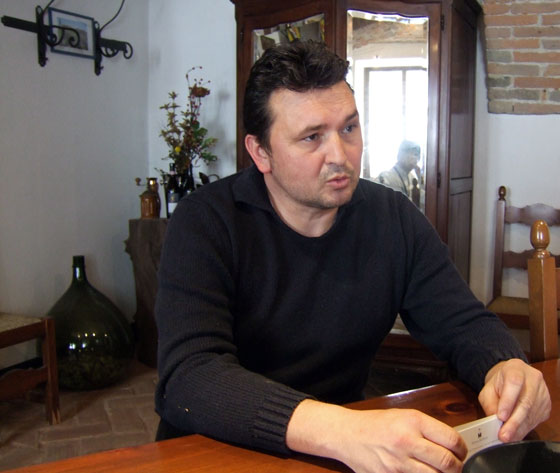
In closing, this shot goes out to all the friends and associates I've annoyed (and have yet to annoy) by publishing photos of them here at MFWT over the years. That's me with Valter, the Langhe hills rolling to the horizon.


Elvio Cogno
Località Ravera, 2
12060 Novello (CN)
Italia
Tel. +39 0173 744006

Thursday, November 5, 2009

Urban Winemaking at Dashe Cellars

Ask any hundred people what they consider the heartland of California wine country and Napa will no doubt top the list, followed closely by Sonoma. Ask the same group – and this implies the participants have at least some basic familiarity with the subject matter – about California’s new frontier and I’d hazard a guess that Santa Barbara or Paso Robles, maybe the Santa Rita Hills, would come out ahead. Yet more and more, some of the most compelling wines being produced in California today are coming from winemakers based within the urban landscape of the San Francisco Bay Area.

The godfather of this “new school” is no doubt Steve Edmunds, who’s been producing characterful wines that buck the trend of over-saturated, Californicated fruit since 1985 and doing so right in the heart of Berkeley. Perhaps it’s no coincidence that his neighbors at Edmunds St. John include the likes of Alice Waters and Kermit Lynch…. On the more freshly cut edge of the movement is the Natural Process Alliance, leading the locavore, low impact and natural wine front from its headquarters in Santa Rosa. Sandwiched between those two – both geographically and chronologically – is Dashe Cellars.

Michael and his wife Anne Dashe produced their first Dashe Cellars release, a Dry Creek Valley Zinfandel, in 1996. Over a dozen vintages later, they’re going strong, having slowly but surely garnered praise from the traditional wine press – they’ve made Wine & Spirits Magazine’s Top 100 Wineries list on several occasions – as well as from, more recently, natural wine cognoscenti. In 2005, Mike and Anne moved their winery to its current home in an industrial district of Oakland where, in the shadows of I-880, they share a 16,000 square foot warehouse/winemaking facility with JC Cellars. Dashe now produces approximately 10,000 cases (120,000 bottles) of wine per year, about 85% of which is Zinfandel.

During my recent trip to San Francisco, I had the chance to catch up with Mike and to visit Dashe Cellars in the full tilt of autumn harvest season. I’ll let the pictures, captions and tasting notes below tell the story. For more information, check out the Dashes’ website and be sure to (re)visit the interview I did with Mike earlier this year for 31 Days of Natural Wine.

Dashe Cellars shares a barn-red, relatively no-frills warehouse (located at 55 4th Street in Oakland, CA) about 60/40 with JC Cellars.

JC works the new barrels (look ma, no stains) to the left of Dashe’s three foudres, while Mike’s production inhabits the remainder of the warehouse, populated primarily by racks of older barriques and the ubiquitous phalanx (not pictured) of stainless steel fermentation tanks.

As mentioned above, we visited during a very busy day in late September, at the heart of NorCal harvest season. This was the second of three truckloads of grapes of the day for Dashe. The first, Petite Sirah, had arrived in the morning hours. This load of Zin arrived shortly after we did in the early afternoon, while a third truck pulled up with the day’s final delivery of Zinfandel just as we were saying our goodbyes. The Dashes, who own no vineyards themselves, source their fruit from primarily organic farms, with which they have long-term contracts, in the Dry Creek, Russian River, Alexander and Potter Valleys of California.


With freshness always foremost in mind, the fruit is moved quickly from the truck to the bin turner in half-ton crates. The process is pretty much business as usual, with Mike and his crew aiming to keep handling and manipulation of the fruit to a minimum. All fruit is hand sorted to remove leaves and any sub-par grapes, not to mention the occasional earwig. From there, it's on to the crusher/destemmer, from which the crushed juice is gently pumped into the waiting tanks inside the winery. All of Dashe's wines see a high percentage of whole berry fermentation; however, all of the Zins – and other wines at Mike's discretion – also receive a dose of press juice (that's Mike's pneumatic press in the bottom right photo) to ensure enough structure to support their ample fruit.


Back in the winery, the work is all focused on keeping the wines pure and expressive, with as little manipulation and adulteration as possible. Mike and Anne do much of the work themselves, helped by a rotating group of interns from enology schools such as UC Davis or by visiting wine makers from other regions. Mike commented that his interns are nearly always shocked to find that very nearly nothing is added to the fermenting and aging wines. Dashe ferments all of his wines, including the white and rosé, on their native yeasts. No commercial yeast, enzymes, acids or other additives/adjuncts are ever used (and Mike does not believe that cross-contamination occurs from the commercial yeast strains being used in the same warehouse space by JC Cellars). A small dose of sulfur dioxide is added at crush and again, though only if necessary and never for "L'Enfant Terrible," at bottling.

Mike is particularly happy with (and proud of) the results he's getting with the three foudres he purchased new from Tonnellerie Rousseau. The majority of Dashe's wines are still aged in older barriques but Mike plans to move more and more toward aging in larger casks as time and cash flow (those foudres are expensive) permit.


Our pals from Monterey, Steve and Stacy, had visited Dashe a few months earlier, not long after reading my interview with Mike, so they were already well acquainted with the wines. While pouring us tastes of a few of his current releases, Mike regaled us with some pretty hilarious stories of his past days writing technical user manuals for Atari. I guess a winery profile like this wouldn't be complete without at least a couple of tasting notes, so:
  • 2008 Dry Riesling, McFadden Farms, Potter Valley (13.8%). Very ripe, round aromas of yellow plums and pineapple. Firm acidity. Succulent. Not as bracingly mineral as I might like but a very fine Cali Riesling.

  • 2008 Grenache, Dry Creek Valley (13.8%). California Grenache under 14% alcohol? Yep. Very fresh, vibrant red berry fruit. Aged in old wood only. Gentle tannins and, for Grenache, good acidity. This reminded me very much of the style of Mike's "L'Enfant Terrible" Zinfandel. Lighter, brighter and fresher than more typical CA varietal expressions.

  • 2008 Zinfandel "L'Enfant Terrible," McFadden Farms, Potter Valley (13.8%). California Zinfandel under 14% alcohol. Yep. The fruit for "the wild child" is sourced from the same cool, high altitude farm from which Mike purchases his Riesling. Macerated strawberries and pepper on the nose. Brightly textured and fresh, though a bit richer than the '07 version. In 2007, 280 cases of the 600 case production of "L'Enfant" were sold at The Slanted Door. As hinted at in the Grenache note above, Mike is considering creating other "L'Enfant Terrible" bottlings in the coming years.

  • 2006 Zinfandel, Florence Vineyard, Dry Creek Valley (14.5%). Produced from young vine fruit. Super ripe on the nose and palate, full of raisins, chocolate and plum pudding but balanced by crunchy tannins.

  • 2007 Zinfandel "Old Vines," Todd Brothers Ranch, Alexander Valley (14.7%). From 50 year-old vines. This was a stark contrast to the Florence Vineyard bottling; a much more elegant, structured style, showing coffee, licorice, blackberry and dark chocolate notes but on a finer, more restrained frame.

  • 2007 Late Harvest Zinfandel, Dry Creek Valley (14.1%). Harvested at 40 brix, finished at 9% RS. Mike allows the fermentation to stop naturally then filters the wine to remove any yeast cells (and to prevent the possibility of re-fermentation) prior to bottling. Pretty damn tasty served, as the Dashes did, with a nibble of dark chocolate.

Clearly less comfortable at the computer and cash register than amongst the barrels, Mike called his wife Anne down from the winery office to meet us and help with our end of visit purchases. In case you've ever wondered about the winery's logo, I can now unequivocally confirm that Mike is the monkey and Anne is the fish.


Dashe Cellars is just a short walk from the Merrit Lake BART station, a quick drive across the Bay Bridge from downtown San Fracisco, and is also easily accessible from the greater Oakland and Berkeley areas. (We popped over to West Berkeley for pizza and beer at Lanesplitter after our visit.) Their tasting room is open to the public Thursday through Sunday from noon to 6:00 PM.

Dashe Cellars
55 4th Street
Oakland, CA 94607
(510) 452-1800

Wednesday, December 10, 2008

Ampelidae: Growing Ambition in Marigny-Brizay

I first met Frédéric Brochet, majority owner of and winemaker at Ampelidae, sometime in late-2002 or mid-2003. He was on a quick business oriented tour of the Mid-Atlantic States and his schedule allowed for little more than time to exchange pleasantries and for me to ask him a question or two about his winemaking and viticultural practices. My main question – something to the effect of whether he farmed organically or biodynamically – must have stuck in his head, as when I visited his property in February of 2004 he not only recognized me right away (always a nice thing) but quickly brought up the topic of our original discussion….

A view of the estate from the main driveway, February 2004.

I’m getting a little ahead of myself here, though, so let’s back up a bit. Ampelidae is a modestly scaled winery located in Marigny-Brizay, a commune of the Vienne Department located thirty-odd kilometers NNE of Poitiers in the southwestern sector of the greater Loire Valley. It sits in the crossroads between the Massif Central and the Massif Breton, in an area with ancient viticultural history but without a well-known modern viticultural presence to back it up, reflected in the fact that the area’s wines are not recognized with AOC status. The region includes about 800 hectares of vines, three-fourths of which are Co-Op operated. Independent, forward-thinking producers are in the distinct minority.

Frédéric (pictured at right) was born on the property in 1972 and his father, Christian Brochet, first gave him the opportunity to make his own wine in 1990. Perhaps not surprisingly, Frédéric went on to study oenology at university. After a working a stage in Australia in 1992, he returned to pursue a PhD in oenology at the University of Bordeaux, focusing on the cognitive aspects of wine tasting. He immediately made an impression there, conducting a series of rather mischievous tastings targeted at proving just how subjective wine tasting can be.

The estate itself is relatively young, established by Frédéric in 1995 and since expanded around the heart of the property that was originally owned by his father. As with so many other vignerons of the current generation, Frédéric is the first to estate bottle wines from his family’s farm, which includes about 35 hectares of vineyards. Those vineyards – situated on or near battleground sites from 5th, 8th and 14th Century conflicts – span a wide swath across a gently sloping hillside, providing all vines with southern exposure. Cabernet Franc and Sauvignon Blanc are planted on the chalky soils near the base of the slope; Chardonnay and Pinot Noir take root in the clay, sandstone and flint base of the mid-slope; and Sauvignon Blanc and Cabernet Sauvignon can be found in the acid, sandy soils at the top of the slope.

The Brochets purchase vine stock from reputable estates in Burgundy and Bordeaux and also propagate vines via their own massal selection. Farming is organic; certification has not been sought. In the vineyards, the soil is turned annually between every row, allowing natural mulch and moisture to aerate the topsoil, keeping it loose and healthy. During the growing season, grass, mâche, wild asparagus and other plant life are allowed to grow amongst the vines, helping to prevent erosion and also attracting an array of insects that are competitive to malignant vine pests, thus eliminating any need for insecticides.

Another view of the property, in a warmer time of year.

In addition to farming his own land, Monsieur Brochet also buys in fruit – mostly Sauvignon Blanc and Gamay – from a number of locally contracted growers with whom he has the ability to guide and dictate farming practices. Wines are made on two basic levels. The so-called “Premium” line is branded as “Marigny-Neuf,” a name meant to capture the essence of the winery’s locale in Marigny-Brizay along with Brochet’s drive to breathe new life into the area’s old and largely forgotten viticultural traditions. These are varietal, négociant bottlings, combining estate-grown and purchased fruit; all vinification is done in steel, with an eye toward a direct expression of local varietal character. The estate bottled Ampelidae wines, what Frédéric considers his “Super Premium” collection, are all barrel aged, richer in extract and more modern in their flavor and textural profiles. At the time of our visit, all the wines fell within the appellation of VDQS Haut-Poitou, a designation which Brochet has recently dropped in favor of Vin de Pays de Val de Loire.

Getting back to where we started, remembering my old question regarding organics and biodynamics, Frédéric made it clear that he prefers technology to what he referred to as “the new age.” His position is reflected not only by the adoption of such modern tools as computer modeling – used to predict the risks of mildew relative to the area’s rainfall – but also by his sense of ambition. He clearly wants his wines to be taken seriously and works accordingly in his cellars, striving to craft wines that may eventually fetch prices far above and beyond the current standards of his neighborhood.

While visiting one of the several small wine making and barrel aging facilities scattered around his property, he extracted barrel samples of a wine that encapsulates that ambition. It was a Pinot Noir he called “L’Étoile” from the 2003 vintage, a wine I believe he’s still yet to market. His goal: to produce what he called a “thick-style” Pinot Noir that might sell to the high-end restaurant market for upwards of 100 Euros per bottle. Based on what we tasted, I couldn’t see it. But we could certainly see the hope in his eyes.

At the time of our visit, the estate seemed to be at a crossroads not unlike the one represented by their location halfway between the pacific culture of the Loire and the mercantile nature of Bordeaux, not far to the south. The best wines were the simplest wines, the “Marigny-Neuf” line, pure, fresh, clean, eminently drinkable and very affordable. The identity of the more serious wines was still punctuated by a question mark. That question is one I think will be answered only with time, as M. Brochet’s sense of purpose falls back into step with his connection to his land. I’ve had very little exposure to the “Ampelidae” line since the time of our visit, but the promise that continues to show via the Marigny-Neuf wines suggests that Ampelidae remains a winery worth watching.


If you’re hankering for more detail, here are the tasting notes from our visit.
  • 2003 Marigny-Neuf Gamay
    Smoky, peppery, ripe red berry fruit. Slightly aggressive but bottled only three weeks earlier. In need of a little time to settle down.

  • 2003 Marigny-Neuf Pinot Noir
    Bottled only two-weeks earlier but already more centered than the Gamay. Crisp, bright griotte fruit, with delicate tannins and a sweetly herbal nose.

  • 2002 Marigny-Neuf Cabernet
    A blend of 80% Cabernet Franc and 20% Cabernet Sauvignon. Meaty and peppery, with plenty of bell pepper going on. Round mouthfeel contrasted by toothy tannins.

  • 2001 Ampelidae “Le K”
    Opposite to the above, this was a blend of 20% Cabernet Franc and 80% Cabernet Sauvignon, aged in barrel. Rich. Aiming at opulence without arriving at sur-maturity. Dark black cherry fruit and a slightly bitter finish.

  • 2002 Ampelidae “P.N. 1328”
    The signature wine of the estate, this is a Pinot Noir named for the address of the old family house. Spicy black fruit and mature aromatic characteristics.

  • 2001 Ampelidae “Le G”
    Barrel aged Gamay. Reductive and aggressively animal on the nose, like sulfured manure.

  • 2003 Marigny-Neuf Rosé
    70% Gamay, 20% Cabernet Sauvignon, 6% Pinot Noir and 4% Groillot. Very nice wine, with clean fruit and decent backing acidity.

  • 2002 Ampelidae “Le X”
    Unusual wine. Varietal Pinot Noir, barrel aged and finished with 38 grams of residual sugar (RS). Like drinking light strawberry preserves.

  • 2002 Marigny-Neuf Chardonnay
    Smoky, apple-y fruit, with a hint of melon and red berries. Crisp and easy drinking.

  • 2003 Marigny-Neuf Sauvignon Blanc
    Riper and rounder than the 2002 (which I was selling at the time). Clean citrus fruit, with a bit of grass and flintiness on the nose. Good mouthfeel.

  • 2003 Ampelidae “Blanc d’Hiver”
    Sauvignon Blanc aged in old oak casks, made for the first time in 2003. Creamy and sweet-fruited, with peach and melon nuances. Finished at 13% alcohol with 13 grams RS.

  • 2002 Ampelidae “Le C”
    Barrel aged Chardonnay, with lots of smoky oak on the nose. The wood was better integrated on the palate. Flowers on the nose and rich texture in the mouth, finishing ever so slightly off-dry.

  • 2001 Ampelidae “Le S”
    This is the barrel aged Sauvignon Blanc. Quite nice on the palate, showing some oak (which was more neutral on the nose). Well balanced.

We also had the opportunity, if just barely, to sit down with a few of Frédéric’s wines over a very fine lunch at Le Pavillon Bleu in Bonneuil Matours.

  • “Armance B” Brut NV
    This is a Vin Mousseux de Qualité, made in the traditional method and named after Frédéric’s grandmother, whose maiden name was Armance. Based primarily on Folle Blanche, rounded out with small proportions of Chardonnay and Sauvignon Blanc, it spends 14-15 months on the lees before disgorgement. Best when young. Fresh, creamy and lively.

  • 2003 Marigny-Neuf Gamay “Rouge d’Automne”
    One-third of the fruit for this cuvée sees carbonic maceration; the other two-thirds goes through traditional vinification. Softer and juicier than the “regular” Gamay. Maybe the most enjoyable wine of the day, and pretty tasty with the chef’s “Terrine de Pot au Feu en Ravigote.”

  • 2001 Ampelidae “P.N 1328”
    This improved in the presence of “Filets de Porc Rôti” but was nonetheless marred by alcoholic heat and an oak influence that punched over the wine’s fruit.

(First photograph courtesy of Eric Tuverson. All other images courtesy of Ampelidae.com.)

Tuesday, April 8, 2008

Celebrating the Chevaliers de Chezelet

This is the final installment of a three-part story of a visit at Chinon's Vignoble Gasnier in February 2004. Links to parts one and two can be found at the end of this posting.

When we’d passed through the dining hall at Domaine Gasnier earlier in the day, in search of some clean stemware, I couldn’t help but notice the hot plates placed at regular intervals along the long, wooden banquet table. I took pause for a moment to ponder their specific purpose; however, we quickly moved on to the more pressing matter of tasting.

When we returned later that night for dinner at Fabrice’s invitation, the first thing we realized was that our group of nine wine travelers had been joined by two dozen or so graduate students from the University in Tours. They’d come for the day to learn about the particulars of the agricultural and culinary history of Cravant Les Coteaux. Not long after, the purpose of those hot plates became clear. Fondue. But I’m getting ahead of myself….


The cultural connection between Rabelais and Chinon (that's Fabrice Gasnier on the right) would become clear as the night wore on.

The next time you think of staging a horizontal/vertical tasting of Chinon for you and thirty or forty friends, consider something along the lines of that evening’s event.

As an aperitif, we were all offered a glass of sparkling rosé, poured from clear glass, unlabeled bottles. It turned out, unbeknownst to me at that time, that Fabrice produced small quantities of sparkling “Chinon” every year, for the sole purpose of enjoying it with family and friends. Since then, perhaps encouraged by our enthusiasm for it, he’s decided to commercialize the wine as a non-AOC bubbly (Chinon regulations do not allow for sparkling wine) called “La Cravantine,” which you can read more about here. Dry, soft, fruity and deliciously quaffable, we enjoyed our first glasses and were offered refills while it lasted.

Dinner started with a simple salad of fresh greens with smoked salmon and local chevre, accompanied by Fabrice’s 2003 Chinon Rosé. Next up was the aforementioned fondue.

This was not your everyday fondue. No oil, cheese or chocolate was to be found. Instead, each fondue pot was filled with basic Chinon rouge, cut with a little water and stock and seasoned with a handful of fresh herbs. Placed in front of every few guests was a plate of glistening, ruby-red cubes of local beef, a mound of potatoes that had been roasted in the hall’s open hearth and a bundle of fondue forks – nothing more, nothing less. With a minute or so in the bubbling pot of Chinon, each morsel of beef emerged perfectly medium-rare, infused with the flavors of the place we’d spent so much time discovering earlier in the day. The only problem was remembering to heed that minute timing, as both wine and conviviality flowed around the communal table.

Fabrice started everyone off with the current release, 2002, of his “Cuvée Les Graves.” I’m not sure what was opened around the rest of the table, but Fabrice raided the cellar for our little corner of the room. Bottles of 1997 and 1996 “Cuvée Prestige” were followed by “Cuvée Fabrice” from 1999, 2000 and 2001. A bottle of “Cuvée Vieilles Vignes” from 1989, a great vintage (which Fabrice made us guess after tasting), was still bright and youthful, rounded at its edges and evocative of dried plums enjoyed around a campfire at the end of a long, autumn walk in the forest.


As the fondue furor subsided, Jacky Gasnier, Fabrice’s father, made his presence know at the front of the hall. Following his retirement from winemaking a few years earlier, Jacky had assumed the duties as head of the local Rabelais appreciation society, the Chevaliers de Chezelet. Apparently, one of my co-workers and fellow travelers, Eric Tuverson, had made a lasting impression during his previous visit with the Gasniers. I think it may have had something to do with a certain drinking technique he displayed at a local rugby match. In any event, Jacky had gathered a couple of members of the Chevaliers to make Eric part of their brotherhood. In keeping with François Rabelais’ famous quote, “Beuvez toujours, vous ne mourrez jamais” (Drink always and never die), Eric’s induction ceremony involved a bottle of Chinon and the largest wine glass I’d ever seen. I’ll say no more, other than that it provided a truly Rabelaisian ending to a long day of learning and fun.

* * *
Related posts:

Part One: On the Farm in Chinon with Fabrice Gasnier
Part Two: Tasting Chinon with Fabrice Gasnier

Sunday, April 6, 2008

Tasting Chinon with Fabrice Gasnier

This is installment two of a February 2004 visit at Vignoble Gasnier in Chinon. If you missed part one, please see On the Farm in Chinon with Fabrice Gasnier.

Our walk through the vineyards and tour of the Cravant Les Coteaux hillsides complete, we headed to Fabrice’s cellar and winery to learn what happens indoors and to sample what he had wrought from the last couple of vintages. Gasnier’s winery is dominated by cement vats, which Fabrice prefers to steel for their slight oxygen permeability. All vats are temperature controlled, with all primary and most malolactic fermentation conducted in cement. The couple of stainless steel tanks in evidence are used only for assemblage and short-term holding. All fruit is de-stemmed and sorted prior to being crushed in a small vertical press. Following natural malolactic fermentation, the wines are left alone, saving for some occasional batonage if deemed necessary.

Fabrice Gasnier pulling a sample from the younger of the two foudres in which he ages his "Cuvée Vieilles Vignes."

Vignoble Gasnier bottles six different wines: four reds – cuvées called Les Graves, Vieilles Vignes, Prestige (since renamed Cuvée à l’Ancienne) and Fabrice – one rosé and a sparkling wine. As no white fruit is planted, Chenin Blanc being the only permitted variety in AOC Chinon whites, no white wine is made. Box wine is produced and available for local sale only.

“Cuvée Les Graves” is Gasnier’s “young vine” red, made from an assemblage of various parcels from throughout the property but dominated by those planted in the gravelly (thus the name) soil nearest the river. It is varietal Cabernet Franc. Less conscientious producers in some parts of the world might be tempted to call this an old vines bottling, as it comes from 20-25 year-old vines. Fruit from any vines younger than 20 is either sold off or used to produce the aforementioned box wines. “Les Graves” represents about 50% of the estate’s total annual production of roughly 10,000 cases. Fermentation is conducted in two separate batches at different temperatures: one at about 22 degrees Celsius to highlight aromatics and one at around 28 degrees to provide extraction and body. Malolactic follows, also in cement, at a cooler temperature of 20 degrees. Maceration lasts 16-17 days. Assemblage of the two batches is performed after completion of primary and secondary fermentation. Typically bottled in May following the vintage, it is the only one of the reds that sees no wood whatsoever. Because the six month aging regime does not allow enough time for all solids to settle in the large-volume cement vats, a light filtration is conducted before bottling.

Gasnier’s “Cuvée Vieilles Vignes,” also 100% Cabernet Franc, comes from vines of 45-50 years, planted in soils of both argilo-siliceous and gravelly character. Primary and malolactic fermentations are conducted in cement, with a maceration period of 22 days. The wine is then moved into two large, 3700 liter oak foudres, one older than the other, for aging. The contents of the two casks are remarried in steel cuves, after which, again because of volume, a light filtration is performed prior to bottling in the September following the vintage. In all cases, Fabrice prefers to bottle on the early side in order to preserve fruit freshness. The Vieilles Vignes represents about 25% of the estate’s annual production.

The “Cuvée Prestige” comes from two specific plots of even older vines – 50-55 years – grown entirely in argilo-siliceous soil. A touch of Cabernet Sauvignon, a small amount of which is planted in one of Fabrice’s oldest plots, makes it into the Prestige. The Cabernet Sauvignon, which is vinified separately, never represents more than 10% of the final blend. Initial vinification practices, in terms of fermentation vessel and maceration period, are identical to the Vieilles Vignes. Aging, though, occurs in barriques used previously for two to six years. Here, the settling rate in smaller casks allows for bottling, also in September following the vintage, with no filtration. Beginning with the 2004 release, “Cuvée Prestige” was rechristened as “Cuvée à l’Ancienne.” This bottling makes up 15% of Gasnier’s annual production. For reasons unbeknownst to me, though perhaps because it tends to have the sternest character of the four reds, this is the cuvée least frequently available on the US market.

Gasnier’s top red is also his most modern. Though I’ve referred to it for years as “Cuvée Fabrice,” it was only in 2005 that Fabrice actually made it official with a subtle change to the wine’s label, replacing the signature “Fabrice Gasnier” with the name “Cuvée Fabrice.” It seems somewhat common for young vignerons, taking over chief winemaking responsibilities from the previous generation, to add a new or signature wine to the lineup. I’m not sure, though, how many decide to name it in self-homage. Somehow it does seem to fit Fabrice’s big, garrulous personality. Anyway, back to the wine….

“Fabrice” comes from a single plot of the oldest vines (60+ years) on the property. As with “Cuvée Prestige,” it includes 5-10% Cabernet Sauvignon. Primary fermentation, as with all of Gasnier’s wines, occurs in cement. At 25 days, maceration is longer than with the other wines. The modern approach begins after maceration and fermentation, as the wine is moved to barriques – 50% new and 50% one-year-old – for malolactic fermentation and aging. As this regime suggests, it is the only wine in Fabrice’s portfolio that shows an obvious oak influence, at least in terms of aroma and primary flavors. It is bottled without filtration after 14 months, in December of the year following its vintage, and represents only 5% of total production.

The remaining five percent of the Gasniers’ crop goes to the production of Rosé. It is produced by taking a bleeding (saignée) of juice from the production of various lots of Cabernet Franc after 24-48 hours of maceration, depending on the vintage characteristics and the desired level of color extraction. Fermentation is then conducted entirely in cement, with bottling in the spring following harvest.

At the time of our visit in 2004, Fabrice also produced tiny quantities of an unlabeled, unnamed sparkling wine, solely for consumption by family and friends. It is varietal Cabernet Franc, solely from the gravelly terroir of the estate. Lacking the facilities and equipment necessary to craft méthode traditionelle wines, he takes his fruit to the local cooperative, where it is produced, aged sur-latte for one year and bottled without dosage. Since then, perhaps based on our vociferous prodding at dinner later that night, he’s started to commercialize small quantities. He calls it “La Cravantine,” a diminutive term for a creation of the Cravant Les Coteaux commune. Originally produced as rosé, he now strives for a clear Blanc de Noir; a barely discernible salmon hue can still be detected by a knowing eye.

Fabrice feels that Chinon rouge, in general, shows its best between three-to-six years of age. Drinking earlier is ok, of course, while wines from the best vintages can be candidates for 10-15 years or more. He opted to begin our tasting session with finished wines, primarily from the bottled but not yet shipped 2002 vintage, which he considers one of the best growing years since 1996.

  • Chinon “Cuvée Les Graves,” 2002
    Beautifully aromatic, with lots of red currant fruit, leaves and spice. Gentle but lively tannic structure. Fabrice always regards this as his “cuvée gourmande,” intended for every day, easy drinking. A pure expression of Cabernet Franc.

  • Chinon “Cuvée Vieilles Vignes,” 2002
    Aromatically closed but already showing richness of body. Less peppery than in some years but still showed fresh, herbaceous suggestions of dill and basil. Darker red tree fruits than in “Les Graves.” Excellent grip.

  • Chinon “Cuvée Prestige,” 2002
    Continuing the climb upwards in terms of grip and structure. Some influence from wood tannins, along with gorgeous fruit concentration. Wild raspberries, cassis and rainier cherries.

  • Chinon “Cuvée Fabrice,” 2002
    The richest texture, with dark plum and black currant fruit. The oak is forward but adds well integrated vanillin and chocolate overtones. A hint of earth on the nose.

  • Chinon “Cuvée Prestige,” 2001
    Here we found the bell pepper that was less in evidence in the 2002 wines. Fresh, damp, loamy earth on the nose. Starting to show some bottle bouquet. Definitely a food wine (but then all Chinon is…).


The landscape surrounding Gasnier's vineyards in Chezelet provides a natural environment for bottle aging caves, excavated directly into the tufa hillsides.

Notes from barrel tastings may not make for the most exciting reading. However, tasting from barrel and vat – particularly after tasting from bottle and spending so much time learning about the viticultural and oenological peculiarities of a producer’s various wines – can be extremely illuminating. It can help to give one a greater sense of how any given wine comes together, from its component parts and through the vinification regimen, to form a whole.

  • A sample of “Les Graves” 2003, from a vat fermented at warmer temperature, had a deep purple color, was firmly tannic and still held a trace of unresolved CO2. The warmer fermentation, combined with a preceding three-day cold soak, is intended to give structure to the final blend. I could almost sense the vines’ plant matter on the palate.

  • From another tank of “Les Graves” 2003, fermented cooler for attainment of aromatic freshness, the scents were more peppery and wine-like. Tannins were softer and suppler. It tasted more finished, with no traces of carbon dioxide.

  • 2003 “Vieilles Vignes,” from the older of two large foudres, had a very peppery nose and showed signs of reduction. In Fabrice’s words, it was “going through a bizarre stage.” Yet it showed promising concentration and structure.

  • From the younger cask of 2003 “VV,” aromas were more shut down but the wine was softer and already pleasing in the mouth, with no signs of reductivity. All wine coming from the same sites and same fermentation tanks, the only difference between the two samples was the age of the foudres, with the younger cask allowing more oxygen interchange between wood and wine than in its older neighbor.

  • 2003 “Prestige” tasted from barrel was lush and velvety in texture. Rich cherry kirsch, with nary a hint of pepperiness in the mouth. Substantial grip. At 13.6% potential alcohol and lower apparent acidity than in the Graves and VV, this was showing signs of what to expect from the freakish 2003 vintage.

  • That trend continued with a sample of “Cuvée Fabrice” 2003, pulled from barrel. Dense and dark but ungenerous on the nose. Very rich palate. Plenty of oak influence on the nose. Already, the lower than usual acidity along with the opulent nature of its fruit pointed toward a wine that would be a hit with the “big red crowd,” not the usual Chinon audience. At 13.8% potential alcohol, this was harvested at about a degree higher than in a typical vintage.

To bring us back from the raw experience of tasting samples of the big 2003s and to finish off our tasting session, Fabrice extracted the cork from a bottle of his 1998 signature cuvée. As it turned out, he’d also chosen to finish on a high note. In 1998, Fabrice did not use any new oak for this wine, instead aging it in all first passage barrels that he’d purchased from Château Margaux. The same barrels, he told us, were now (in 2004 that is) being used for his “Cuvée Prestige.” Beautiful aromatic development had occurred in the bottle, with a nose of dried red fruits, fresh tanned leather, curing tobacco and prunes which followed to a supple, silky and well balanced palate. Red currants and intensely concentrated strawberry preserves blossomed on the follow through. Lovely stuff.

* * *

Our work day was done but there was still more to come. Fabrice and his wife Sandrine invited us to return for dinner. It would turn out to be quite the Rabelaisian evening…. So please stay tuned for part three, coming soon.

Friday, April 4, 2008

On the Farm in Chinon with Fabrice Gasnier

Provided with impetus by the most recent Wine Blogging Wednesday theme – French Cabernet Franc – we return to the midpoint of a European wine junket. It’s late February 2004, on my group’s second day in the middle-Loire. Leaving our morning appointment with Domaine Ricard, near Thésée la Romaine, just east of Chenonceau, we headed west, straight past Tours and toward the western border of the Touraine district, toward Chinon.


After stopping to check into our rooms and freshen up, we grabbed a quick bite to eat – ham and cheese on baguettes from a local café. Our hotel, directly across the Vienne River from the center of Chinon, provided a spectacular view of the fortress that dominates Chinon’s profile. No time to sightsee though. We were right back to it. Heading across the river and turning immediately right, we avoided the town center entirely, instead following the path of the Vienne back eastwards, against its flow, to the commune of Cravant Les Coteaux. It was there, in the small hamlet of Chezelet, that we were scheduled to visit Vignoble Gasnier.

We discovered Fabrice Gasnier at work in his vineyards, pruning his vines in preparation for the coming of spring. Fabrice began his work at the property during the benchmark vintage of 1989. He and his father Jacky, who has since retired, incorporated the Domaine as it now stands in 1993. Their family has owned land and farmed here in Chezelet for four generations, during which time the estate has grown from its original three hectares to its current 24. All of those 24 hectares – 23 planted to Cabernet Franc and one to Cabernet Sauvignon – are located on the flat portions of the Cravantine landscape, within a two kilometer radius of Chezelet. Finding Fabrice in his fields presented the perfect opportunity to really gain an understanding of his farming techniques and of some of the peculiarities of his terroir.

All of Gasnier’s vines are Simple Guyot trained, with one main baguette producing seven eyes. A second, smaller baguette is pruned to two eyes and trained in the opposite direction, the intention being both to begin the growth cycle for the following year’s season and to prevent bunch clustering. Farming is entirely organic (the estate is now in the process of organic certification through ECOCERT), using only natural products and homeopathic principles, practices which Fabrice describes as preventive rather than curative viticulture. Predator insects and bio-organisms are relied upon for pest control. As we can see, standing in a freshly plowed 2.5 hectare plot of vines planted by his grandfather 50-60 years earlier, the earth is turned regularly to promote deep root systems and a maximum expression of terroir. Following pruning – and completing the cycle – vine cuttings are mulched and returned to the soil to reintroduce their stored energy to the vineyard.

Fabrice typically conducts a green harvest – vendange verte – in July in order to reduce the farm’s yields to the desired number of bunches per vine. At harvest, his aim is always for medium ripeness. As natural as Fabrice’s farming is, we were surprised to learn that he machine harvests, a practice that many view as an impediment to creating truly natural wines. He explained his reasons in simple terms. With 24 hectares (nearly 60 acres) and a mere six full-time staff members, of which only three are dedicated to the fields, machine harvesting is an economic necessity of scale. On the plus side, mechanical picking allows for the entire estate to be harvested in just two days, ensuring uniform ripeness levels across the various parcels of property and decreasing the risk of damage by fall rainstorms.

A plot of Gasnier's Vieilles Vignes waiting for pre-season pruning.

Soil is of two basic types on Gasnier’s property. Here at the heart of the estate, the primary makeup is of argilo-siliceous clay, to a depth of approximately 1.5 meters, below which lies rock. Closer to the river Vienne, the vineyards are planted on gravelly terraces. Given the proximity of the river and the northerly situation of Chinon in general, spring frosts can be a major danger. A day earlier and only a few kilometers away, we’d learned of severe frost damage to Francois Chidaine’s Montlouis vineyards at the beginning of the 2003 growing season. To combat the problem here in Chinon, Fabrice relies on a system of human nighttime weather watchers to sound the frost alarm and three different frost prevention mechanisms. Wind circulators, which look like small turbine engines mounted on flagpoles, are scattered at intervals throughout the vineyards, their aim being to move warmer air from above down to the cooler ground and vine level. Paraffin pots are burned amongst the vines to ward off the cold. Lastly, water may be sprayed on the vines to form a protective outer coating of ice that will prevent frost from penetrating the plants.

Not only did Fabrice manage to avoid any frost damage in 2003, he was also the only vigneron we met on our entire trip who laid claim to a problem free 2003 growing season. Given the extreme heat and drought of the summer, which continued right up to harvest time, that’s a big statement. He attributed the success to the deep root system and general good health of his vines. Nonetheless, 2003 was not without its natural effects. Following 2002, a great vintage in Fabrice’s estimation, the dry heat in 2003 produced fruit with the highest natural sugar levels – approaching 14% – on record in the area. Acidity levels were normal, while tannin levels were greater than usual, helping to balance the high sugar levels.

Our walk through the vineyards and tour of the Cravant Les Coteaux hillsides complete, we headed to Fabrice’s cellar and winery to learn what happens indoors and to sample what he had wrought from the last couple of vintages….

* * *

Editor’s note:
To avoid creating the longest posting in the history of the blogosphere (at least that’s where I feel like this was heading), the rest of this Vignoble Gasnier trip report will appear in installments. Stay tuned for parts two and three.

Part Two: Tasting Chinon with Fabrice Gasnier
Part Three: Celebrating the Chevaliers de Chezelet

Wednesday, January 30, 2008

Domaine Ricard: Growing in the Touraine

Vincent Ricard farms seventeen hectares of vineyards in the Touraine, located outside the village of Thésée la Romaine, near the banks of the river Cher and not far from Chenonceau, in the heart of central Loire Valley château country.

Vincent Ricard, circa 2005 (photo: B. Celce)

When first I met Vincent in February of 2004, he was a young man of 27 years, just beginning to get his feet wet yet already taking a strong stance in the Touraine wine scene. Actually, given his relative youth, his experience was fairly extensive. He returned to his family's property in 1998 after a two-year internship with Philippe Alliet in Chinon and a short stage with François Chidaine in Montlouis. It took him only a year from that point, with help from his father, to declare and incorporate Domaine Ricard. Like so many other young vignerons before him, Vincent was the first in his family to make the move to winemaking following many generations of family farming. Prior to 1999, the fruit grown by his family had always been sold to the local cooperative. It’s only in the last dozen years, he told us, that a small handful of producers in the Touraine, mostly young guns like Vincent, have moved to estate bottling and export market sales.

The large, hodgepodge Touraine AOC is still dominated by négociant houses and production of commercial vin ordinaire. That dominance has created a market – supported by self-fulfilling INAO guidelines – that expects very simple, fruity, quaffable and eminently uninteresting wines. Ricard, in contrast, aims for structure on the palate, the possibility of bottle aging and the development of secondary characteristics. His philosophy does not stem from his time in oenology school where he tells us, “Average methods are taught.” Rather, he’s taken influences from the people he’s worked with like Alliet and Chidaine and placed himself along with them, as he sees it, among the avant-garde. He’s not shy about considering his wines atypical to the region or about occasionally butting heads with the INAO. Along with a few of his peers, he is pushing for the establishment of a new appellation for his immediate area. If granted, this new AOC – Chenonceau – would allow for reds based on Malbec (Côt), Cabernet Franc and Gamay as well as whites from Sauvignon Blanc.

The entrance to Ricard's winery (photo: B. Celce)


In spite of all his ambition and a flair for the modern with his labeling, when it comes down to nuts and bolts, Vincent is essentially a farmer. He’s interested in making wines that speak of their place. He’s not looking to expand his property or production, only to increase quality. With that in mind, his ideal would actually be to shrink his estate to a more focused and compact twelve or thirteen hectares.

For the time being, he makes do with all seventeen. At only 20 meters above sea level and gently rolling at best, his property is essentially flatland wine growing country. Here, although exposure still plays a role, it’s not the hillside which is most important as much as are the simple raw materials of soil and vine. Ricard’s terroir consists primarily of sand and silex-based topsoil above clay and chalk based subsoil. His vines average 60 years of age, with some parcels as old as 80. Cultivating primarily Sauvignon Blanc, Vincent also grows Côt (Malbec), Gamay and small amounts of Cabernet Franc, Cabernet Sauvignon and Chardonnay, the latter a trickle-over influence, perhaps, from nearby Cheverny. Overall production is approximately 75% white and 25% red, with nearly 75% of the wine sold on the export market.

Vincent Ricard in the vineyard (February 2004).

Vincent believes strongly in the merits of natural farming. Exposed to biodynamic principles through his work with Chidaine and well versed in organic techniques, he picks and chooses the farming practices which make the most sense for his vines and his wines. Herbicides are never used. He allows grass to grow between every row, though he may eventually cut back to every other row to reduce the nitrogen richness the grasses impart to the soil. Vines are cut and trained later in the spring than typical to delay bud break, to protect the young shoots and buds from frost damage, and to forestall Sauvignon’s precocious ripening tendencies.

Even taking those precautions is not always enough to avoid loss in as northerly a situation as the Loire. In 2003, the season just preceding our visit, frost occurred on April 27, very late into the season, causing the loss of about 30% of all buds and, hence, a tremendous reduction in yields for the year. We’d heard a very similar tale of frost damage and reduced yields just the day before when visiting François Chidaine in Montlouis. 2003 would also turn out to be a shorter than usual growing season. Following a summer and early autumn of high heat and little rainfall, harvest began at Domaine Ricard on August 28 – nearly three weeks ahead of the typical schedule.

In the cellar:

As is common in the Loire, Ricard’s winery is built directly into a hillside on the property. It’s little more than a purpose-excavated garage cum cave, shaped like a small airplane hangar and suited perfectly, given its natural temperature control, to the utilitarian rows of cement vats and small-to-medium sized barrels. Despite the simple subterranean surroundings, the cleanliness of the space was immediately apparent. That cleanliness – a good sign at any winery – is particularly important here, as Ricard entirely eschews the use of sulfur within his crush, fermentation and aging regimens. Developing wines are casked tightly to prevent oxidation or spoilage. A light filtration, if necessary, and very low dose of sulfur are applied only at bottling time. Malolactic fermentation is not encouraged and rarely occurs for the whites, though it's not forcibly prevented.


Evolution can be seen in Ricard's cave between 2004 (photo at left: E. Tuverson)
and 2005 (at right: B. Celce)


Touraine Sauvignon “Pierre à Feu” 2002 (from bottle)
Varietal Sauvignon Blanc, from a plot of flint and silex rich soil, farmed to average yields of 40-45 hl/ha. The vineyard is visibly strewn with egg to fist sized pieces of pinkish white flint, a geology that continues into the subsoil. Rubbing two of the stones together gives a faintly smoky, gunflint aroma. Temperature controlled fermentation and aging in cement vat. Following a damp summer, warm temperatures in September and into October allowed for late ripening and resulted in a later than typical harvest. Light bodied, with bright acidity, lemony fruit and good persistence. The flintiness of the vineyard site shows through in the wine’s bracing minerality.

Touraine “Les Trois Chênes” 2002 (from bottle)
Also varietal Sauvignon, though not indicated on the wine’s label. The name of this bottling comes from a stand of three old oak trees that once grew on the site. 40-60 year-old vines give naturally yields of 30 hl/ha. The vines are on native rootstock, as the phylloxera louse does not take well to the extremely sandy soil of the vineyard. The richness of the fruit from this site lends itself to barrel fermentation, with battonage performed twice weekly during fermentation and continuing post-fermentation depending on the clarity of the wine. Time in barrel varies depending upon vintage conditions. A distinct undercurrent of minerality is provided courtesy of the presence of silex in the sandy top-soil as well as by the calcaire sub-soil in the vineyard. Citrus elements are supplemented by riper, pear-toned fruit and rounder mouthfeel. Ricard prefers a relatively warm serving temperature – 15 to 16 degrees Celsius – as cold will mask the richness and texture of this cuvée. Let’s just say that serving conditions in his cave on a brisk February morning were far below that ideal.

Touraine “?” 2002 (from bottle)
Here, the young Ricard’s willingness to bend rules, design modern labels (a large question mark cut-out adorns the bottle) and push the envelope of “Touraine typicity” came into more obvious relief. Primarily Sauvignon, this cuvée comes from vineyards farmed to yields of less than 20 hl/ha. What else is in the wine? “?” Maturity is pushed to the max. Fruit harvested at 14.7% potential was finished to 14% with 6 grams of residual sugar. Fermentation is done in new barriques with 20% malolactic. Oak, sweetness and fruit forward characteristics are held in check by acidity and physiological concentration, with an intense core of stony minerality again showing through.

Touraine “Cuvée Armand” 2002 (from bottle)
This is a small production bottling from a second tri from the “Les Trois Chênes” vineyards. It is named after Vincent’s great-grandfather, who sold some of the family’s wines in Paris from 1880-1900. It’s also Vincent’s statement/experiment as to Sauvignon’s potential to create a full range of wines from sec to richly demi-sec in style, just as with Chenin in Vouvray and Montlouis. He feels that, “Sauvignon is being made generic and terroir-less all over the Loire.” This is one of his efforts – interpret it as you might – to fight against that trend. Harvested at 16% potential, the 2002 was finished intentionally demi-sec to 13% alcohol with 35 grams of residual sugar. Loads of ripe, exotic fruit, with minerality still managing to find a foothold.

Touraine Sauvignon “Pierre à Feu” 2003 (assembled from barrel)
Very smoky and mineral on the nose, with lower acidity and richer texture compared to the 2002. Overripe grapefruit, along with a hint of cantaloupe, on the palate. To be bottled in about a month.

Touraine “Les Trois Chênes” 2003 (assembled from barrel)
Very fat and creamy, with low acidity but a concentration of physiological matter that keeps the wine from flabbiness. Showing peachy and smoky fruit but not yet integrated.

Touraine “?” 2003 (from barrel)
Oak is more obvious, at least at this early stage, than in the 2002. Also showing some heat and over-the-top fruit. Still fermenting, the wine as tasted was at 14% and 8 grams RS.

Touraine “Cuvée Armand” 2003 (from barrel)
Ripe and honeyed, with flavors of pear nectar and candied licorice. 2003 was a natural year, given low yields and high heat, in which to produce demi-sec wines; this was 13.5% with 40 grams RS when tasted.

Vincent pulls a sample from cement vat. If you inspect the photos above, you'll see that the vats were relocated to a new portion of the cellar following our visit to make room for more barrels. (photo: B. Celce)


Before shifting our palates to red wines, Ricard primed us with a bit of viticultural background. As recently as 40 years ago, Côt – the local name for Malbec – was virtually the only red variety grown in this part of the Touraine. However, much of it has since been replanted due to Côt’s tendency toward extreme variability from vintage to vintage. Vincent believes in Côt for his terroir – it’s less of a risk now due to very careful rootstock selection – but also cultivates Cabernet Franc and a small amount of Cabernet Sauvignon to allow flexibility in blending and making a wine that best represents the characteristics of any given growing season. He is against the practice of specific clonal selection in the vineyard, preferring natural selection as he wishes to avoid the risk of homogeneity.

Touraine “Le Vilain P’tit Rouge” 2002 (from bottle)
When Vincent first produced this Touraine rouge, the INAO inspectors, upon tasting a sample, denied him the Touraine AOC, proclaiming the wine atypical because of its structure and concentration. He was forced to label it as Vin de Pays, which, at least in theory, lowers the sale price and increases the difficulty of marketing the wine. After Ricard sold out his entire production, the INAO inspectors granted AOC status in the following vintage. The name, which can be translated in many different ways, i.e., “The Nasty Little Red,” is meant as a thumb of the nose to the authorities.

In 2002, “Le Vilain” was a field blend of equal parts Côt and Cabernet Franc. Previously the selected varieties had been fermented separately and assembled prior to bottling. With the 2002 vintage, he moved to co-fermentation (in cement tank) to allow the varieties to marry their attributes at an earlier stage. The resulting wine had substantial grip, medium acidity, bell pepper and smoky aromas, and wild black cherry and cassis fruit.

“Le Vilain P’tit Rouge” 2003 (from barrel)
Again a co-fermented field blend, in 2003 the blend for “Le Vilain” shifted to roughly equal thirds of Côt, Cabernet Franc and Cabernet Sauvignon. Tasting from barrel, the wine still on its lees, our sample was naturally reductive yet showed rich, juicy fruit, very dark color, creamy textures with a firmly tannic backbone, and lower acidity relative to the 2002. Hints of bay leaf and bell pepper showed on the finish. Vincent, as of February, planned to leave the wine in barrel until June or July. Due to its concentrated nature, he suspected the wine might again be denied AOC status when the inspectors arrived to sample. Though I’m not certain, it very well may have been denied AOC; the 2003 never appeared on the US market.

Touraine “L’Effrontée” 2002 (from bottle)
Our final taste would take us back to Sauvignon, a very atypical Sauvignon. “L’Effrontée” – literally “the challenge” or “the confrontation” – is a late harvest, 100% botrytis affected, varietal Sauvignon Blanc from a site near the river purposely selected for the possibility of making a botrytized wine. Only four or five other producers in the Touraine produce a Sauvignon in this style, which is more typically reserved for the Chenin-based wines of the region. Logically, Ricard went to his friend François Chidaine for help and advice on making the wine. The fruit is harvested in a single tri with 30 people picking to bring in yields of less than ten hectoliters per hectare. In 2002, fruit was harvested on November 7-8. The finished wine was beautifully clean, with grapefruit, lavender, honey and minerality lingering on a very long finish. Its 110 grams of RS were kept afloat by edgy, chalky acidity.

The wines of Domaine Ricard might easily be viewed as modernist. In a good sense, they are. Vincent pushes the envelope of style and fights against the average. Yet he does so through the application of natural farming techniques, not through heavily interventionist manipulation in the winery. His wines may not be for everyone; he’s not shy of subtle sweetness in some of his Sauvignons or of intense textures and aromas in his reds. Yet the minerality that shines through in even the richest whites and the varietal and local typicity in his reds speak to his belief in the terroir of his little slice of the Touraine. This is a Domaine and a young wine grower worth watching.

Addendum: Much to my chagrin today, though perhaps to the benefit of my note taking capabilities in 2004, I went without a camera through the duration of this trip. One of my traveling companions has provided photos from some of the other stops but shots from a few of our visits, including this one, are conspicuously short in supply. I am indebted, therefore, to Bert Celce, author of the fantastic blog Wine Terroirs, who agreed to share some photos from his 2005 visit at Domaine Ricard. Thanks Bert! Label images were borrowed from Domaine Ricard’s website.
Blog Widget by LinkWithin