Friday, November 26, 2010
Red Bourbon and Breton: Brief Scenes from a Thanksgiving Table
Posted by
David McDuff
0
comments
@
Labels: Bourgogne, Catherine and Pierre Breton, Chinon, Fabrice Gasnier, Giacomo Conterno, Langhe Nebbiolo, R. Lopez de Heredia, Ratzenberger, Rioja, Thanksgiving Wine
Monday, February 1, 2010
Winter at Talula's Table

Four guys (including me behind the lens), representing three time zones and four regions of the country, formed the core group of the weekend's revelers. You may recognize the man of honor, Steve Litvin (at right), from my fall adventures in Northern California. Steve came all the way from Monterey, where he is a postdoctoral researcher at Stanford University's Hopkins Marine Station, to celebrate his impending nuptials. Joining us were his old college water polo pals Carleton Yoder (at left), who's now based in Vermont, and Todd Dolan, who flew in the day before from Denver, Colorado. Carleton and Steve had both eaten with me at Django when it was under the purview of Talula's owners, Aimee Olexy and Bryan Sikora, but Todd was a virgin diner.
While the rest of the weekend may have revolved primarily around some of Philly's best spots for beer, tonight it was all about good food and wine. Though late in January 2010, the Winter 2009 menu at Talula's was (and still is, as of this writing) in full swing.

Hors d'oeuvre
with
Vouvray Brut, Foreau (Clos Naudin) NV
Since my last visit, the kitchen has changed things up just a bit, sending out a series of small bites to the diners lingering in the market area rather than plating a single amuse bouche at the dinner table. I'd left my camera back in the kitchen, so you'll have to do without pics, or any real details for that matter, of the three nibbles we were served. Suffice it to say they were as tasty, artful and soulful as is most everything done at Talula's. With them, we toasted a fine start to the evening with Foreau's Vouvray Brut, which, though not on the same plane as Huet's vintage Vouvray Pétillant, was still pretty darn good.

Short Stack, House-Smoked Smoked Trout, Shaved Pickled Carrots, and Pennsylvania Maple Syrup
with
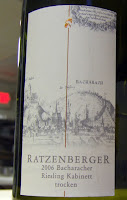
Mittelrhein Bacharacher Riesling Kabinett trocken, Ratzenberger 2006
There seems to be a mini-movement of late to pair fish eggs with something sweet. It may sound odd but it works on the same principle of "sweet and salty" that makes chocolate covered pretzels so good. And, when done right, it works. Here, the sweetness was delivered ever-so-subtly by the essence of maple syrup that permeated the "short stack" of tiny little pancakes. Along with excellent quality smoked trout, this was a standout first course — even if the Vermonter among us was perturbed that it included maple syrup from PA — that paired quite nicely with Ratzenberger's dry Riesling.

Winter Kale Soup, Burgundy Snail Tortellini, Toasted Garlic, Rich Tomato Fondue
with
Touraine "Les Trois Chênes," Domaine Ricard 2008
The snails may have hailed from Burgundy but the combination of hearty greens, garlic and tomato made me think of Sauvignon. So, with no St. Bris in hand, to the Touraine we went. The wine was delicous, tropical at first whiff then quickly morphing toward citrus oil-laced, sappy fruit and an intensely mineral finish; a real head-turner for Carleton and Todd who are primarily red drinkers. The soup was in turn delicious, the kale preparation itself taking center stage, cooked, as Steve put it, in such a way as to retain all of the kale's flavor while subduing its bitter, tough tendencies.

Winter Squash Crème Brulée, Cranberry Influence, Chocolate Dipped Chester County Bacon
with
Coste della Sesia Rosato "Rosa del Rosa," Proprietà Sperino 2007
Reactions to this course were mixed, a couple of the guys listing it among their faves while I wasn't so sure. The squash soufflé was delicious in and of itself, but I wasn't entirely sold on the chocolate covered bacon. I know it's another iteration of the sweet and salty principle but, for me, it can be too much of a good thing. There's no question that it was done well, though.
As for the wine, I've been thinking, since it was first produced a few years back, that Proprietà Sperino's rosato should hold up to a little cellaring. While this was hardly old, at two-years plus of age it was indeed showing very well, still full of the watermelon rind essence of its youth but also having developed a rich core of cured meat and vanilla cream flavors, along with a classically Nebbiolo-driven nose of rose petals. Very vinous, too.

Saffron Marinated Monkfish, Lemon Scented White Beans, Chorizo and Fried Herb Panada
with
Touraine "Le Clos de Vauriou," Domaine Ricard 2008
Yes, it's that wine. Again. Blame it on Chef Sikora, who brought it out and insisted on sharing it with us when he saw we'd brought another wine from Vincent Ricard. It was hardly a natural match with the food (the rosato might have been the way to go) but it's a versatile enough wine that things still worked out just fine. The fish dish was another of my favorite courses of the night, not just for the deliciousness of the monkfish itself but even more so for the interplay between the white and black beans, the chorizo, the fish, the saffron overtones and the way that the dish's seasoning, handled incredibly adeptly, tied everything together.

Confit of Canadian Goose, Cider Glaze, Cheddar Polenta, Smoked Onions, and Goose Juice
with
Chinon "Les Picasses," Catherine et Pierre Breton 2004
Though not the evening's last savory course, this was without doubt the heavy hitter of the evening, full of rich, heady, meaty flavors. The polenta is from Anson Mills, the cheese crisp topping made with Cantalet.
I got a kick out of Brooklynguy's recent potluck post and thought he was dead-on when associating good Chinon with the rich, fatty, salty flavors of confit (duck, in his case). The Bretons' 2004 "Les Picasses" was, for me, the most natural, satisfying pairing of the night, its own richness offset by the naturally vibrant acidity and tongue-cleansing texture of well-structured, well-balanced Chinon. I'd planned to save this, my last bottle, for several more years but the bachelor of honor has been on a C&P Breton groove ever since I turned him on to both versions of "La Dilettante" at Terroir back in the fall and I wanted him to try one of their more intensely structured wines. Hey, why save when you can share?

Venison Tenderloin, Potato-Turnip Purée, Caramelized Brussel Sprouts, Raisin-Red Wine Sauce
with
Alexander Valley Marlstone Vineyard, Clos du Bois 1995
Another killer course. I've probably said it here before, in fact I'm sure I have so I'm not even going to go back and look... Bryan has a gift when it comes to cooking game. The venison was meltingly tender and incredibly flavor intensive, infused with the exotic influence of pâté spices and balanced by the subtle sweetness of the wine reduction sauce. Those brussel sprouts didn't suck, either.
The wine? This one might surprise some of my regular readers. Yes, it was highly polished and not loaded with clear sense of place, but at 15 years, Clos du Bois' Marlstone Vineyard cuvée, a Bordeaux blend, was still fresh and vibrant. Plenty of life left to go, in fact. I don't have much experience with more recent bottlings, so I can't say where the wine has headed since, but this was made back in that turning point era between 1994-97, when California Cabs were just starting the leap into their high alcohol, high extract, not-so-food-friendly era. At 14.2%, this was balanced and played just fine with the deer.

Got Goat? A Goat Cheese Collection with Roasted Chestnut Jam
with
Coteaux du Layon "Cuvée S," Château Soucherie (Pierre-Yves Tijou) 2001
In the last few months, the cheese course at Talula's has moved away from the traditional tri-milk mixture toward a single-milk theme, still with a classic progression from mild to more pungent flavors. Soucherie's "Cuvée S" was still a baby. Very fat and honeyed. Even though delicious with the cheese, it turned out to be a better match with the dessert course.

Organic Champlain Triple from Champlain Valley Creamery
On top of being an all-around great guy and huge beer and wine lover, our friend and fellow diner Carleton Yoder is the owner and head cheese(maker) at Champlain Valley Creamery. Though he started his business with a focus on producing fresh cream cheese, which is still one of his primary products, his triple cream cow's milk cheese has quickly become his best seller over the past couple of years. We brought along a few discs of it for the crew at Talula's to try and Kate Stroh, Talula's resident sous-cheese monger, plated one up for us as a surprise course.

Clementine Chibouste, Lemon Curd, Citrus-Champagne Sauce
and
La Colombe espresso
After such a hearty, wintry meal, it was a smart choice to serve a dessert course that was only lightly sweet, its focus more on tangy, refreshing seasonal flavors. That light hand with the sugar helped it to pair so well, as mentioned above, with the sticky Loire Chenin from Soucherie. The coffee was just a digestive. Decaf for me, as I can't handle caffeine much past noon any more, that is unless I want to be staring at the ceiling at 4:00 AM.... As the espresso cup indicates, Philly-roasted La Colombe is now the coffee of choice at TT.
C'est tout! Thanks, Steve, Carleton and Todd, for providing the impetus for such a great meal. See you again in March, my friends.
Talula's Table102 W. State Street
Kennett Square, PA 19348 [map]
610-444-8255

Previous visits:
Posted by
David McDuff
7
comments
@
Labels: Catherine and Pierre Breton, Clos du Bois, Domaine Ricard, Foreau, Proprietà Sperino, Ratzenberger, Restaurant Report, Soucherie, Talula's Table
Monday, August 10, 2009
Breton and Burgers
On Friday, I experimented a little with condiments, adding mustard and cheese only to find them both unnecessary, even distracting from the purity of the lamb’s flavor. Saturday night I dialed it in…. Slice a ciabatta roll (I didn’t bother to toast it but it certainly couldn’t hurt) and drizzle on some good olive oil, which marries much more harmoniously with the lamb than does mustard or ketchup. On went a single slice of ripe, heirloom tomato. And the finishing touch – a few of the ramps I pickled earlier in the year. They’re damn tasty on their own (if I do say so) but are even better atop burgers, their sweet pungency working exceptionally well with the meaty rusticity of lamb.
A super simple meal, extremely tasty and even better with:
Chinon “Les Picasses,” Catherine et Pierre Breton 2004$25. 12.5% alcohol. Cork. Importer: Louis/Dressner, New York, NY.
No detailed tasting notes for you today. This was showing so well that I just had to sit down, settle in and enjoy. Loaded with layers of black fruit and minerality, richly flavored yet lithe, juicy and graceful all at once. If, as its label suggests, “Les Picasses” is indeed aged in barriques, the wine sure doesn’t show any woodiness – just sheer succulence. And as good as it was solo it was even better when enjoyed along with the lamb burger double header. More than once my wife asked if everything was okay and I had to explain that, yes, everything was fine, those noises she was hearing were just my groans and grunts of pleasure. Good food, great wine and a pairing that beautifully exceeded the sum of its parts.
The academician in me will strive to persevere for another few years before opening my last bottle of this little gem from the Bretons but my inner hedonist will be fighting all the way. If you’re lucky enough to be holding multiple bottles, have at a couple of ‘em; this is in a really great spot right now.
Friday, January 9, 2009
Turducken Considered
Until that day, I’d been a turducken virgin. The idea of the dish – as CajunGrocer describes, “a semi-boneless turkey stuffed with a deboned chicken and deboned duck breast [with] creole pork sausage & cornbread stuffing between each bird” – had always struck me as odd. Why the heck would someone go to all that trouble and who the hell thought it up in the first place? Is it really a Louisiana specialty or just a marketing gimmick? On the rare occasion – maybe once or twice a year – that someone would walk into the wine shop and ask for a suggested pairing for the turducken they were planning to cook, it always made me kind of laugh. Silently, of course. Or maybe it was out loud…. When chortle came to shove, though, I was more than happy to give the turducken a wing.

Before and after roasting.
Given that the turducken ships frozen, the only time or labor intensive part of its preparation is thawing, which took about three days in my refrigerator. As it arrives fully prepared, cooking is as simple as preheating the oven, putting the bird(s) in a roasting pan, tenting it with foil, putting it in the oven and shutting the door. CajunGrocer’s instructions suggest about five hours cooking time. Mine took closer to six but that extra time is a typical side effect, in my experience, of the heavyweight All Clad roasting pan I use. There are actually a couple of sets of cooking directions on the CG site: one that recommends water in the roasting pan combined with occasional basting, another that goes for straight-up dry roasting. I went with the latter, preferring to keep the heat in the oven and the process as rudimentary as possible. You could, of course, get creative with basting methods or pan sauces but I wanted to keep it simple, to see how the turducken would turn out with as little doctoring as possible.
I removed the foil at around the four-hour point to allow the turkey’s skin to crisp and ran periodic temperature checks after another half-hour. When my not-so-insta-read thermometer hit160°F when inserted in the center of the roast (CG’s directions suggest 165, no doubt for litigation’s sake), I removed the turducken from the oven, tented it and allowed it to rest while cooking our side dishes. Not much to it, really.
The end result? In the simplest sense, the turducken turned out quite nicely. Its skin was perfectly golden, the meat tender, flavorful and moist.

Our turducken at two different stages of the carving process.
Slicing and dicing a little more deeply, the best came first. Carving from the neck end of the turkey we quickly hit the duck/chicken mother lode, both smaller birds delivering greater richness and depth of flavor than the white meat of the turkey alone. By the halfway point of the roast, the duck was long gone, leaving a crosshatched pattern of turkey and chicken, still moist and well flavored by the meat’s rub of creole seasonings. As the butt end of the bird approached things turned less favorable, as the chicken went the way of the duck and the stuffing took over. That stuffing, an unattractively brown mixture of cornmeal and seasoned pork, was the weakest point of the turducken, bland and dense, acting more as filler than flavor enhancer.

On the table and leftovers.... We served our turducken with cornbread, roasted yams with coriander-citrus butter and sauteed brussels sprouts with a balsamic glaze. The leftovers, at the butt-end of the roast, illustrate one of my main issues with the construction of the dish: uneven distribution of the creole stuffing.
At about $85, the average price after shipping, CajunGrocer’s turducken might seem like a rather hefty investment for what many might consider a novelty act. Take into account the amount of work – not to mention trial and error – that would go into making one from scratch though, along with the fact that it’s easily enough food to feed twenty people, and you might just consider it an investment worth risking.

Finally, yes, I do recommend wine pairings for turducken when asked. I suppose beers such as Blackened Voodoo or Abita Amber would have been more appropriate to turducken's Louisiana roots. For my own purposes, though, I opted for a couple of Loire Valley Cabernet Francs. Catherine & Pierre Breton's 2005 Bourgueil "Clos Sénéchal" stole the show. It's painfully young but still delicious, brimming with black and blue fruits and a brooding, sauvage aromatic profile. The 2003 St. Nicolas de Bourgueil "Vieilles Vignes" from Joël Taluau, which was pleasantly plump and quite tasty on release, has now shut down and gone into a completely dumb phase. We still managed to drink it... but forget about it for a while if you're holding any.
The roasting pan:
Posted by
David McDuff
14
comments
@
Labels: Bourgueil, Catherine and Pierre Breton, Joel Taluau, St. Nicolas de Bourgueil, Turducken
Wednesday, April 2, 2008
WBW #44: French Cabernet Franc
Today marks the monthly meeting of the meme called Wine Blogging Wednesday, which was originated by Lenn Thompson of LennDevours back in the autumn of 2004. For the theme of this 44th edition, this month’s host, Gary V at Wine Library TV, chose French Cabernet Franc. For many of the participants, I expect this might open the door to new tasting experiences. For me, on the other hand, it’s a no-brainer. Sure, there’s the occasional Bordeaux blend that’s dominated by Cabernet Franc, particularly in the northern crescent of Saint-Emilion. Think of Châteaux Cheval Blanc, Jean-Faure and some of their neighbors, for instance. And for those who go out of their way to find them, there’s the occasional oddball Franc from the hinterlands of the southwest corner of the country. In fact, I could have just taken the lazy way out of today’s assignment by recycling an old post on Irouléguy Rouge. However, when one thinks of French Cabernet Franc, all roads ineluctably lead to the Loire Valley, the undisputed center in France – and the globe for that matter – for the cultivation of Cabernet Franc.
Not only am I a Loire enthusiast, I’m also a Cabernet Franc adulator, a certified Breton-head and a firm believer in the vine’s overall merits. It gives birth to some of the most food capable red wines out there. I drink Chinon, Bourgueil and St. Nicolas de Bourgueil, not to mention various reds from the Anjou-Saumur, on a pretty regular basis. So the challenge for this event was not in finding a wine to review; it was deciding which ones to review. Again, I could have just recycled an old post, maybe the one from a tasting with F.X. Barc of the Chinons of Domaine Charles Joguet. In the end, however, I decided to write two new notes: the first because it ties into another posting I’m working on and the second just because I felt like it.

Chinon “Cuvée Fabrice,” Jacky & Fabrice Gasnier 2003
I’ll be pleasantly surprised if any other participants choose a wine from this estate, as Fabrice Gasnier produces some of the least talked about, most underappreciated wines of Chinon. This is his top red, produced from a specific vineyard of 60 year-old vines, a blend of 95% or more Cabernet Franc with just a peppering of Cabernet Sauvignon. It undergoes primary fermentation in cement vat, followed by Malolactic fermentation and aging for 12-14 months in barriques, 50% new and 50% from wines of one year. As such, it’s also the estate’s only modernist cuvée, new barrels being a relative exception to the traditional rule in Chinon.
I chose the 2003 from among the several vintages in my cellar because it comes from the growing season which immediately preceded my visit to the estate in February 2004 (a report on which will be coming soon). Also, I wanted to check in on the progress of a wine grown in the notoriously hot and dry conditions of 2003. I wasn’t completely happy with or terribly surprised by the results.
Aromas are of ripe red fruit, cocoa and dark baking spices. There’s plenty of red cassis and chocolaty richness in the mouth, and even a decent amount of muscle. But it’s all covered with a squishy layer of baby fat that makes the wine feel unfocused and atypical. Alcoholic warmth, both on the nose and on the finish, doesn’t help. It’s not the burn that comes from overly high alcohol but rather a slightly unbalanced glow, driven by alcohol that’s not fully interwoven with the wine’s physiological structure. I know from my barrel tasting notes that the alcohol is close to a degree higher than the listed 13%. While 14% (13.8, actually) may not sound high by modern international standards, it’s awfully high for Chinon, where the typical degree averages 12.5 to 13. In spite of all this, there’s an element to this cuvée, mainly in its round texture and gushing red fruit, which a lot of people might find easy to like. Though I enjoyed it on release, this is now just not singing. All things considered, a strong sign that 2003 is a vintage to drink up rather than hold. $20 on release. Labeled at 13% alcohol. Natural cork. Imported by Petit Pois, Moorestown, NJ.
Chinon “Beaumont,” Catherine & Pierre Breton 2005
No technical notes for this one. I’ll leave that to someone else, as I expect to see one or the other of Catherine and Pierre Breton’s Bretons (yep, I had to do it) in any number of this month’s WBW submissions. Heck, I’ve already noticed this exact cuvée among Dr. Vino’s notes. The Breton’s, who produce wine in both Chinon and Bourgueil, are among the current crop of natural wine growers who have been attracting a lot of high energy attention of late.
This is classic if young and slightly disjointed Chinon. Electric energy flows through the fruit, letting your palate know it’s alive. There’s lean sinew here; no baby fat. Wild red berries, rhubarb and red cassis ride a frame of crackly acidity and firm yet light-handed tannins. Its sense of disjointedness stems not from any imbalance but rather from a feeling that the wine’s parts have yet to harmonize into a whole, a feeling that’s exacerbated by a slightly plastic flavor that snakes its way through the wine’s center. I need to try this again in three months, maybe six, or even twelve. Why not just make it all of the above. There’s promise here, assuming everything integrates and resolves, for serious mid-term enjoyment. $16. 12.5% alcohol. Nomacorc. Imported by Louis/Dressner Selections, New York, NY.
Posted by
David McDuff
14
comments
@
Labels: Cabernet Franc, Catherine and Pierre Breton, Chinon, Fabrice Gasnier, Wine Blogging Wednesday