Friday, February 12, 2010

Domaine de la Tournelle's Ploussard de Monteiller

Here's a wine I've been wanting to try ever since reading of its vanquishing a small but stellar field in Brooklynguy's roundup of a blind tasting of Arbois Ploussards. I finally did, just the other night. Popped the cork and poured it to go with one of my favorite Poulsard pairings: poultry pot pie (and no, it's not just about the alliteration). Truth is, I didn't love it, at least not right away.

Arbois Ploussard de Monteiller, Domaine de la Tournelle (Evelyne et Pascal Clairet) 2004
$24. 12.5% alcohol. Cork. Importer: Jenny & François Selections, World Wide Wine, New York, NY.
First, a little techno-background info. Monteiller is a lieu-dit vineyard with gray marl soils and southwest exposure, farmed to yields of about 40 hl/ha. The Ploussard is hand-harvested from the Clairets' naturally farmed vines and is completely destemmed before being lightly crushed. The wine ferments on its natural yeasts in open-top vats for 10-20 days depending on vintage character. It's then put in cuves for the malolactic fermentation, followed by aging in old oak foudres for anywhere from 8-18 months, again depending on the traits of the growing season. The finished wine is bottled without filtration and with no added sulfur dioxide (a small amount of sulfites do occur naturally via the wine's fermentation process).

The resulting wine is extraordinarily pale, pale even by Poulsard standards, like an orange-tinged tea of rose petals. It's so pale you can read through it. The burnished, slightly reductive aromas when first opened blew off after about fifteen minutes, letting the wine's more delicate purity emerge. There's at best a whisper of tannin; instead, the naturally uplifting acidity of Arbois Ploussard is all that's really needed to give balance to the wine's ethereal structure. The fruit, too, is very delicate and restrained. Think of wild cherries and baked orange but more of the sense of taste you get from smelling them, not from eating them. Again, think in whispers and you'll get a sense of the wine.

Twenty-four hours later, not surprisingly, the wine showed even subtler intensity. I noticed a lean wood influence, or at least a woodsy flavor, that I hadn't registered a day earlier. There was even a sneaky little suggestion of sweetness near the rear palate, just beofre the wine finished with a cascade of sour minerals. There was something vaguely metallic, too, though I don't believe it was Brett. What I do believe is that this is really puzzling, really provocative wine. It's not the type of wine that scores hedonism points or that screams out for attention, more the type that you overlook at first sip but are then drawn back to, full of mystery, raiser of questions. In the end, I still didn't love it. But I am looking forward to the next bottle.

Elsewhere in the blogosphere:

You'll find a beautiful set of pictures from a day spent at Domaine de la Tournelle at the increasingly photo-centric site of The Wine Digger.

The Wine Digger has gone into hiding and eviscerated his blog since this was originally posted; his photos are no longer publicly available.

Wednesday, February 10, 2010

Teaser Alert: Wine and Chocolate with Éclat

This Friday night, gods of weather and authorities of the road permitting, I'll be teaming up with chocolatier Christopher Curtin to deliver a pre-Valentine's Day double-header wine and chocolate "social" at Curtin's shop, Éclat Chocolate, in West Chester, PA.

Chris and I have been threatening to team up for a little chocolate and wine pairing fun ever since our path's first crossed at a wine tasting event I conducted last year, and I'm jazzed to see our plans finally put into fruition.

Friday's event — two ninety-minute sessions, each for 16 guests, held in the intimate retail space at Éclat — is already sold-out, so today's post is a bit of a tease. Assuming all goes well, though, we'll be repeating and building upon our efforts at additional sessions in the months to come. To be notified of our future events, please drop Chris a line at info at eclatchocolate dot com and ask to be added to the Éclat e-mail list.

I don't want to give away too much of what we have in store for our guests but I can tell you that one of Curtin's newest creations will almost certainly figure into Friday's tastings. In the video below, you'll see Chris demonstrating the production techniques of that new chocolate, a rose-infused white chocolate heart, and catch him improvising his way through power-less and scissor-less moments, all aired live last week on Philadelphia's NBC-10.


Hope to see some of you on Friday.

Éclat Chocolate
24 South High Street
West Chester, PA 19382
610-692-5206

Monday, February 8, 2010

Standing on the Ridge

98 Lytton Springs Vineyard, bottled 12/99
El Niño delayed the 1998 growing season by an entire month; late August brought an unseasonably early rain and some water damage in the clusters. We opened the vines to light and air, and thinned repeatedly over the next forty days as soon as any damaged fruit appeared. Aided by fine weather, we had clean, very ripe grapes at harvest. Intense fruit, a rich structure, and firm tannins characterize this lovely vintage, which will be at its best over the next five to six years. Alas, the severe thinning has resulted in significantly smaller quantities than usual.
— PD [Paul Draper] (11/99)

Now there's 750ml less....

I've always liked Ridge's packaging, from the short silver capsule that lets the winery and vintage info stamped on the cork show through the bottle neck, to the crisp, minimalistic styling of their label's typography and layout. I also like Paul Draper's liner notes, driven by marketing as are all such label talkers but, much more than most, also informative and inclusive of some meaningful information.

There was a time when I also might have said that I've always liked Ridge wines. But as my preferences have changed over the last ten or twelve years, my relationship with Ridge has become one based more on respect than on unabashed admiration. The wines are absolutely well made and expressive — I think it's fair to say they're standard bearers — but they just don't deliver the pleasure they once did, at least not to me.

A side effect of this shift in my tastes is that I still have a decent little cache of Ridge wines, mostly from the mid- to late-90s, resting in my wine fridge. So, when friends from the neighborhood trudged over for a post-blizzard dinner this weekend, bearing gifts of bacon-wrapped filets mignon, I figured it was due time to make a cellar sacrifice.

California Dry Creek Valley "Lytton Springs," Ridge Vineyards 1998
~$25 on release. 14.3% alcohol. Cork.
One of the things I have always respected about Ridge is the ability of their wines to age. Five years beyond the drinking window originally recommended by Ridge proprietor Paul Draper, the 1998 Lytton Springs is still chugging right along, with another five or ten years to go, easy. What's happened over the last ten years in bottle? Well, the wine still does show some of its characteristically raisin-rich Zin notes but on a frame that's grown narrower with age. In a way, that's let a certain elegance show through that, if my memory of long ago consumed bottles is at all accurate, was somewhat less evident earlier on. Now, spicy yet subtle red berry fruit intertwines with cedar and tobacco leaf aromas; a firm yet supple tannic quality and still bright, medium-acidity help the wine achieve its sense of balance. It paired just fine with the richness and smokiness of the beef and bacon, not at all too high in alcohol to work with food.

So what's not to like? For me, and I've said it here before in similar but slightly less kind terms, it's the indelible oak signature born by nearly all of Ridge's red wines. American oak, in particular. In spite of the elegance that's emerged from the good raw materials of the Lytton Springs Vineyard, and in spite of the life that continues in the bottle, there's a wood-driven, cedar-y character that dominates the wine. It doesn't totally obscure the fruit; it just makes it much harder for the fruit's voice and, one could argue, the vineyard's voice, to be heard. It's part and parcel of the Ridge winemaking signature. I just have a harder time swallowing it than I once did.

* * *
Elsewhere in the blogosphere....

Wolfgang Weber recently wrote a piece, which I think deserves your attention, on the apparent prevalence of cork taint in Italian wines. If there's one thing that the Italians, and most European wineries for that matter, could learn from their US counterparts, it's the value of shelling out the dough for high quality corks.

Though I'm sure there's a TCA-tainted bottle out there somewhere, I've never once had a corked wine from Ridge. The high quality of their corks has to play a role in that track record. A trace quantity of tartrate crystals was in evidence on the stopper pulled from the '98 Lytton Springs, but there was nothing to suggest that the cork had been in the bottle for more than ten weeks, much less for ten-plus years.

Also, the frequency with which my wine blogging peers and I seem to find ourselves on similar topics at similar times is a never ending source of amazement. Point in case, I stumbled upon Lyle Fass's recent post about Opus One and, you guessed it, changing tastes regarding oak influence, while taking a break from writing this piece. It's worth a read too, especially for Lyle's take on cowboy boots and suits.

Sunday, February 7, 2010

Franco Ballerini, RIP

Fans and competitors of professional cycling alike mourn the loss of one of cycling's great stars of the last two decades, as Italian Franco Ballerini died today as a result of injuries sustained when the rally-car in which he was acting as race navigator crashed this morning.

Ballerini will be best remembered by riders and fans of his own generation as a key member of the fiercely dominant Mapei-GB team, for which he rode from 1994-98. His impact on riders of the following generation was just important as, after his own retirement from the pro ranks in 2001, Ballerini managed the Italian National Cycling Team from 2002 on, leading the squadra azzura to four World Championship titles as well as to an Olympic gold medal.

Franco's career included several victories and many, many more hard-fought days in the saddle riding in support of his own teammates. Like many, I'll always remember him most clearly for his two firsts and a second in the most infamous of spring classics, Paris-Roubaix: getting nosed out on the line by Gilbert Duclos-Lasalle in 1993 and then going on to win in both 1995 and 1998.


Rest in peace, Franco. Franco Ballerini (December 11, 1964 – February 7, 2010).

Wednesday, February 3, 2010

Exploring Guímaro and Ribeira Sacra

The inhabitants of the tiny village of Sober — all nine of them if the latest census reports are correct — must count themselves as lucky souls. That is assuming that young wine grower Pedro Rodríguez Pérez shares some of his tiny production of Ribeira Sacra with his neighbors.

Sober is located in the Amandi sub-zone of Ribeira Sacra, a D.O. area of modest proportion located in Galicia, not far from the northern border of Portugal in the northwest corner of Spain. Here, the 35-year-old Rodríguez has no choice but to farm his seven hectares of vineyards completely by hand, as those vines are perched on precipitous slopes above the River Sil.

Pedro Rodríguez Pérez overlooks his vines in Ribeira Sacra (photo courtesy of Triage Wines, Guimaro's distributor in the Pacific Northwest).

Pedro works fifteen separate vineyard plots, planted primarily to Mencia, along with small quantities of Caino tinto and other native black grape varieties, plus small parcels of Godello and Treixadura, from which he produces a single white wine. His vines average 40-years in age. There are three reds in his cadre, all of which, along with the one white, are bottled under his label Guímaro (which means "nonconformist").

Aside from Pedro's inclusion in Eric Asimov's excellent New York Times profile of Ribeira Sacra and other random tidbits around the Web, there's surprisingly little information available about the wines of Señor Rodriguez. So, ever in search of knowledge, I contacted Guímaro's importer, Jose Pastor, who shared with me the following details. (I've edited Jose's words for context and style but will still attribute them as a quote, as I would not have had access to such information without his help.) Says Jose,

"As far as I know Pedro makes four diferent cuvées:
  • A barrel fermented white, mainly from Godello, naturally fermented with some batonage, bottled on the early side with no filtration. He makes 2 barrels every year.
  • Then he does a basic red cuvée, fermented/aged in tank and also bottled on the early side, which goes by the name of Guimaro Joven (which means "young"). Since '08, this comes in a Burgundy bottle. (The '07 and some early bottles of the '08 were shipped in a Bordeaux bottle with a blue label, which may have caused some confusion out there; this is the same cuvée.) Starting in 2009, the Joven is going to be raised half in foudre and the other half in tank. Also, a small part of the cuvée will be whole-cluster fermented.
Lastly he produces two old vine cuvées:
  • 'B1P' is made from old vine Mencia grown in Pedro's highest elevation vineyard; this one is fermented in open-top foudres with whole clusters.
  • 'B2M' is also old vine Mencia but from a lower elevation plot. It is 100% de-stemmed, fermented in tank and then raised in used barrels.
Pedro told me that in 2009 both of these cuvées will be whole-cluster fermented as he likes how the B1P is developing. Current releases for the old vine cuvées are '07 and, as far as I know, are only available in California."
Given that only only 25 cases of "B1P" make it into the US, I was lucky to have started out my experiences with Guímaro right at the top of the range while in San Francisco last fall. More recently, I've had the chance to go back to step one.

Ribeira Sacra Summum, Guímaro (Pedro M. Rodríguez Pérez) 2008
$15. 13.5% alcohol. Diam. Importer: Jose Pastor Selections (Vinos & Gourmet), Richmond, CA.

This is the "Joven" bottling referred to by Jose in the technical notes above. The word "Amandi," which appeared on the front label of the old Bordeaux-shaped bottles but now appears only on the bottle's rear label, is a reference to the wine's place of origin. "Summum," in turn, is the highest designation for Ribeira Sacra; red wines thus labeled contain a minimum of 85 per cent preferred red varieties, 60 per cent of which must be Mencía. Summum wines can be labeled varietally (which Guimaro's is, as Mencia, again solely on the rear label) only if the wine contains 85% or more of that variety.

Enough with the regulatory stuff... The wine leads off with a fresh, very lively nose of blueberry, black cherry and wild plum fruit, spiced up with whiffs of bay leaves and tobacco. Very coolly textured, round and smooth in the mouth, with a fine acid/tannin balance and a distinctly mineral finish. It's both firm and taut yet not at all hard. And it cries out for food. I paired it with a pasta dressed with a sauce of crushed tomatoes, a pinch of coarsely chopped garlic and a small tin of anchovies, all of which I sauteed in a little olive oil. I don't think that's an even remotely Galician dish but it was a pretty freakin' delicious combo, nonetheless. Riding solidly into day two, there was still plenty of bright red fruit, a slight leaning-out in the textural department, and the emergence of enticing aromas of cured meat and salami spices.

On the surface, this is juicy, pleasurable, hard-not-to-drink-the-whole-bottle vino, but there's the kind of meaningful substance to it — structure, length and penetrating flavors, a real sense of individuality — that delivers far beyond the overwhelming majority of wines at its $15 price point.

Addendum: Caught up in the rigor of writing, I nearly forgot to add that today's post also provides the answer-in-full to last weekend's episode of Name That Wine.

Monday, February 1, 2010

Winter at Talula's Table

This, the fourth and final installment of "What We Did During the Big Bachelor Party Weekend," takes us almost all the way back to the beginning, back to the lowest key, highest toned night of the three-day fest. The big splash. Dinner for four in the kitchen at Talula's Table.


Four guys (including me behind the lens), representing three time zones and four regions of the country, formed the core group of the weekend's revelers. You may recognize the man of honor, Steve Litvin (at right), from my fall adventures in Northern California. Steve came all the way from Monterey, where he is a postdoctoral researcher at Stanford University's Hopkins Marine Station, to celebrate his impending nuptials. Joining us were his old college water polo pals Carleton Yoder (at left), who's now based in Vermont, and Todd Dolan, who flew in the day before from Denver, Colorado. Carleton and Steve had both eaten with me at Django when it was under the purview of Talula's owners, Aimee Olexy and Bryan Sikora, but Todd was a virgin diner.


While the rest of the weekend may have revolved primarily around some of Philly's best spots for beer, tonight it was all about good food and wine. Though late in January 2010, the Winter 2009 menu at Talula's was (and still is, as of this writing) in full swing.


Hors d'oeuvre
with
Vouvray Brut, Foreau (Clos Naudin) NV
Since my last visit, the kitchen has changed things up just a bit, sending out a series of small bites to the diners lingering in the market area rather than plating a single amuse bouche at the dinner table. I'd left my camera back in the kitchen, so you'll have to do without pics, or any real details for that matter, of the three nibbles we were served. Suffice it to say they were as tasty, artful and soulful as is most everything done at Talula's. With them, we toasted a fine start to the evening with Foreau's Vouvray Brut, which, though not on the same plane as Huet's vintage Vouvray Pétillant, was still pretty darn good.

Short Stack, House-Smoked Smoked Trout, Shaved Pickled Carrots, and Pennsylvania Maple Syrup
with
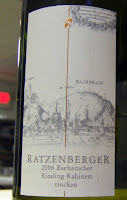
Mittelrhein Bacharacher Riesling Kabinett trocken, Ratzenberger 2006
There seems to be a mini-movement of late to pair fish eggs with something sweet. It may sound odd but it works on the same principle of "sweet and salty" that makes chocolate covered pretzels so good. And, when done right, it works. Here, the sweetness was delivered ever-so-subtly by the essence of maple syrup that permeated the "short stack" of tiny little pancakes. Along with excellent quality smoked trout, this was a standout first course — even if the Vermonter among us was perturbed that it included maple syrup from PA — that paired quite nicely with Ratzenberger's dry Riesling.


Winter Kale Soup, Burgundy Snail Tortellini, Toasted Garlic, Rich Tomato Fondue
with
Touraine "Les Trois Chênes," Domaine Ricard 2008
The snails may have hailed from Burgundy but the combination of hearty greens, garlic and tomato made me think of Sauvignon. So, with no St. Bris in hand, to the Touraine we went. The wine was delicous, tropical at first whiff then quickly morphing toward citrus oil-laced, sappy fruit and an intensely mineral finish; a real head-turner for Carleton and Todd who are primarily red drinkers. The soup was in turn delicious, the kale preparation itself taking center stage, cooked, as Steve put it, in such a way as to retain all of the kale's flavor while subduing its bitter, tough tendencies.


Winter Squash Crème Brulée, Cranberry Influence, Chocolate Dipped Chester County Bacon
with
Coste della Sesia Rosato "Rosa del Rosa," Proprietà Sperino 2007
Reactions to this course were mixed, a couple of the guys listing it among their faves while I wasn't so sure. The squash soufflé was delicious in and of itself, but I wasn't entirely sold on the chocolate covered bacon. I know it's another iteration of the sweet and salty principle but, for me, it can be too much of a good thing. There's no question that it was done well, though.

As for the wine, I've been thinking, since it was first produced a few years back, that Proprietà Sperino's rosato should hold up to a little cellaring. While this was hardly old, at two-years plus of age it was indeed showing very well, still full of the watermelon rind essence of its youth but also having developed a rich core of cured meat and vanilla cream flavors, along with a classically Nebbiolo-driven nose of rose petals. Very vinous, too.


Saffron Marinated Monkfish, Lemon Scented White Beans, Chorizo and Fried Herb Panada
with
Touraine "Le Clos de Vauriou," Domaine Ricard 2008
Yes, it's that wine. Again. Blame it on Chef Sikora, who brought it out and insisted on sharing it with us when he saw we'd brought another wine from Vincent Ricard. It was hardly a natural match with the food (the rosato might have been the way to go) but it's a versatile enough wine that things still worked out just fine. The fish dish was another of my favorite courses of the night, not just for the deliciousness of the monkfish itself but even more so for the interplay between the white and black beans, the chorizo, the fish, the saffron overtones and the way that the dish's seasoning, handled incredibly adeptly, tied everything together.


Confit of Canadian Goose, Cider Glaze, Cheddar Polenta, Smoked Onions, and Goose Juice
with
Chinon "Les Picasses," Catherine et Pierre Breton 2004
Though not the evening's last savory course, this was without doubt the heavy hitter of the evening, full of rich, heady, meaty flavors. The polenta is from Anson Mills, the cheese crisp topping made with Cantalet.

I got a kick out of Brooklynguy's recent potluck post and thought he was dead-on when associating good Chinon with the rich, fatty, salty flavors of confit (duck, in his case). The Bretons' 2004 "Les Picasses" was, for me, the most natural, satisfying pairing of the night, its own richness offset by the naturally vibrant acidity and tongue-cleansing texture of well-structured, well-balanced Chinon. I'd planned to save this, my last bottle, for several more years but the bachelor of honor has been on a C&P Breton groove ever since I turned him on to both versions of "La Dilettante" at Terroir back in the fall and I wanted him to try one of their more intensely structured wines. Hey, why save when you can share?


Venison Tenderloin, Potato-Turnip Purée, Caramelized Brussel Sprouts, Raisin-Red Wine Sauce
with
Alexander Valley Marlstone Vineyard, Clos du Bois 1995
Another killer course. I've probably said it here before, in fact I'm sure I have so I'm not even going to go back and look... Bryan has a gift when it comes to cooking game. The venison was meltingly tender and incredibly flavor intensive, infused with the exotic influence of pâté spices and balanced by the subtle sweetness of the wine reduction sauce. Those brussel sprouts didn't suck, either.

The wine? This one might surprise some of my regular readers. Yes, it was highly polished and not loaded with clear sense of place, but at 15 years, Clos du Bois' Marlstone Vineyard cuvée, a Bordeaux blend, was still fresh and vibrant. Plenty of life left to go, in fact. I don't have much experience with more recent bottlings, so I can't say where the wine has headed since, but this was made back in that turning point era between 1994-97, when California Cabs were just starting the leap into their high alcohol, high extract, not-so-food-friendly era. At 14.2%, this was balanced and played just fine with the deer.


Got Goat? A Goat Cheese Collection with Roasted Chestnut Jam
with
Coteaux du Layon "Cuvée S," Château Soucherie (Pierre-Yves Tijou) 2001
In the last few months, the cheese course at Talula's has moved away from the traditional tri-milk mixture toward a single-milk theme, still with a classic progression from mild to more pungent flavors. Soucherie's "Cuvée S" was still a baby. Very fat and honeyed. Even though delicious with the cheese, it turned out to be a better match with the dessert course.


Organic Champlain Triple from Champlain Valley Creamery
On top of being an all-around great guy and huge beer and wine lover, our friend and fellow diner Carleton Yoder is the owner and head cheese(maker) at Champlain Valley Creamery. Though he started his business with a focus on producing fresh cream cheese, which is still one of his primary products, his triple cream cow's milk cheese has quickly become his best seller over the past couple of years. We brought along a few discs of it for the crew at Talula's to try and Kate Stroh, Talula's resident sous-cheese monger, plated one up for us as a surprise course.


Clementine Chibouste, Lemon Curd, Citrus-Champagne Sauce
and
La Colombe espresso
After such a hearty, wintry meal, it was a smart choice to serve a dessert course that was only lightly sweet, its focus more on tangy, refreshing seasonal flavors. That light hand with the sugar helped it to pair so well, as mentioned above, with the sticky Loire Chenin from Soucherie. The coffee was just a digestive. Decaf for me, as I can't handle caffeine much past noon any more, that is unless I want to be staring at the ceiling at 4:00 AM.... As the espresso cup indicates, Philly-roasted La Colombe is now the coffee of choice at TT.

C'est tout! Thanks, Steve, Carleton and Todd, for providing the impetus for such a great meal. See you again in March, my friends.


Talula's Table
102 W. State Street
Kennett Square, PA 19348 [map]
610-444-8255
Talula's Table on Urbanspoon

Previous visits:

Friday, January 29, 2010

Two Kinds of Sour: Cuvée De Ranke

Much like my friend Joe at Old World Old School, who included drinking more beer and paying more attention to it among his resolutions for the New Year, I've been meaning to write about beer here at MFWT at least a little more often for some time now. It's the paying attention part that really clicked with me, as beer already slots in pretty regularly to my eating and drinking routines. There was a major focus on beer during the course of my posse's pub crawling activities last weekend. One of our stops, in particular, provided plenty to contemplate, though we of course never lost sight of pursuing the pleasure principle.

In a city increasingly populated with great beer-centric bars and restaurants (if only wine would catch up...), we still couldn't pass up a visit to that holy grail of all brews Belgian: Monk's Cafe. Having set the stage with a thirst quenching bottle of Cantillon Gueuze and a follow-up with Lost Abbey's Red Barn Ale, our server, Jill, didn't hesitate one second when I asked her what I should try next. "Cuvée De Ranke." Cantillon, I do love you; and Lost Abbey, I like you well enough, though I'm still getting to know you. But Jill nailed it, for on this day it was the Cuvée De Ranke that most captured my attention and most delivered on the principles of pleasure. With an ever so slightly sweet, more so sour center akin to better known Flemish Sour Ales, followed up by a funky, tart sneak-attack à la spontaneously fermented Gueuze, and finished off with a refreshing hint of hoppy bitterness, the De Ranke was a very complete, primordially satisfying brew.

Ex post-facto research reveals that my gut reactions to the beer were more accurate than I could have expected. "Cuvée," it turns out, actually is a blend of two styles of Belgian sour beer. About 70% of the blend is a red/brown sour ale brewed by De Ranke in the tradition of the Roeselare/Kortrijk/Oudenaarde regions, top-fermented using Rodenbach (perhaps the most famous Flemish sour producer) yeast strains. The other 30% of the blend is actually lambic, which De Ranke purchases from Brouwerij Girardin. After blending, the beer is bottle-matured before release. According to De Ranke, it is capable of mid-term aging. It didn't stand much of a chance of that on our table, though.

De Ranke is brought into the US by one of my favorite beer importers, Shelton Brothers; you'll find more information about their beers at the Sheltons' site as well as at De Ranke's homepage.

Wednesday, January 27, 2010

Name That Wine

Yessiree folks, it's time for another episode of "Name That Wine." Anyone care to hazard a guess as to what I enjoyed with dinner over the last couple of nights?

And by the way, did I already mention that the DIAM is my preferred alternative in-neck closure? Why yes, yes I did.

A Burger and a Beer at Swift Half Pub

It's really only by way of happy accident that our core BP-weekend group ended up at Swift Half Pub for lunch and to commence our adventures in pub crawling. At the request of my three Philly loving comrades, we'd actually headed out to Northern Liberties with lunch at Standard Tap in mind; problem was, I'd forgotten that Standard does lunch only on Saturday and Sunday.... So, a quick walk up 2nd Street it was. We momentarily contemplated Cantina Dos Segundos, but the Denverite amongst our group shot down that idea as he gets his regular fill of Mexican food back home on the Front Range. Continuing on then, we soon found ourselves at the Piazza at Schmidt's.

The Piazza itself is actually worth a visit if you find yourself in the neighborhood, both for its public courtyard design and its conceptual approach to community-focused living. I'm not sure I like the idea of having my living room or bedroom overlook a twenty-foot wide television screen and a courtyard designed for late night communal reveling. But I can see the appeal for those that are more socially minded than I. And I can certainly see the appeal of having a decent place or two to eat and drink within rolling distance of your front door; of the several options at the Piazza, we pointed ourselves straight for the Swift Half.

I'd expected Swift Half to have a hipster dive bar feel along the lines of Center City's Good Dog Bar, as both pubs are under the same ownership. Instead, we found a wide open space with large booths, airy lighting, ample seating and elbow room, finished brick walls, ESPN on the TV.... Kind of MOR one could say, definitely family friendly and, actually, very much in keeping with the open, contemporary, something-for-everyone design of the Piazza at Schmidt's.

Given that I'd worked up a ferocious hunger with that long hike up 2nd Street and that I hadn't filed A Burger and A Beer report since my trip to California back in the fall, it didn't take me long to figure out what to order.

Swift Half's "Traditional Burger" is aptly named as, unlike at Good Dog, where its counterpart is stuffed with molten blue cheese and topped with a mass of caramelized onions, here there are no bells and whistles. Just a half-pound, hand-formed patty of tender sirloin, a leaf of lettuce and a slice of tomato, all sandwiched between a just-barely-substantial-enough-to-hold-it-all-together brioche bun. I opted for a slice of Keen's aged cheddar, worth the $1.50 up-charge for the sharp, nutty, salty goodness it added to the burger, which I might add was copiously juicy and cooked just to the bloody side of medium-rare. Just how I like it. The shoestring fries were satisfying enough but, really, it's the burger that's worth the trip. That and the admirable tap list. A pint of Bell's Amber Ale, which seems to be making a resurgence around town at the moment, was just the thing with which to wash it all down.


Swift Half Pub
1001 North 2nd Street
Philadelphia, PA 19123
(215) 923-1600
Swift Half on Urbanspoon

Tuesday, January 26, 2010

DiNic's Roast Pork

Things have been quiet around here the last few days but that's only because I've been busy eating and drinking my way around town with a group of friends who'd gathered in Philly for an extended bachelor's party weekend. Not to worry, there's no extended blow-by-blow on the horizon but at least a few of the details are ready for prime time play.

* * *
A must stop on my short list of places to take friends visiting from out of town, the Reading Terminal Market has been a Philadelphia institution since it first opened its doors in 1893, One of the country's oldest public markets, there really is something there for everyone: excellent butchers and produce purveyors, cookbooks and kitchen supplies, one of the city's best cheese mongers, crack cookies.... There's also a fabulous array of what are essentially indoor street food vendors from which to choose, making the RTM a great spot to go for lunch when everyone in your crew wants something different.

Even with all the great choices, there's one that always seems to call my name: Tommy DiNic's Roast Pork and Beef. DiNic's for short. The rest is a given.

Visiting the RTM for the first time at mid-day on a Saturday is akin to baptism by fire. You get to see the market in full swing, experience the energy and bustle of peak traffic. But if you're claustrophobic or crowd averse, it can be a bit overwhelming. Suffice it to say that every aisle is a constant traffic jam and every seat is snapped up within seconds of being vacated. You'll get only a slight sense of it from the above picture of DiNic's, where the line actually wrapped around all three sides of their "end of block" space at the market's center before doubling back to the order and pick-up area. We were lucky on this day, as four guys handed over their seats at the counter just as we had made it to that point in the line.


The Philly cheesesteak might steal all the thunder when it comes to our fine town's sandwich traditions but I'll go for roast pork four times out of five. And I think there's little question that DiNic's is one of its foremost practitioners.

DiNic's offers hand-carved roast beef, brisket, pulled pork and grilled sausages, all of which are quite admirable. Just as DiNic's always calls my name, though, it's only one of their sandwiches that does the same: their roast pork. It's one of those things that is so good I just have to order it every time, no matter what else is on tap. My preferred version is exactly what you see above: roast pork with provolone and greens. On any given day, the greens option may include broccoli rabe and/or spinach. While both are excellent, I favor the spinach, which adds to the overall flavor of the sandwich without dominating the succulence of the pork. The provolone is very sharp, accent on very, so much so that it actually adds a piquant aspect to the experience. The pork, though, flavorful and tender, awash in its own pan juices, along with the soft roll that willingly soaks up all those delicious drippings, is what really makes it special.

I'm not sure there's a better post-pub-crawl recovery meal or, for that matter, a finer pre-pub-crawl prep. On this weekend, it served more than admirably in both capacities.


Tommy DiNic's Roast Pork and Beef
1136 Arch Street
(in the Reading Terminal Market)
Philadelphia, PA 19107
(215) 923-6175
Tommy DiNic's Roast Pork and Beef on Urbanspoon
Blog Widget by LinkWithin