
Showing posts with label Riesling. Show all posts

Sunday, January 9, 2011

A Slate of Decay

There's an oft expressed, somewhat romantic notion that wine, once in the bottle, takes on a life of its own, riding a curve not unlike that of most other life forms from infancy to youth, from young-adulthood through to maturity, old age, and eventual expiration.  I'm a romantic myself, in many senses of the term, and as such I'm not inclined to disagree with the idea that wine is, or at least should seem to be if it's any good, alive.  There's certainly a transformative process innate to wine—from grapes on the vine, through fermentation and aging, to a beverage, an end point more different from than similar to the starting point—that supports the notion of life in the bottle.

Just as strong an argument can be made, though, that grapes, once plucked from their vines, are dead, just like flowers, stems clipped for display in a vase.  Such an argument might continue that making those grapes into wine is a way of trying to preserve the life that once was, of slowing—to a certain extent even controlling—the decay that inevitably ensues.

Semi-relevant interlude (right down to the slate) courtesy of Good Grape.
Perhaps a more holistic way of looking at it would be to picture the evolution of wine on the classic (and admittedly over generalizing) bell curve.  In such an evolution, wine could be said to take its start as a rebirth of the fruit on the vine.  Once fermented, vinified and bottled, its life forces ride the surge toward the crest of the wave.  Decay eventually ensues, leading down the slippery slope toward the inescapable flat line.

The problem with that scenario is that it creates the idea of a perfect moment. How do you know when a wine is ready to drink, when it's at its peak?  Really, one never does.  But the expectation of capturing that moment, of patiently chasing it, holding one's breath in anticipation of it, can lead to a kind of fear or exaggerated expectancy that all too often makes wine exploration more an obsessive venture than an enjoyable one.

The trick to truly enjoying wine, getting the most out of it, is to drink it.  Stop obsessing over it.  You're in the mood to check out that lone bottle of '05 Grand Cru Burgundy you bought, even though you think it might not be "ready"?  Just do it.  A friend came over and you'd really like to pop the cork on your last bottle of  '89 Bordeaux from Château X, even though you've been saving it for a "special" occasion? Pop that cork.  Keep imagining the scenarios for not opening a bottle—from infanticide, to price vs. situation concerns, to the ideal day on the biodynamic calendar—and just open that bottle.

This is all a strong argument for buying multiple bottles of any given wine.  Drink some now, save some for later.  Use your memory or compare notes to learn about how the wine evolves over time.  Of course it helps if the wine in question is only $12.50 per/bottle (see below)....  There are some well-respected wine writers out there who counsel others not to buy wines that they can't afford to buy by the case, or at least in quantities of three or four.  I don't always follow that advice, as it would prevent me from experiencing too many wines that I really want to try.  But I still stand by that advice, particularly for those who are looking to build and sustain cellars that will actually reward their drinking patterns.  Here's a case in point:

Saar Kanzemer Sonnenberg Riesling Kabinett trocken, Johann Peter Reinert 2001
$12.50 on release.  10% alcohol.  Cork.  Importer: Petit Pois, Moorestown, NJ.
It could be argued that I drank more than my fair share of Johann Peter Reinert's '01 Kabinett trocken when it was first released.  Why not?  At $12.50 a bottle, it was a solid value and a clear reminder that Riesling is not only incredibly versatile at the table but also can indeed be bone, bone dry.  I drank another bottle or two midway through the gap between '02/'03 and now, then semi-intentionally left one alone for later investigation.

Without the residual sugar of a fruity-style Kabinett or the intensity of physical extract of a Spatlese or Auslese trocken, a Riesling Kabinett trocken, particularly from a marginal viticultural area like the Saar, relies primarily on its acidity, along with its harmony and balance (without which the equation crumbles) for preservation. Reinert, who specializes more in feinherb and fruchtig style Rieslings, generally produces lower-pradikat trocken Rieslings only in vintages when he feels the balance is right.

Even with that fine original balance, I suspected that nine years from the vintage might be pushing things a bit—again, I'd saved this one half intentionally, to learn from its progress, and half accidentally, passing over it many a time in favor of something else that seemed right in the moment—and I was right, in a way at least.  The wine has clearly entered a state of decay.  Gone was its pale color of youth, replaced by a lightly burnished gold in the glass.  Gone too was the nerve of youth, its acidity now completely relaxed, almost slack. What trace of fruitiness remained was, coincidentally, most clearly reminiscent of another, much quicker path to decay, that of a clementine left a little too long on the counter, still edible but not as bright and juicy as when at its peak of ripeness.

While the pleasure in drinking may have changed, it hadn't disappeared.  Perhaps that's partially me, as I like to experiment and am very open to seeing what happens to a wine as it takes on air over the course of days in an open bottle, or develops over the course of years in the cellar.  It's also certainly part of the magic of good German Riesling.  There are few other wines so capable of clearly expressing their origins.  If you've drunk young Rieslings and doubted that conclusion, try leaving a few good ones longer than you'd normally think sensible.  In this case, in spite of the decay in the fruit and structural departments, there was a clear sense of the wine's origins, of slate, of oily, diesel-like characteristics (some call it truffle-y).  It was as if the wine was fighting the bell curve and instead going full circle, returning to the earth from which it was first born—like it or not, a beautiful thing.

Sunday, November 21, 2010

More Deliciousness from Florian and Peter Lauer

Here's a not-so-little something I've been wanting to try ever since first drinking its "junior" brother last winter.

Just as the lead-in sentence above is a riff on the opening line of last year's post on Weingut Peter Lauer's Riesling "Senior" Fass 6, I could almost get away with copying and pasting in the note from 6 for its big brother, Florian and Peter Lauer's Riesling "Unterstenbersch" Fass 12. The two wines share more in common than they do in the way of difference.  That's not to say there aren't differences, though, significant ones at that.  Besides, you knew I wouldn't take such an easy way out, no?

Saar Ayler Kupp Riesling "Unterstenbersch" Faß 12, Weingut Peter Lauer 2008
$36. 11.5% alcohol. Cork. Importer: Mosel Wine Merchant, via USA Wine Imports, New York, NY.
Florian Lauer's '08 "Unterstenbersch" brims with pungent aromas of slate and apricot kernel, backed up by accents of white asparagus and yellow apple skins.  The overall aromatic sense of the wine suggests richness and at least a little residual sugar, both of which are confirmed as the wine makes its first impressions on the front palate. From there on, though, the wine's fairly muscular acidity and minerality drive that almost opulent opening on through an unctuous center before ending with a quite dry-seeming finish.  To put it into quantifiable qualitatswein terms, it feels to me like a Spätlese feinherb up front, closer to a Spätlese trocken on the finish.

If he could, that's exactly how I think Florian would choose to label his Unterstenbersch bottling; he categorizes it on the winery's website as "trocken bis feinherb" (dry to medium-dry, roughly translated).  However, the German wine authorities tend to frown on such things, so the Lauers omit any dryness designation from their label and simply let the wine speak for itself.

There's a pungency to the wine, as mentioned earlier, that to me is classic to the best wines from the Saar, a saturated mineral character, redolent of the slate from which it stems, with a subtly sour twinge. Drinking the wine makes me want to work a harvest in Kupp, just so I can taste the fruit of the vines in situ and get an even truer sense of the wine's place.

Discipline alone allowed me to save a couple of glasses for a second day, when the wine took on a more relaxed stance, its round, creamy core coming more to the fore.  What it may have lost slightly in nerve , it more than made up for in the aroma department.  Buttercups, golden raisins, golden pear, golden apples... it seems the color choice for the Fass 12 label is quite apropos — even if it is meant to signify "Unterstenbersch" as one of the Lauers' alte reben (old vine), top cru bottlings, rather than to symbolize its flavor palette.

Buried beneath all that mineral depth and fruit intensity was a subtle yet telltale whiff of sponti character, the aromatic signature that confirms that Florian ferments his wines on their native yeasts.  It's very inconspicuous, though, noticeable, if at all, only as an added nuance, not as a primary signature.  And lying on top if it all, equally quiet in demeanor, was just the slightest whiff of sulfur.  Far from enough to be off-putting, I expect it should pass even further from notice with more time in the bottle.

As long as I'm dabbling in technical info here, it bears pointing out that Florian has a relatively light hand with sulfur, especially when compared to more typical levels used for off-dry wines in Germany.  Dan Melia, the US-based half of the Mosel Wine Merchant team, tells me that Lauer sulfurs only once, a few weeks prior to bottling, adding about 45 ppm of SO2, in the case of Unterstenbersch, to help ensure stability on the bottling line and through the rigors of shipping and storage.

And as long as I'm dabbling in over-the-top tasting notes, I'll add that as the wine opened even further, as that last glass took on air, I picked up a delicate spiciness together with a marmalade-like flavor that made me wonder if there might not have been a small percentage of botrytis influenced fruit in the vats.

Lest you think all this detail somehow sucked the joy out of the experience of drinking the wine, let me assure you that nothing could be further from the truth.  The wine showed all of these things to me, compelled me to sniff, taste and feel them.  As murky or convoluted as my notes may seem, the wine itself was sheer transparency, totally clear in its expression.

Where it differs from "Senior" most is in the scope of that expression.  Where "Senior" was forward, Unterstenbersch was more reserved.  Where the former was more immediately generous, the latter proved just as rewarding and will likely pay greater dividends further down the road.  I'm sure that the 60 year-old vines in the Unterstenbersch parcel play a role in the wine's stature, but then "Senior" includes fruit from even older vines.  Perhaps the aging regime for Unterstenbersch — 100% in old oak fuder as opposed to the mixture of oak and tank employed for Senior — lends it some of its greater impenetrability and inner density.  Most importantly, though, the wine reflects its site.  Unterstenbersch, as Lars Carlberg tells us on the Mosel Wine Merchant blog, is local dialect for unter dem Berg (“at the foot of the hill”), and an old, unofficial name for the plot at the base of the Ayler Kupp from which this wine is produced.  The Lauers consider it a grand cru site and, to me at least, that stature of character speaks through their wine.

Thursday, September 9, 2010

Rocking 2009s from C. von Schubert

While in New York for a couple of days last week, I lucked upon the chance to taste a whole slew of Mosel-Saar-Ruwer Rieslings, mostly from 2009 but with a few back vintage wines thrown into the mix as well. The real standouts, though, were saved for last — a stunning lineup of 2009s from the C. von Schubert estate, aka Maximin Grünhaus. From their basic QbA right up through the Eisweine, they offer tremendous focus, clarity and consistency.

Were I a bigger fan of photo editing, I would have picked this apart into individual shots for your perusing pleasure. Instead, here's a much larger than usual image (click on photo to enlarge). The wines run from right to left in terms of the tasting order described below.

Here are a few choice words about each. Call 'em tasting notes if you must but, really, they're just my immediate, gut reactions.

  • Maximin Grünhauser Herrenberg QbA "Superior," C. von Schubert 2009
    Simple, but in a good way. Very stony and quite pleasing, redolent of grapefruit oil. Not sure of the going price, but if it's still under $20 it's a solid value.

  • Maximin Grünhauser Herrenberg Kabinett, C. von Schubert 2009
    The same dark minerality as displayted in the QbA — blue slate came to mind, although Herrenberg's terroir is based more on red slate — but with greater filigree and defined grace.

  • Maximin Grünhauser Abtsberg Kabinett, C. von Schubert 2009
    Lighter yet simultaneously funkier and deeper than the Herrenberg Kabinett.

  • Maximin Grünhauser Herrenberg Spätlese, C. von Schubert 2009
    Highly focused and excruciatingly young. In other words, very promising.

  • Maximin Grünhauser Abtsberg Spätlese, C. von Schubert 2009
    Open and more outwardly delicious than the MGHS. Very good already.

  • Maximin Grünhauser Herrenberg Auslese, C. von Schubert 2009
    It was becoming clear at this point that the steps between Pradikat levels at this estate are really well defined. Not at all drastic but well expressed and measurable, one could even say classic in '09. Darkly mineral again, with a mouthful of apricot flesh and great acid structure.

  • Maximin Grünhauser Abtsberg Auslese, C. von Schubert 2009
    Rounder and softer than its counterpart from Herrenberg. Very pretty.

  • Maximin Grünhauser Abtsberg Auslese "149," C. von Schubert 2009
    Beautifully high-toned aromatics at play here; richer in RS than the "normal" Abtsberg Auslese but totally balanced. Big, pure acid profile.

  • Maximin Grünhauser Brudergerg "Jungfernwein" Auslese, C. von Schubert 2009
    This started off with a super dense, mineral-laden nose, leading to a broadly muscular palate. Excellent length. If this is what's coming from the first vintage produced from new vines in Brudergerb ("Jungfernwein" translates literally to "virgin wine," or the first vintage produced from newly planted vines) then watch out in the years to come.

  • Maximin Grünhauser Herrenberg Eiswein, C. von Schubert 2009
    Oh my.... Spice attack. Orange confit. Mint. Racy. Stellar eiswein, really finely balanced at 7%. A wine for the ages.

  • Maximin Grünhauser Herrenberg Eiswein "82," C. von Schubert 2009
    For those who like it opulent. Much more intense, even syrupy, relative to the previous Eiswein. Darker color and lower alcohol (6%) to match. Marmalade, menthol, honey-lemon drops.

For serious fans of German Riesling — and you really all should be — these are very much worth seeking out and socking away.

Saturday, July 3, 2010

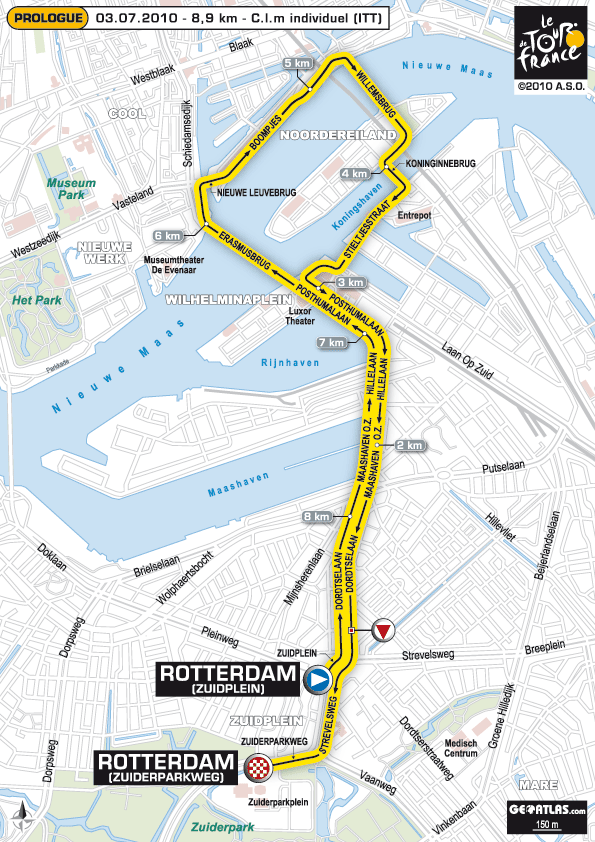
TDF 2010 Prologue: Rotterdam

It's 9:00 PM here on the East Coast. It's tomorrow in France. I'm just now sitting down to watch the prime time coverage of today's Tour de France prologue. Don't tell me who won, please. I still don't know. For years now, I've struggled not to learn the results until I've had a chance to actually watch the race. Such is my situation at the moment.

So, for tonight you'll just get a teaser of a post. It's actually rather fitting, as the prologue essentially serves as the amuse bouche of the Tour, the appetizer before the twenty course meal to follow.


This year's course, through inner-city Rotterdam (click on the map above for an enlarged view of the course), is long by prologue standards at just under 9km. It's rare that the prologue has proved to be a meaningful stage in the overall picture but it's still an incredibly prestigious stage. It's a chance for the fast men, the bike handlers, the powerhouses and the anaerobic performers to stencil their names into the list of stage winners. More importantly, it's a chance, in just a few minutes, to stake an early claim to the leader's yellow jersey. The maillot jaune. The symbol, almost universally recognized now, of Tour leadership.

I don't know the results yet, but I have watched enough to know that the conditions for a fast, technical stage like this are far from ideal. Rain. Inner city streets. Oil. Painted stripes and sharp corners. A recipe for road rash and disappointing finishing times. All of that said, my call for the stage still goes out to Fabian Cancellara, one of the true strong men of the professional peloton who's made a specialty of stages like this over the last several years. Time has already told, but I will see over the course of the next hour or so....

In the coming days, I hope to provide content that covers both the Tour and the wine and food culture of the areas through which it passes. For today, not so much. Remember, this is just a teaser stage. I could tell you that Rotterdam is one of the ten largest cities in Europe. But I've never been there....

So I'd rather tell you that I celebrated the opening of the race with friends over dinner tonight at an excellent little Japanese restaurant, Masamoto, in the strip mall suburbs of the Brandywine Valley. A pair of 2007's – Keller's Westhofener Kirchspiel Riesling Spätlese "R" and François Chidaine's Montlouis "Les Tuffeaux" – provided most excellent pairing experiences.

And I'll tell you that in the days to come there will be much, much more action. So, thanks as always for reading, for watching, and for not telling me who won.

Wednesday, December 23, 2009

Peter Lauer's Riesling "Senior" Fass 6

Here's a little something I've been wanting to try ever since first reading about it at the Mosel Wine Merchant blog. MWM principal Lars Carlberg's writeup goes well beyond describing the wine in question; it also details the history of the pertinent vineyard, maps out its various parcels and even gets into the etymology of the names given to each part of the site. If this is salesmanship, it's salesmanship at its best, and a textbook example of what — along with the regularly featured, stunning photography by Lars' friend, Tobias Hannemann — makes the MWM blog one of my required reads. It's the kind of post that really gets my mouth watering.

I had only to wait for the wine to enter the US market, then for a bottle to make its way into my shopping cart and, from there, eventually to find its way onto my own table....


Saar Ayler Kupp Riesling "Senior" Faß 6, Weingut Peter Lauer 2008
$26. 11.5% alcohol. Cork. Importer: Mosel Wine Merchant, via USA Wine Imports, New York, NY.
Showing gorgeous clarity in the glass, "Senior" delivers a deeply penetrating nose of minerals, green aples and gooseberry. Those aromas actually set up much steelier expectations relative to what first meets the palate, as there's some serious richness to the wine's mouthfeel. Behind that weight, though, is a blade of acidity that drives waves of lemon-lime fruit across the tongue, leading to a long, sweet-and-sour lemon drop finish.

As Lars mentioned in his post, "Senior" is "dry-tasting" for a wine that, with 13 grams of residual sugar, is technically halbtrocken. Yet to my palate, it's not quite "trocken-tasting," either. Though Florian Lauer designates the wine as trocken (I wonder if it's labeled that way on the German market), here in the US there is no dryness designation at all, save what can be guessed at via the wine's stated alcohol level. In the end, classic Saar delicacy and acid/sweetness balance wins out, but there's no mistaking the fact that Lauer's old vines (80-90 years) have delivered intense physiological extract.

A day later, the wine's aromas had shifted more into the dark end of the slate and mineral spectrum, also moving away from citrus and toward pit fruit scents of canned peach and fresh apricot. Showing less zingy, more muscular acidity, the wine was indeed more clearly dry tasting, day one's confectioner's dusting having disappeared/integrated into the wine's core.

I'd love to drink this with pan-seared scallops in a beurre blanc sauce. Or perhaps pair it, as I did with the similarly balanced bottle of Emrich-Schönleber's "Lenz" that I wrote up not long ago, with a simple dinner of pork chops and baked potatoes. On this occasion, I enjoyed it with two entirely different dishes: cheese and onion pierogies with peas and sautéed onions on day one, and green chile and cheese tamales on day two. Just for fun, anyone care to guess which pairing worked better... and hazard an explanation as to why?

Monday, December 7, 2009

The New York Finger Lakes Riesling Shootout

So, there's this guy Lenn who, for the last couple of months, has been encouraging my friend Joe Roberts (aka, 1 Wine Dude) and I to get together and taste a bunch of Rieslings from the Finger Lakes. It's all part of a program called Taste NY – Lenn Thompson is its founder, prime champion and chief sample sender – that's designed to get wines from New York state in front of a select group of wine/food bloggers and, thenceforth goes the hope, into the public eye.

The stars and schedules having finally aligned, last night was to be the night. Joe and I, along with our significant others, descended on Teikoku, a member of the Win Signature Restaurants group, where the owners and staff had graciously allowed us to BYO6B (that's "bring your own six bottles," y'all). Rather than just conducting a quick sip, swish and spit routine, we'd decided to taste and imbibe along with a table full of sushi in order to get the complete picture of how the wines work both on their own and with food.

I half expected to walk into the restaurant and find Joe, who was the recipient and caretaker of the bottles in question, with the wines already bagged and lined up for blind tasting. But nope, he'd opted to keep things open and easy, simply taking a best guess at the appropriate tasting order. In keeping with that approach, there was no doling out of points – just tasting, consideration, discussion and a modicum of note taking. Below you'll find my own take on the six Finger Lakes Rieslings we tasted, listed according to my order of preference.


  1. Hermann J. Wiemer Dry Riesling 2007 (12% alcohol, $18):
    With a snoot full of slate and diesel oriented aromas, the Wiemer had the most precise nose of the bunch. Though labeled as dry, the wine felt to me like what the Germans would call halbtrocken or medium dry, not because of a high concentration of sugars but rather due to the gentle attack of its acidity. With our food, I wouldn't have minded just a touch more cut but then I am a bit of an acid freak.... It still worked admirably and, in fact, was both finely balanced and very persistent on the finish, marred only slightly by a just noticeable dash of sulfur. Unquestionably the most Mosel-like of the line-up and, for me, the most complete wine and the best overall value of the night. I'm pretty sure it took top spot among the group consensus as well.

  2. Red Newt Cellars Riesling "Reserve" 2006 (12% alcohol, $24):
    Like the Wiemer, Red Newt's Reserve Riesling was not terribly RS-rich (5 grams/liter, per the back label) but definitely showed a graceful kiss of up-front sweetness before resolving to a fairly dry finish. Delicacy was the word here. Very clean and polished wine, with a pretty nose of yellow grapefruit and elderflower. A slightly bitter finish – think of the pith from that same yellow grapefruit – worked with the wine's medium acidity to make it a solid pairing with our sushi assortment.


  3. Fox Run Vineyards Riesling 2008 (12% alcohol, $14):
    This was the first wine we tasted and I was quite surprised by the ferocity and grippiness of its acids. Though labeled as just left of center on the wine's rear label "sweetometer" (with all due credit to Mrs. Wine Dude for her coinage), this was actually quite dry both up front and on the finish, showing its hint of sweetness only on the mid-palate. (Its slight off-dry character became more obvious when revisiting it later in the evening at a slightly warmer serving temperature.) Green apple and yellow apple skin flavors dominated on the palate, along with hints of baked lemon and mace. A touch of volatile acidity (VA) in the wine's top-notes and a slight vegetal hint kept this from moving higher up the ladder. Nonetheless, a pretty solid wine, especially at its sub-$15 price point.

  4. Dr. Konstantin Frank Dry Riesling 2007 (12% alcohol, $17):
    Soft and by a good shot the lowest acid of the evening's lineup, this was also the most disappointing wine of the night for me because I know that Dr. Frank can do better. It places fourth only because I found greater flaws in the following two wines. Very gentle and round, with a faintly floral nose followed up by apricot nectar on the palate, where the wine otherwise lacked focus and washed out, particularly when tasted with food.

  5. Heron Hill Winery Riesling "Old Vines" 2005 (13% alcohol, $24):
    At 13%, this was the biggest wine of the night. That extra dose of power resulted in an aggressive finish, with the wine's flavors not able to stand up to the intensity of its structure. There was some interest here. In fact, the wine reminded me a little of one of the old white Riojas from Lopez de Heredia; however, it didn't have the fruit, the balance or the nuance to carry things off. Very truffly and a touch oxidative, this also showed a touch of VA. My biggest complaint, though, is that I found this to be much more developed than I'd expect at only four years of age; it was nearly bereft of fruit. I can't help but wonder if the wine wouldn't have survived and worked better if finished at a slightly lower alcohol level (higher RS level).

  6. Sheldrake Point Vineyard Riesling "Reserve" 2006 (12.1% alcohol, $26):
    If anything, this was even more intensely vinous and powerful on the palate than the Heron Hill. Though showing the darker fruited flavors of its bit of age, the wine was still quite yeasty on the nose and lacked aromatic vibrancy. Hot on the finish, overtly muscular and unbalanced, this was definitely an example of a wine marked by over-extraction at the expense of fruit. Though arguably less flawed than the wine I slotted into fifth place, it was also less compelling.


If there's a lesson to be learned here, it's that the importance of balance in a wine should always come before the achievement of dryness (or any other stylistic expression), no matter what the market and prevailing tastes dictate. I'd absolutely purchase Wiemer's Riesling for my own drinking pleasure and would definitely consider doing the same with the wines from Red Newt and Fox Run. But I can't say the same for wines four through six.

All in all, even though my results were pretty clearly split right down the middle, I found the tasting persuasive enough that a trip up the Finger Lakes might just be in order for sometime in the impending New Year.

Wednesday, November 25, 2009

This is Not a Thanksgiving Post

Thanksgiving has long been one of my favorite holidays. A time to share food, wine and festivities in the company of friends, family and loved ones. Working in the wine trade, though, Thanksgiving is also one of the busiest, most frenetic times of year. Christmas may surpass it as the holiday for which the most wine is sold but no holiday, not even Xmas, drives a single, repetitive mission with such ferocity: "What should I drink with Thanksgiving?" There's not even a need to mention the food, the tradition is such a given.


After days and days of answering the same question over and over again, there are nights when the last thing I want to do is have to think about what I'll drink myself. Or what I'll cook for that matter. I just want comfort. The comfort of familiar surroundings, a simple meal and a wine that I know so well that drinking it is like getting together with an old friend. Funny thing is, what I reached for on just such an evening earlier this week was a wine I'd been recommending all week long for the TG feast. But I wasn't about to cook turkey.

So, without further ado, here's what to drink with Thanksgiving... if you're having pork chops.

Nahe Riesling "Lenz," Emrich-Schönleber 2008
$24. 11.5% alcohol. Cork. Importer: Petit Pois, Moorestown, NJ.
"Lenz" is an archaic German word for the season of spring. Though not labeled as such, it is Werner and Frank Schönleber's halbtrocken offering, a bottling that's replaced several different pradikat and vineyard designated halbtrocken bottlings they had produced before simplifying and reconceptualizing their portfolio along VDP lines a few years back. It's what Lars Carlberg of Mosel Wine Merchant might call a "dry tasting Riesling," a wine that contains a measurable element of residual sugar but finishes with a completely dry sensation, driven home by mouthwatering acidity and an intense dose of minerality.

The 2008 is punchier and seems drier than did the 2007. It's nervous as a tightrope walker in training. Schönleber's wines, even the theoretically simple ones like this, can take years to really show their stuff. They're delicious when young, so much so that it can be hard not to drink the whole bottle. I always get the distinct feeling when drinking them this young, though, that I'm only seeing part of the picture; yet that part carries a distinct imprint of the whole. Like seeing a young girl who's cute in a gangly way today but you just know will be dangerous in a few years. Or like admiring an orchid in partial bloom.

I'm not sure I can really improve on the producer's own cleverly concise tasting note: "Vineyard peach, animating acidity, 'Spring fever' in the mouth."

It was great with pork chops. Salt, pepper, a light rub of olive oil and a quick turn on the grill. A buttered baked potato and a simple salad. Couldn't get much simpler, I don't think, or more comforting. But yeah, it'll work just fine with turkey, too.

Thursday, May 14, 2009

Wines at the Spring Table

One of the most enjoyable aspects of my day job on the retail wine sales floor is helping people select wines to pair not just with their Monday night pizza but also with really specific dishes. It can be an overly fetishistic process, I know, but when the stars align, the end results can also deliver an amazing amount of pleasure. That’s exactly what I shoot for, and exactly why I enjoy the challenge.

One of my favorite challenges in that context is recommending the wine pairings to accompany the seasonal menu at Talula’s Table, something I’ve been doing on a more or less monthly basis ever since the inception of their farmhouse table dinners. When I have the opportunity to eat there myself, I’ll sometimes take exactly what I’ve recommended. The occasional self-test is always a good thing. Just as often, though, I’ll pull wines from my own cellar, always with an eye to the food but also with an eye toward fun and exploration as well. On this trip, it was mostly the latter….


Nahe Riesling halbtrocken, Schäfer-Fröhlich 2006
$19. 11.5% alcohol. Cork. Rudi Wiest Selections, Cellars International, San Marcos, CA.
Very approachable if somewhat muted, and definitely a good starting point for the meal. There’s a subtle vegetal sense at the wine’s middle but overall it’s driven by flavors of orange oil and red slate spiciness… I’m guessing there’s a measurable dose of Frühlingsplätzchen fruit included. Its acidity is slightly lower than usual (most likely a vintage signature) but not in a bad way; it made the wine gentle and beckoning rather than flat. A still lingering dash of residual CO2 helped keep things lively.

I’ve heard great things about the ’07 version – which I believe follows the current fashion of dropping “halbtrocken” from the label – but have yet to have the opportunity to try it. (As a matter of trivia, winemaker Tim Fröhlich is a member of the VdP’s Junge Generation.)


Wachau Unterloiben Ried Loibenberg Loibner Grüner Veltliner Smaragd, Weingut Emmerich Knoll 2002
$26. 13% alcohol. Cork. Vin di Vino, Chicago, IL.
As much as there is to detest about Pennsylvania’s state controlled liquor and wine system and as much as I’m prone to gripe about it (here’s a recent example), I can’t say it’s not without the occasional accidental merit. You just have to have patience and do a little foraging to find it. Case in point, I stumbled upon this ’02 Knoll Smaragd GV not long ago. It was priced at an already reasonable $33 – the current vintage goes for upwards of $50 – then marked down further to $26. There being no visible suggestions of damage or foul play, I rolled the dice and grabbed a bottle. Good move.

Weingut Knoll is unquestionably one of the top producers in the Wachau. The wines are made in a non-interventionist fashion, with the emphasis always being on quality of fruit and expression of terroir. Most of their wines are fermented in steel, aged in wood (purely for oxidative effect, not for oaky flavors of any kind) and are built to last.

At seven years, this Loibenberg Grüner Veltliner has assumed an almost day-glo yellow color, like classic Gatorade diluted with Pilsner. The inherent flesh of a Smaragd wine has come out with rest in the bottle; its acidity totally resolved and mellow. Immediate impressions were of lemon confit, white peaches and truffled minerals. The typical peppery character of younger and/or lighter styles of GV, if ever present in this wine, had completely dissipated. On day two – leftovers are usually “handled” by the crew in the kitchen but some of this was definitely coming home with me – the wine improved if anything. The peach fruit took on a spicy nuance while the minerality became more profound yet simultaneously more delicate. Aromas were of heady white and yellow blossoms, followed on the palate and down the gullet by light marmalade, clover honey and a suggestion of malted mocha. As delicious as it is now I’d drink up if you’re holding any, though if you have more than a couple of bottles it could be academically interesting to hold one for a few more years.


Saint-Joseph “Lautaret,” Eric & Joël Durand 2005
$30. 13% alcohol. Cork. Fruit of the Vines, New York, NY.
This was my first encounter with the wines of Domaine Durand, so a little research is in order. Brothers Eric and Joël took over their family estate in 1991. Their farm comprises a total of thirteen hectares (eight in Saint-Joseph and five in Cornas) planted to mostly granitic soils. They grow only Syrah and produce solely red wines in, by their own admission, a fairly modern style.

They didn’t need to tell me that, though, as this comes out of the gates with a dense, rich and developed fruit attack, all wrapped up in a sash of spicy oak. There’s definitely some good raw material here but the wine, for me, came across as dull, muddied by overly concentrated fruit and lacking the hothouse flower and pepper scents I associated with more transparent expressions of Saint-Joseph rouge. In its defense, it did gain interest with some time in the glass, developing a little earthy, mushroomy nuance. But not enough to send me scampering back for more.

Thursday, February 26, 2009

Hana and von Hövel

Sometimes simple is best.

It’s remarkable how the most authentic restaurants – much like the most expressive or individualistic wines – polarize their audiences. The clearer the voice, the more people seem to either love it or hate it, leaving very little room for the middle ground. So I couldn’t help but chuckle at what I found today when looking up the phone number for Hana, one of my favorite Japanese restaurants on the non-Jersey side of the Philly burbs.


Hana may not easily win your heart. It’s not at the level of the Jersey spots – Fuji and Sagami – I hinted at above. And Hana’s not likely to win awards. It’s a non-descript looking restaurant located in a non-descript strip mall on a busy, commercial stretch of road. There’s nothing flashy about its interior: just a few basic booths and tables, a five-seat sushi bar, a couple of hanging paper lamps and neutral walls decorated with a modicum of traditional Japanese artwork and knickknacks. And there’s nothing flashy about the food. The rolls don’t have cute names and don’t sprout spines or include intentionally international ingredients. There aren’t any sushi “boats” or any strips of plastic grass adorning the plates. No spicy mayo or cream cheese oozing here and there, either.

What you get is simple food – spartan almost – that’s simply prepared. It’s fresh, pure of flavor and clearly made with care. It’s not all about the sushi and sashimi, though they’re very good. The cooked dishes are also excellent, from belly warming tempura udon to handmade pork shumai to perfectly pickled and refreshing vegetable sunomono. The service is quiet – never forward but always attentive. I’ve not been to Japan but something tells me this is the real deal, a notion seconded by old friends who eat at Hana and have spent time in Japan.

I love it. But apparently, lots of people hate it. Citysearch is not a site I ever use intentionally but it appeared at the top of the Google listings recently when I searched for “Hana Japanese restaurant Wayne PA.” All I wanted was a phone number. What I found was a bunch of user reviews that careened from spiteful to glowing then right back to downright awful.

* * *

Sometimes simple can be complicated.

Hana is a BYOB spot. When I go there, I invariably take Riesling. It’s become a stereotypical pairing with all variety of Asian cuisines. In this case, the stereotype delivers substance.

Saar Riesling, von Hövel 2007
$17. 8% alcohol. Screwcap. Importer: Rudi Wiest, Cellars International, San Marcos, CA.
A growing number of respected wineries in Germany are producing simple, value-oriented bottlings for the export market. A quick look at the front label of this example from Weingut von Hövel reveals little other than the producer’s name and the grape in the bottle, Riesling in this case. There’s also a pretty picture, a definite change from the classically prosaic labeling style used by most producers for their higher-level wines. In at least one sense, this simplicity no doubt works in the wine’s favor, as people who have developed a comfort level with Riesling (but perhaps not with the complexities of German labeling syntax) are likely to be drawn to the bottle. That simplicity also works in the winery’s favor, as the lack of any village, vineyard or Pradikat designation leaves the producer free to blend wines from multiple sites and, if deemed necessary, to chaptalize.

That very simplicity, though, is just as likely to be misunderstood, to play right into unjust stereotypes. A savvy Riesling shopper might spot the 8% alcohol level designated in small print on the back label of the bottle and surmise that the presence of residual sugar is a strong likelihood. Given the simplicity of the front label, though, the absence of any equally simple mention of style (dry, off-dry, etc.) is very likely to result in misunderstanding. The same people that dismiss Hana for its lack of flash or its dainty portions – or anyone, for that matter – might be just as likely to write-off von Hövel’s Riesling because it’s light or, more likely, because it’s “sweet.” And that would be a shame.

Von Hövel’s Saar Riesling is simplicity embodied. It’s light, direct and easy to like. And yes, it’s a little sweet. But it’s a classic expression of Saar Riesling, its hint of sweetness balanced by wiry acidity and its finish crackling with pungent, slate-y minerality. That gentle sweetness helps the wine work with the vinegar in sunomono. Its acidity provides lift to the weight of the rice (just a touch gummy and under-seasoned on our most recent visit to Hana) in nigiri and provides more than enough cut for the natural oils of salmon, hamachi and other salt water fish. The wine’s vaguely sour minerality intertwines effortlessly with the flavors of the sea expressed in sushi and sashimi. Its pretty expression of apples, white peaches and lemons does not overwhelm the palate. And its overall delicacy is in fine balance with the grace and harmony of a typical Japanese meal.

It’s a pure, expressive wine. And much like a no-nonsense, traditional Japanese restaurant, it's just as likely to be despised as it is to be embraced.

Hana
387 W. Lancaster Avenue [map]
Wayne, PA 19087
610-687-3320
Hana Japanese on Urbanspoon

Friday, February 13, 2009

Tempering Alsace

Alsace Riesling “Saint-Hippolyte,” Domaine Marc Tempé 2005
$28. 12.5% alcohol. Cork. Importer: Vintage ’59 Imports, Washington, DC.

For a few reasons, simple and not so simple, I don’t drink wines from Alsace all that often. Simply, there are only so many wines one person can drink and I don’t like to write about wines I’ve only sipped and spit, though I’ll occasionally make an exception in the context of a formal trade tasting. Also, my love for German (and Austrian) Riesling tends to push Alsace wines – Rieslings and all the other specialties of the region – into the back seat. Less simply, more and more of the wines from the region, including those from top producers, have been getting bigger and bigger, richer and richer, over the last several years. Eric Asimov focused on this very trend a few months back at The Pour. While I have no problem with sweetness if it’s balanced by the wine’s other traits, I do have a problem with wines that are over-the-top, and that’s where an awful lot of Alsace juice seems to have headed.

Along with global warming and the global trend toward pushing the boundaries of physiological ripeness, one of the culprits Asimov and others have mentioned is a farming practice that many lovers of natural wine have enthusiastically embraced: biodynamics. The nurturing of the soil and harnessing of energy achieved through biodynamie can actually accelerate vines' growth and production cycles and result, especially in already warm climates like Alsace, in ultra-ripe, concentrated grapes.

Marc Tempé’s Riesling “Saint-Hippolyte” 2005, which is the end product of biodynamic farming, doesn’t buck the trend toward richness but it does take its scale in stride. And it does so with aplomb. On the nose, it’s ripe with scents of spiced pear and melons, with an underlying layer of the kind of dark mineral scents that develop only with the onset of bottle development. It’s on the palate that the wine finds its lift, bursting with lemon and lime fruit driven by a combination of physical extract and acidity that form an extremely invigorating mouthfeel, like a swirl of fine-grained prickles across the palate. That may not sound pleasant, I know, but it was. Though the wine possessed an undeniably honeyed aspect – one that came more strongly to the fore on days two and three – it was kept in check by superb balance and structure. A happy meeting of traditional style and new-found scale.

Friday, January 2, 2009

Going Through the Change, or Hitting Riesling in Its Sweet Spot

I made an unspoken – at least I think it was unspoken – resolution around this time last year to taste more Riesling in 2008, to explore wines from producers new to me. I’m not sure how good a job I did of it but, hey, slow progress is better than no progress. One thing the goal didn’t stop me from doing was continuing to explore and enjoy wines from the German producers who have been near and dear for many a year. And I happen to have alit upon a particular high point just as ‘08 was coming to its close….

Saar Wiltinger Schlangengraben Riesling Kabinett, Johann Peter Reinert 2004
$14. 8.5% alcohol. Cork. Importer: Petit Pois, Moorestown, NJ.
I consider myself lucky when I catch Riesling in its sweet spot, as it’s going through the change – the change from its fruit-forward, frank youth to its dark, truffled, rounded maturity. When you catch a good bottle in transition, it can display the best elements of both ends of the spectrum.

I also love the Saar wines of Johann Peter Reinert. They don’t seem to get a lot of play; they’re kind of off the radar. But they’re pure and expressive, whether trocken, feinherb or fully fruchtig (the German term for delicately sweet wines), whether Spätlese, Auslese or Eiswein. It’s his Kabinett Rieslings, though, that I really dig. They’re real Kabinetts – light, graceful and crystalline – that are perfect as aperitifs and also eminently food friendly.

Reinert’s 2004 Kabinett from the Wiltinger vineyard Schlangengraben (yeah, it’s a name that inspires sophomoric jokes – it means “serpent’s den” in German) is in that ideal ‘tweener spot right now. Its color has taken on a pale yellow hue, darker than its original white light. The nose delivers an immediate wallop of petrol-rich minerality while second and third inhalations uncover rich scents of apricots and golden peaches. Eyeing the glass again, with a backdrop of light, there’s a slight appearance of effervescence. That trace of residual carbon dioxide is still apparent on the tongue, combining with the wine’s scintillating acidity to balance and, really, wipe away any impression of sweetness stemming from natural residual sugar.

And that youthful, crystalline acidity delivers the first notes on the palate – clementine, blood orange and clove. It then finishes with rounder, more mature acids that bring back the flavors of stone fruit hinted at earlier by the wine’s aromatic profile. It’s delicious stuff and, at only 8.5% alcohol, superbly drinkable. On day two it showed even better, if that’s possible. Nothing different really, just a magnification and refinement, an additional layering of all the good stuff that showed up right out of the gates. I have one bottle left and I’ll look forward to its demise in another few years. If only I’d stashed away a case….

Saturday, December 6, 2008

Riesling on Repeal Day

In stark contrast to last year, when Repeal Day elapsed without a taste of wine passing my lips, I spent yesterday, the 75th Anniversary of the abolition of prohibition, pouring some great German wines. As it happens, I was happy to be serving them alongside the men who grew them, some of the finest producers from their respective regions. While there was nary a lowlight on the evening, certain wines in each grower’s lineup inevitably showed their mettle.


Young Frank Schönleber (pictured above), in his second year holding the winemaking reins at Emrich-Schönleber, is already demonstrating that he has a great grasp of the terroir in his slice of the Nahe. His 2007 Monzinger Halenberg Riesling trocken is just beginning to show its stuff. Beautiful fruit, intense minerality and fine filigree are all balanced by depth and muscle that hint at a fine future to come.

Jochen Ratzenberger and Andreas Laible, both a bit tired after their long and interrupted trans-Atlantic flight, were nonetheless happily sharing their wines in great spirits.

It was a true pleasure to sip the 2007 Bacharacher Riesling Kabinett trocken of Jochen Ratzenberger. However, it was his 2005 Steeger St. Jost Riesling Großes Gewächs that stole the show, demonstrating that the best German wines from top quality sites can possess every bit as much richness and profundity as the top whites of the Côte de Beaune and Chablis, while also showing a level of bundled nerve and fruit expression that similarly priced white Burgundies rarely achieve.

I also really enjoyed meeting Andreas Laible for the first time. Though the focus at his estate is on Riesling, he was kind enough to diversify the evening’s slate by opting to pour examples of his other varietal wines. Though I’d find greater day-to-day flexibility in his lovely Weißer Burgunder Kabinett trocken, it was his 2007 Baden Ortenau Durbacher Plauelrain Traminer Spätlese trocken that begged for attention, its decadent nose of flowers, herbs and citrus oil balanced by fine acidity and rich, prickly texture.

Spending a little bit of time with the three of them yesterday – along with thinking about the wines as I write about them now – made me pine for a return trip to Germany. There’s so much more to explore….

Monday, October 20, 2008

A Great 2006 from Schäfer-Fröhlich

I’ve been keen to explore the wines of Schäfer-Fröhlich for a while now, particularly since reading Brother Lyle’s trip report from last year and his subsequent tasting notes over the course of said year. When I spotted Schäfer-Fröhlich's 2006 Halenberg Spätlese trocken while browsing the recent relocation sale offerings from Chambers Street Wines, I jumped at it. I’ve been drinking Halenberg Spätlesen trocken from Emrich-Schönleber for years now and thought it would be educational (and fun) to explore the work of another top grower from the same site.

Monzinger Halenberg Riesling Spätlese trocken, Schäfer-Fröhlich 2006
$39. 13% alcohol. Cork. Importer: Rudi Wiest, San Marcos, CA.
This offers up an immediate, explosive nose of key lime pie and briny, oyster shell minerality. Comparing it to memories of Schönleber’s efforts turns out to be tough. It's wilder in its scents and feel. Less suavely textured and less dark fruited perhaps, but no lesser a wine – just a very different expression. Intense lemon, lime and grapefruit zest, along with loads of mineral extract, drive across the palate with electric nerve. The wine finishes with sensationally grippy acids. The mouthfeel is just stunning, changing and evolving, taking minutes to fade away after each taste. Bound up in all that tactile energy is some lovely fruit, citrus and peach in particular, that’s just waiting to emerge, which it does with time and patience in the glass. We only had so much patience though. I’d love to have tasted it on day two, even day three, but that wasn’t to be on this occasion. A great choice for the cellar if any remains available.

Tuesday, October 7, 2008

Wines at the Beach

It should come as little surprise that my recent week off from work and a week away from the blogosphere hardly meant a week off from wine. However, in keeping with Brooklynguy’s recession busting advice – brew your own coffee, pack your own lunch – it did mean carting along some wines from the home cellar rather than exploring the downstate wine shops in search of new finds. It also meant a week of much more casual note taking than usual (which is to say none…) so the following quick write-ups are based mainly on raw impressions.

Traisental Grüner Veltliner “Hugo,” Weingut Huber 2007
$10. 12% alcohol. Stelvin. Importer: Boutique Wine Collection, Philadelphia, PA.
Certainly the beachiest of the bunch. Relatively generous yields show through in Hugo’s relative lack of concentration but I challenge you to find another $10 Grüner Veltliner that shows as much quality as this. Crisp, fresh and light, it bursts with flavors on the citrus and grassy side of the GV spectrum. Not at all vinous or serious, just a good, refreshing quaff and a worthwhile alternative for anyone tired of drinking inexpensive Sauvignon.

Longuicher Maximiner Herrenberg Riesling Spätlese, Carl Schmitt-Wagner 2005
$17. 9% alcohol. Cork. Importer: A Terry Theise Selection, Michael Skurnik Wines, Syosset, NY.
It was hard to pass up at the price but this is the second ’05 from Schmitt-Wagner that I’ve been a little under whelmed with in recent months. A soaked through cork hinted at the possibility of poor provenance, which may explain the dulled flavors of the wine. It wasn’t without appeal, showing pleasant, baked apple fruit. But its length was shorter, its acidity softer and its minerality less pronounced than I would have hoped. More than drinkable but less than memorable.

Touraine “Cuvée Gamay,” Clos Roche Blanche 2007
$16.50. 12% alcohol. Neocork. Importer: Louis/Dressner, New York, NY.
After reading rave reviews about this from both Neil and Mike recently, I expected to be wowed. Instead, I was a little let down, a particularly coincidental experience as I’d just defended Clos Roche Blanche in response to Neil’s posting. High expectations are always hard to meet, so I should say that this was far from bad wine. It was just a touch flat, showing hints of the aspartame character I sometimes find in direct, simple Gamay as well as a touch of the plastic flavor I’ve found in some wines – is it just my imagination? – sealed with Neocork/Nomacorc. An off bottle? I’m not sure, but I’d love to see CRB (and other producers) switch to screw caps instead of synthetic stoppers.

Champagne Verzenay Grand Cru Brut, Jean Lallement & Fils NV
$40. 12% alcohol. Cork. Importer: A Terry Theise Selection, Michael Skurnik Wines, Syosset, NY.
Without question, this was the wine of the week. Even though the price has crept up closer to $50 in some markets since I purchased this, it’s still a damn good value in grower Champagne. Creamy, succulent and showing lovely phenolic concentration up front, it finished with a grippy, pithy twist of the tongue, showing fantastic acid backbone, even a suggestion of a little tannin. Flavors of yellow peaches led into fresh raspberries and cream. The finish brought a return to peaches along with red apples – the skins rather than the flesh. Really compelling bubbly.

Chinon “Les Picasses,” Olga Raffault 2002
$20. 12.5% alcohol. Cork. Importer: Louis/Dressner, New York, NY.
We took this and the Lallement to dinner at a Rehoboth restaurant called Nage. My wife summed it up something like this: “That Champagne was delicious. This is… hmmm… hmmm… this is good wine.” The young sommelier, who had never tried Chinon before, found it sour. You know what? They were both right. Leaner and quieter than I expected and, yes, even a little sour on the finish but an excellent food wine. Red currant, black tea, thyme and olive characteristics were carried on a narrow frame. Delicate tannins, high acidity and a little on the austere side, albeit quite supple in feel. This one requires some devotion but is worth the effort.

Monday, September 15, 2008

A Slightly Incomprehensible Riesling from Beate Knebel

Riesling feinherb – “feinherb” means something along the lines of “delicately dry” – is a stylistic term that’s started to appear with greater frequency on German wines over the last few years. For many producers, it’s nothing more than a preferred synonym for halbtrocken, a style (or at least a term) that’s started to fall out of favor on the contemporary German market. For others, though, feinherb provides a subtle distinction, crossing over between the richer end of the halbtrocken spectrum (up to 18 grams of RS) yet stopping short of the amount of RS usually found in a fully fruity-style Kabinett, Spätlese or Auslese. A handful of the wineries in this latter group have even been known to produce halbtrocken and feinherb wines from the same vineyard and at the same pradikat level in a single vintage.

Mosel Winninger Hamm Riesling Kabinett feinherb, Weingut Reinhard und Beate Knebel 2005
$19. 12.5% alcohol. Cork. Importer: Mosel Wine Merchant, Manhasset, NY.
In the simple context of residual sugar, Beate Knebel’s 2005 Winninger Hamm Kabinett feinherb seems to slot right into the feinherb category, most likely at the drier end of its possible spectrum. There’s nothing delicate about it, though. The sprightly minerality, light, fresh fruit and lithe acidity I’ve come to associate with most other Kabinett level wines from the Terrassenmosel aren’t in evidence. Instead, the wine expands across the palate with earthy, pungent flavors of slate, displaying a breadth and darkness of flavor along with the muscular expression of acidity I’d expect more from a Spätlese trocken from the same area. Flavors are less of crisp apples and white peaches than of apricots and baked apples. At 12.5% alcohol – even though Winningen is considered a warm spot – it’s also way up the scale relative to what I’d expect from a Kabinett feinherb (something more along the lines of 10-11% perhaps).

In case the notes above left you wondering, I liked it but it definitely caught me off guard, made me scratch my head a little. My translation: I’d hazard a guess that this is declassified Spätlese, fairly ripe Spätlese at that, fermented long and slow. This is speculation on my part, not backed up by technical specs from the winery or importer, so I’d be more than happy to hear from anyone with more experience with Knebel’s wines.

Thursday, September 4, 2008

One for Porterhouse, More for Fun

I got together with a couple of the UDPs recently, just to celebrate the kickoff of the long, Labor Day weekend. Sharing the haul of fresh produce Bill had landed at Reading Terminal Market earlier in the day was simply icing on the cake.

Mittelrhein Bacharacher Kloster Fürstental Riesling Sekt Brut, Ratzenberger 1998
$20 on release. 13% alcohol. Cork. Importer: Petit Pois, Moorestown, NJ.
The occasion seemed to call for an aperitif – something fizzy, perhaps. After pouring Ratzenberger’s 2003 Sekt in the context of my sparkling wine seminar last week, I thought it would be cool to check in on a bottle with a little age under its belt. There’s some lovely stuff starting to develop here, yet it’s still drinking incredibly young. Just the slightest whiff of white truffles. Pale, the color of slightly green straw. The mousse looked large in the glass but felt fine and tiny on the tongue. The wine’s creamy texture was followed by a very persistent, acid driven finish. Very stony and finely detailed. It seemed to correspond in weight and texture to a Spätlese halbtrocken, one lifted afloat on a bubbling brook. The palate delivered flavors of apricot skin and lemon oil, plus loads of mineral extract. With air it became even creamier than at first, taking on a faintly dairy aspect that reminded me, somehow, of Délice de Bourgogne. I’m having a hard time describing it any better than that. But I’d love to try the pairing sometime.

Nahe Monzinger Frühlingsplätzchen Riesling Kabinett trocken, Emrich-Schönleber 2004
$21 on release. 12% alcohol. Cork. Importer: Petit Pois.
Schönleber’s lighter trocken wines – the basic QmP and Kabinett level bottlings – often take longer to show their goods than their richer counterparts. Three years after release, this is still painfully young, just not as searingly so as when it first hit the market. It’s just starting to broaden out enough to show the breed that’s inherent to all of Werner and Frank’s wines. A lovely, red-spiced mineral character, with fruit tones that ranged from grapefruit to peaches, finished off on a dark, serious note, just shy of stern. Pretty damn tempting now but, if you have any of this, I’d recommend continuing to hold for at least another couple of years. (NB: As of the 2007 vintage, Schönleber has come completely in line with the VdP program and no longer produces wines labeled as Kabinett trocken.)

Toscana IGT "Cepparello," Isole e Olena 2000
$51 on release. 13.5% alcohol. Cork. Importer: Petit Pois.
When Bill told me he’d picked up a couple of dry-aged porterhouse steaks from Harry Ochs, I immediately thought of something Tuscan for accompaniment. Even if he wasn’t giving them the full-on “Bistecca alla Fiorentina” touch, there’s something about good Sangiovese that marries just beautifully with porterhouse.

Cepparello is one of the few wines I ever collected. Yes, collected. I put an end to the habit a few years ago as its price started to creep ever higher and as my tastes evolved. But I still have a nice little vertical going in the cellar, from 1997 up through 2002. What better time to check in on a bottle? I picked the 2000 because of the softer, less structured characteristics typical of the vintage. It turned out to be a solid choice, as this bottle was in a very good place. Showing some maturity, it had developed a slightly port-like nose, further perfumed with aromas of dried cherries, cinnamon bark and animal hide. As expected, both its tannins and acids have softened up more quickly than in a more classic vintage. While I expect this should remain solid for at least another five years, there’s no reason not to start enjoying it now. Oh yeah, it was pretty kickin’ with the steaks.

Savennières "Trie Spéciale," Domaine des Baumard 2003
$30. 13% alcohol. Cork. Importer: Ex Cellars, Solvang, CA.
We seem to have gotten into the habit at these get-togethers of following dinner with something Loire, something Chenin. Come to think of it, we did have a little cheese course…. I had always assumed that Baumard’s “Trie Spéciale” was exactly what its name implies: a cross-section of the estate’s best fruit, selected on multiple passes (tries) through the vineyards. A quick look at their website, though, suggests that it’s actually a single vineyard wine, produced from a plot situated between “Clos du Papillon” and “Roche aux Moines.” Those technicalities aside, this surprised me given the vintage. I would have expected either a little RS or at least a full degree higher alcohol. But no, this was dry – not bone dry, but certainly dry – and even a touch on the delicate side. It gave off a big whiff of boiled wool and quince right up front, while the palate delivered white peach, gooseberries and a lightly honeyed touch. An intensely fruit-driven example of Savennières, and quite yummy.

Porto Late Bottled Vintage, Quinta de Santa Eufêmia 1997
$20. 19.5% alcohol. Cork. Importer: MHW, Manhasset, NY.
A year and a half into this blog and this is the first time I’ve ever written up a Port? It’s kind of hard to believe, I know, as I actually do like Port. Then again, I hardly ever drink the stuff anymore – especially not in August – so it kind of makes sense. However, given that Bill Jr. whipped up a mean batch of chocolate chip cookie sundaes – made with what we’ve come to call “Crack Cookies,” the addictive goodies from Famous 4th Street Cookie Company in the Reading Terminal Market – it seemed to make perfect sense. Weather be damned. Now, on to the wine.

My notes were nonexistent on this one so I’ll just provide some basic impressions. An LBV from a small, very traditional house located in the Cima Corgo. Bottled without filtration, this is holding up very well. Indeed, there are some late bottled Ports out there that can stand up to cellaring, at least in the mid-term. I remember this being quite decadent yet really well balanced upon release. It’s now shed what few rough edges it had four or five years ago and has reached a very mellow state. Christmas plum pudding and rich black cherry notes dominate. The finish is soft and reasonably long, the alcohol entirely integrated. Not a bad finish to the evening.

Friday, August 29, 2008

Bubbly Bubbly Notes

Tuesday's class on the sparkling wines of Europe was a success, at least so I'm told. I've never had such a quiet, studious group before. A good thing, I hope. In any event, the wines showed well, including a surprise or two, so I thought a few quick notes would be in order. You know, just in case you didn't manage to follow along on short notice. Here's what I poured:


Bugey Cerdon VDQS, Raphaël Bartucci NV (L07)
Very direct Bugey, both in its fruitiness and unabashed sweetness. Pure macerated strawberries with just a whiff of spicy earth. Perfect picnic wine and a fun way to lead off class.

Prosecco Montello e Colli Asolani, Bele Casel NV
Crisper, brighter and not as creamy as the Prosecco di Valdobbiadene from the same producer. A nice mineral tingle on the finish, too. Very peachy up front. Extra Dry in style but drinks no sweeter than an awful lot of Brut wines. Very tough after the Bugey, though, as the sweet red fruits left on the palate tended to wash out the Prosecco, which isn't shy on fruit in its own right.

Bacharacher Kloster Furstental Riesling Sekt Brut, Weingut Ratzenberger 2003
2003 remains the fruitiest rendition of Ratzenberger's Sekt that I've ever tried. Some time in bottle since last I drank it, though, has allowed the fruit to settle a bit. In turn, that's letting its hallmark mineral and floral notes emerge more clearly and it's tasting more like the Traditionelle Flaschengärung (traditional method) wine that it is. The intensity of its fruit nonetheless had a few attendees thinking it was sweeter than the Prosecco (which it's not).

Vouvray Pétillant Brut, Domaine Huet 2002
Amazingly different than when last tasted, so much so that I at first thought I was dealing with a bad batch. The corks had no spring-back and initial aromas were intensely mushroomy and otherwise mute. It turned out that patience was all that was needed. After about an hour of open air, this turned into a beauty, though still surprisingly more developed than only two months earlier. Loads more Chenin character. Rich, wildflower honey and quince with just a touch of dried biscuit. Plenty dry but plenty generous and truly pétillant, showing just a subtle trace of bubbles when poured in a white wine glass.

Champagne Blanc de Blancs Brut, Diebolt-Vallois NV
This is an old friend, warm and welcoming. Like any old friend, it's sometimes neglected but it's always good to get reacquainted. When this wine is young, like the bottles opened this night, it just brims with creamy lemon curd flavors and aromas, carried on a light, nervy frame. Delicious Blanc de Blancs that might have unduly suffered from being sandwiched between two more intense wines.

Champagne Extra Brut Réserve, Bereche et Fils NV
This was the showstopper, kind of as expected. Muscular, grippy Champs, loaded with dark red fruits and displaying plenty of depth. Really finely balanced. This is a serious food wine, one I'd love to drink with a meal starting with a platter of oysters and moving on to chicken breasts with a thyme infused cream sauce and fresh morels. Real vinous extract. Even a little tannic on the finish. I expect this should age quite nicely.

Moscato d'Asti, G.D. Vajra 2007
If the Bugey makes for a perfect lunchtime quaff, this makes an ideal breakfast wine. A vibrant expression of Moscato Bianco. Fresh, grapey and intensely perfumed, it's totally refreshing and a real joy to drink. Vajra makes one of the most concentrated examples out there. A good way to finish class on a light, happy note.

Wednesday, August 13, 2008

WBW 48 and MFWT 300: A Blast from My Past

Well, it’s that time of the month again – Wine Blogging Wednesday time. Today marks the 48th installment of the venerable institution, making it the 4th anniversary of the event started way back in 2004 by Lenn Thompson of LennDevours. By way of celebration, Lenn is also hosting today’s edition. It’s a milestone of sorts for me as well – my 300th post. So, a special thank you goes out to Lenn, not only for hosting but also for his serendipitous good timing.

Mr. Thompson’s theme for the day is getting back to your roots. Your wine drinking roots, that is. In his words, “I just want you to pick one of the wines from the beginning of your journey, taste it again for the first time in a while, and tell us about it.”

I’ve decided to tell you about three different wines, representing three different phases of my formative wine years. In a rare example of MFWT restraint, though, I’m only going to revisit one. However, so as not to disappoint anyone, I promise to spice things up a bit in another fashion. It’s a long journey, so sit back and relax.

While wine has been an important part, parcel and passion of my adult years, it took a distant back seat, from my childhood all the way through young adulthood, to music. I wrote about music long before I ever dreamed of writing about wine. Though I’m nowhere near as actively involved in the music scene as I was at one time, music – like wine – remains a strong driving force in my life. So, without further ado, here’s an entry from McDuff’s Wine & Music Trail: the formative years.

Part One: Early History

It’s not that wine was never around my house or on the table when I was a kid. For my folks, though, wine was not a serious matter of interest. The bottles that did make it onto the table were generally the usual suspects of the 1970s: Mateus and Lancers, Black Tower and, only around the holidays, Andre Cold Duck. It’s the latter of the bunch, the purple, fizzy juice called Cold Duck, which stands out most clearly in memory. Whether there’s any truth to it I’ll never know but my parents were convinced that Cold Duck was my grandmother’s favorite tipple. So almost without fail, it made an appearance on the table at every Thanksgiving and Christmas meal throughout my childhood years. No offense to Andre, whoever he is, but I’m not about to plunk down any of my hard earned cash on a bottle of Cold Duck, even if it is for WBW. So, you’ll have to settle for a picture (courtesy of WineChef) and a taste of what I might have been listening to before sitting down to one of those holiday meals.

My first teensy taste ever might have coincided with something like this:


By the time I was allowed a real sip or two, it was probably more like this:


And during the heart of my skateboarding years of teen rebellion, it just might have been:

Cold Duck was there all the way.


Part Two: The Awakening

What was the first wine that really opened my eyes? I hate to tell you I can’t remember exactly what it was. I do remember, though, where and when I drank it, at a long defunct restaurant in Baltimore. I think the name was Auberge or Aubergine… it’s been a long time. I was in college and was also a pretty strict vegetarian at the time. Our waitress suggested a wine for our meal, a Mosel Riesling, most likely a Kabinett from the late 70’s or early 80’s. I remember that much, just not the producer or any more specific information. What I definitely remember is an incredibly refreshing, flavorful blast of apple and peach fruit, and the distinct minerality of the wine. It was also great with whatever was on my plate. I was sold. Not to the point of becoming an instant wine geek, mind you, but I was henceforth very interested in the possibilities. It would just be another few years before I really dove in and started to explore them.

Riesling remains, to this day, one of my true wine passions. Because I write about it here with some regularity, I opted not to pick one as the wine to taste for this episode. If that bums you out, there’s plenty to read here. At around the time of that eye-opening bottle, by the way, I was almost certainly into something like this:

The sound/video quality's not great but it was a fun show.


Part Three: The Trail

By the late 1980s, wine had become a much more regular exploration for me. It was during my first trip to the Napa Valley in the early 90s, though, that the big bug really bit. I was accompanied by the woman who would eventually become my wife. And I was hooked. California Cabernet (and Merlot, Zinfandel, Chardonnay, Riesling, etc.) would become my primary focus for the next few years. I was already exploring European wines at the time but the best wines we tasted on that trip took me in their grip.

We visited several wineries on that first journey, as well as taking in the sites of the valley. The winery that really stood out for me was V. Sattui. Their tasting room is a pretty little spot on Highway 29 between Rutherford and St. Helena, right in the heart of the valley. It’s still a fun place to stop for a picnic lunch and a glass of wine. We tasted everything they offered us that day, from Muscat and Gamay Rosé to estate bottled Cabs. I joined their wine club on the spot, my first and, to this day, only wine club. I’ve long since canceled my membership and long since consumed most of the wines. I also don’t drink California wines nearly as often as back then. However, there are still a few bottles of V. Sattui Cabernet Sauvignon, just a few, lingering in my cellar from the latter days of that monthly subscription. Lenn’s choice of topics has given me a perfect excuse to dispatch with one of them.

Napa Valley Cabernet Sauvignon “Suzanne’s Vineyard,” V. Sattui Winery 1995
I’m consistently amazed at how differently good California wines and good European wines evolve. At thirteen years from its vintage, this is still extremely solid in color, a dark ruby red just barely going pale around the edge of the glass. It’s also still surprisingly sturdy, with resolved but firm tannins and an edge of acidity that still merits a good grilled steak. 1995 sits right between the two benchmark vintages of ’94 and ’97 in Napa, a period when things started to change from the leaner, food friendly styles of the past into today’s prevalent big-point, fruit-bomb style. This bottle still shows a sweet fruited element that’s typical to wines from the period but it also possesses a real sense of Napa Valley terroir that’s all too hard to find in many of today’s wines.

The first thing I notice when I stuck my nose in the glass was a pure blast of eucalyptus, immediate and unmistakable. Following that minty nose were hints of thyme and cedar riding on a crest of medium-rich red currant fruit. The oak influence is still present but drying and well balanced by the wine’s other traits. After an hour or two of air, the alcohol – even at a modest, fairly old school 13% level – makes itself more known than I’d like. I’d hardly chalk it up as a classic of the ages, but it’s still a pretty solid wine, one that hasn’t lost touch with its roots. I’d be happy to drink it again.

Oh yeah, the tunes….

These guys were there for me through Parts 2 and 3, and they're still turning me on today.
Blog Widget by LinkWithin