

Showing posts with label Moulin-à-Vent. Show all posts

Saturday, December 4, 2010

Beaucoup du Beaujolais: Return of the B-Side

It's been way too long since I filed my last (and first) B-side report, something I originally intended to be a fairly regular installment here at MFWT.  So, when I recently gave the once over to the collection of dead soldiers that had accumulated on my kitchen table and realized that 80% of them were Beaujolais of one ilk or another, I figured it was due time for a return.

The hits—these could've/should've been A-sides (had I been studying in addition to enjoying):

Morgon, Marcel Lapierre 2008 and 2009
$25 and 22. 12 and 13% alcohol.  Cork.  Importer: Kermit Lynch, Berkeley, CA.
In the wake of Marcel Lapierre's recent death, I'm willing to hazard a guess that more of his wines have been consumed worldwide over the last two months than of any other artisan scale Beaujolais producer.  I'd bet the same applies to purchase rates, especially of the 2009, which piles vintage fervor on top of sentimentality. I'd love to buy some more of the '09 while the getting is still good but it's the 2008 that I'd really like to drink today.  Don't get me wrong, there's nothing wrong with the '09—full of bright, ripe fruit, juicy texture and a touch of earth—but it's still wearing a layer of baby fat, not yet ready to reveal its underlying stuffing.  The '08, on the other hand, is a perfect example of the old maxim that a great farmer and producer can make wonderful wines in so-called bad vintages.  2008 may have been difficult relative to 2009 but Lapierre's Morgon shows it only in its relative lightness and transparency when compared to the '09 (or good bottles of the '07); at heart, it's pure, elegant and lovely to drink.

Fleurie "Clos de la Roilette," Coudert Père et Fils 2009
$20.  13% alcohol.  Cork.  Importer: Louis/Dressner, New York, NY.
As much as I've been enjoying the Lapierre and any number of other 2009 Beaujolais and Cru Beaujolais, I've yet to find one that represents a better value than Coudert's Fleurie "Clos de la Roilette."  It's already received A-side treatment here, albeit in brief, so please allow me to reiterate, even more briefly, that the '09 Roilette is simply delicious.  The last couple of bottles I've tried suggest that it may be tightening up a bit but it's still delivering great pleasure.  If you haven't tried it, do.


The indie out-takes—throwin' down some funk:

Beaujolais-Villages, Damien Coquelet 2009
$15.  13% alcohol.  Cork.  Importer: Louis/Dressner, New York, NY.
A recent bottle was my first experience with Damien Coquelet's Beaujolais-Villages.  My immediate impressions put it right smack in the middle of the "does method trump terroir?" discussion that's been going on here recently.  There's an unmistakably natty, funky character to it that comes close to without entirely dominating the wine's sense of Beaujolais-ness.  For now, I can say that it is eminently drinkable, and there's nothing wrong with that.

Moulin-à-Vent, Domaine des Côtes de la Molière 2009 (Isabelle et Bruno Perraud) 2009
$22. 12.5% alcohol. Cork. Importer: Jeffrey Alpert Selections, New York, NY.
This didn't do nearly as much for me (at least not at first) as did the theoretically simpler "Côtes de Poquelin" from the same estate.  In the first couple of days open, I found it to be much more an expression of natural wine making than of Moulin-à-Vent.  Mind you, I don't mind finding obvious natty signatures in a wine, just so long as they don't obscure the wine's terroir (sound familiar?).  Going back to the wine after at least seven days (my gut tells me it was closer to ten but I didn't keep exact track), though, it was showing a good deal better.  Still not the most profound example of Moulin-à-Vent, but a much clearer expression of cru Beaujolais than in its first days.  The "Poquelin," it should be noted, also performed really well over the course of several days, providing solid evidence, especially when combined with this experience, that sans soufre wines are not always as fragile as they're made out to be.


The misses—if I were still a music director, these might not have made the playlist:

Beaujolais-Villages, Gilles Gelin 2009
$16.  13% alcohol.  Cork.  Importer: Petit Pois, Moorestown, NJ.
and
Beaujolais-Villages "Tracot," Domaine DuBost (Jean-Paul Dubost) 2009
$16.  12.5% alcohol.  Cork.  Importer: Petit Pois, Moorestown, NJ.
Two more new wines from producers who are new to me.  If I'd tasted these blind, I think I'd have pegged them both as being from 2008 rather than 2009 as they showed attributes that suggested the not so great side of the '08 vintage: lean texture, tangy, confected fruit, and slightly green acidity.  The Gelin started out at that candied end of the spectrum but improved somewhat on day two.  DuBost's "Tracot," on the other hand, showed its best right out of the gates, all but falling apart by the next day.  DuBost has been getting decent traction of "natural-leaning" wine lists of late but this effort leaves me wondering why.  I wouldn't rule out revisiting other wines from these two estates but will not be inclined to plunk down $16 again on either of these particular bottlings.


The jury's still out—put them away for a while, bring them back later for another hearing :
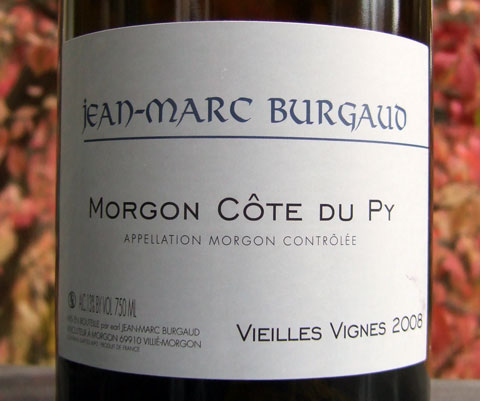
Morgon Côte du Py "Vieilles Vignes," Jean-Marc Burgaud 2008 
$16.  13% alcohol.  Cork.  Importer: Free Run, Seattle, WA.
Here's a wine that shows the '08 vintage character in spades—lean, taut, somewhat unyielding—yet all the components are in place.  Jean-Marc Burgaud's Morgon "Côte du Py" is yet to show the elegance already displayed by Lapierre's Morgon but it's also not showing any of the unattractive characteristics of under-ripeness or chaptalization so common in the 2008 vintage in Beaujolais.  I've somewhat accidentally amassed a three-year vertical ('07-'09), so I'll give this a rest and give them all a revisit at a later date.

Côte de Brouilly "Cuvée Zaccharie," Château Thivin (Claude Geoffray) 2007
$39.  12.5% alcohol.  Cork.  Importer: Kermit Lynch, Berkeley, CA.
and
Côte de Brouilly "Cuvée les Ambassades," Domaine du Pavillon de Chavannes 2009 
$19.  12.5% alcohol.  Cork.  Importer: Vintage '59, Washington, DC.
I may be comparing apples to oranges in the vintage department with this pairing but we're definitely talking oranges to oranges when it comes to the wines.  Both showed intense concentration and the kind of scale, in terms of body, color and texture, that one does not typically associate with Beaujolais.  Both also show a marked oak influence, especially Thivin's "Cuvée Zaccharie," which sees 10% new barrique and isn't shy about it.  These are unquestionably well made wines but their, I'll say it again, intense concentration is hard for me to get my arms around.  These are both wines that, if I had unlimited space (and budget, in the case of the Thivin), I'd like to put away not just for a little while but for a few years.  But I don't....

PS: In spite of the poor color rendering in my photos of the labels from Château Thivin and Domaine du Pavillon de Chavannes, it's hard not to notice that they look practically identical.  The intertwined history of the two estates is a typically French story of marriage, inheritance, birth, death and separation; it's not easy to follow but you'll find a good telling of the story on the Vintage '59 website.

Monday, November 9, 2009

Pierre-Marie Chermette's "Les Deux Roches"

Pierre-Marie Chermette. His were the first wines that turned me on to not just the pleasures but also the deeper possibilities of Beaujolais. I first started drinking them in the mid-to-late nineties. It wasn't long thereafter that I found myself selling them, mostly the "Cuvée Traditionelle" but also the Crus, in fairly copious quantities. It's been a few years now since the shop where I work ended business relations with Chermette's US importer. I still terribly miss having such ready access to the wines.

Over the years, I've found that Chermette's wines are in possession of certain inimitable qualities that make them unmistakably delicious. They're so good that people of all persuasions are simply drawn to the wine, whether or not they understand why. I think part of that draw is the wines' intense concentration. In most vintages, the "Traditionelle" possesses richness far beyond most basic regional and Villages level Beaujolais, while the Fleurie and Moulin-à-Vent bottlings can go beyond concentrated to downright powerful.

There's a certain gut (or perhaps knee-jerk) response to call wines such as Pierre-Marie's atypical for their richness, darkness or concentration. I suppose in a sense they are atypical, as they are richer than typical Beaujolais; however, this really brings to light not some witchcraft or chemistry that Chermette is performing in the winery to achieve "big" wines but rather just how much Beaujolais out there is not so much light and simple as it is over-cropped and dilute. If more producers followed in a path similar to Chermette's, perhaps his wines would not seem so unusual.

Pierre-Marie and his wife, Martine, farm sustainably, harvest lower yields than average in the Beaujolais, and thin their crops as necessary to ensure full ripeness on the vine. As a result, the wines never require chaptalization. Fermentation techniques are traditional, based on native yeasts only and, to complement the natural structure of the fruit, run over a longer maceration period than is the norm. The wines are aged in foudres – even barriques for some of the Cru bottlings – and are finished without fining, filtration or much if any addition of sulfur dioxide.

In more recent years, I've shifted my fancies more to the Beaujolais of other producers; to the freshness and energy of Jean-Paul Brun, the beautiful bone structure of Coudert, and the filigreed purity of Jean Foillard, to name but a few. But there's still an honored spot in my heart for the occasional bottle that crosses my path from Domaine du Vissoux.

Moulin à Vent "Les Deux Roches," Domaine du Vissoux (Pierre-Marie Chermette) 2005
$25. 13% alcohol. Cork. Importer: Weygandt-Metzler, Unionville, PA.

"Les Deux Roches" takes its name from two parcels of vines owned and farmed by the Chermettes: the one-hectare "Rochegrès" and a two-hectare plot called "La Rochelle," both of which are granite-rich terroirs. The finished wine is based on an assemblage (blending) of wines from the two sites that occurs following fermentation and aging of between 4-6 months in previously used barrels. Pierre-Marie suggests keeping this cuvée anywhere from five to ten years from the vintage date; a recently enjoyed bottle gave me no reason to disagree with that prognostication.

Medium, translucent red in the glass, still hinting at its earlier purpler stage. Likewise on the nose, this is beginning to go pinotisé – morphing from primary, fruity aromas to meatier, earthier, more Burgundian characteristics – but still gives up an aromatic trace of Gamay's signature, youthful fruitiness. Great feel, both mouth-fillingly round and firmly yet gently gripping. The wine's power brings with it a flicker of heat in the upper palate, but that proves to be tamed when it's drunk with food rather than tasted without accompaniment. Medium acidity carries a wave of black cherry, damson and spiced red fruits across the palate. There's no doubt that this would be right at home in a mixed line-up of regional and even village level red Burgundies.

Thirty minutes in, the nose and fruit shut down hard, going mute and picking up a hint of musty earth. Another half-hour later the wine went into a whole other phase, richer and denser, showing the influence of a ripe vintage as well as the geographical proximity of Beaujolais to the Northern Rhône. Twenty minutes more and the wine returned to a more delicate, fresh acid-driven state but also blossomed aromatically, bursting with red raspberries on the nose. With day two came diminished vitality, but there was still plenty of pleasure to be found, particularly in the presence of food. Dead-on with roast poultry. Even more clearly pinotisé than a day earlier, this would make for a nice ringer in a flight of Marsannay or Côtes-de-Nuits-Villages.

A few more bottles would be a most welcome presence in my cellar, as I expect this will continue to develop and morph in compelling directions over the next five years.

Thursday, July 9, 2009

Four for the Fifth

On the Fourth of July, I was far too busy wishing I was in Monaco to give much thought to what’s probably the biggest backyard BBQ holiday in America. A relaxed Sunday brought the opportunity to at least give tradition a nod, with some easy cheeseburgers and asparagus on the grill along with a potfull of early season corn on the cob. What we chose to drink seemed appropriate enough to the food if not the holiday.


Rheinhessen Grüner Silvaner trocken, Wittmann 2006
$28. 12% alcohol. Cork. Importer: Frederick Wildman, New York, NY.
Glowing medium yellow in the glass, with aromas of corn, fresh pressed linen and crisp green pears. At once rich and nervy on the palate, ever so slightly pétillant and showing a few graciously handled grams of RS. My first tasting impressions were hazy but one thing was certain right away: the wine has amazing length. Spätlese-like extract levels stain the palate, the wine’s flavors clinging with great tenacity. There’s also a great mineral depth lurking behind the up front pear and garden-fresh flavors. Much richer and more intense than Keller’s estate Silvaner trocken, and correspondingly more expensive.


Saumur-Champigny “Terres Chaudes,” Domaine des Roches Neuves (Thierry Germain) 2006
$25. 13% alcohol. Cork. Importer: Vos Selections, New York, NY.
This displayed the side of Loire Cabernet Franc that still sometimes leaves me scratching my head, showing aromas that nudge right up against those often associated with TCA though absolutely not corked. It’s little wonder that so many people have a hard time coming to grips with Cab Franc. In the end, just to be clear, I did like the wine. It showed lots of pepper – both black peppercorns and bell peppers – balanced by juicy plum and blackberry fruit. With a little time in the glass, it showed more aromatic depth: sweat, blood, pencil lead and some animal character. Firmly tannic, slightly low on the acid front and a little bit awkward, this needs some more time in the cellar to find its harmony though I expect it will always be more intriguing than elegant. It also needs meat on the table, so was a happy match with our burgers.

After an incredibly rainy June, the weather 'round here's been delightful of late. A fine night for dining al fresco, complete with patio flames as tended by Fireman Bill.


Rioja Crianza “Viña Cubillo,” R. Lopez de Heredia 2002
$22. 12.5% alcohol. Cork. Importer: USA Wine Imports, New York, NY.
65% Tempranillo, 25% Garnacho, 5% Graciano and 5% Mazuelo. Medium red, with faint garnet, brick hues. Its nose of forest floor and dried cherry tobacco hints at the beginnings of maturity yet the wines was juicy and sprightly as could be on the palate. This is Heredia’s “everyday wine” – and a really tremendous value. Beef jerky and dried cherries develop on the nose, as does a leathery streak on the mid-rear palate. But above all, the wine has energy and spirit. It’s as if you can taste the striations of the vines – sinewy, cut and fully detailed yet with no sense of clinical precision. I’ve heard of some bottle variation with this vintage – the last bottle I opened was corked, but that’s another story. This one was singing.


Moulin à Vent “La Réserve d’Amélie,” Domaine Gérard Charvet 2002
$16 on release. 13% alcohol. Cork. Importer: Wine Traditions, Falls Church, VA.
This we opened just to check in on its progress. My notes read something like this: “Pepper eau de vie, pepper juice, black pepper tea, brined green peppercorns….” You get the idea. Either I was wrong about this one when it was released or it’s going through an extremely strange stage. I’m heavily inclined to think the former is the case. When young, this was delicious and showed what I though was great potential. Now, though, it’s not exactly shot but it’s far from becoming. My last bottle is going into the experimental bin for a final examination a few years down the road. You’ll find slightly less disappointing notes on the 2004 vintage here, though my dining companions on this Fifth of July related that their last bottle of ’04, opened recently, was in a less enjoyable state than was this bottle of ’02. A never ending mystery….

Monday, February 9, 2009

French, Italian and Cajun

Another fairly impromptu get-together provided all the inspiration necessary for today’s post. Carryout from Cajun Kate’s, a few interesting things to taste and a little conversation with friends…. Definitely not a bad way to spend an evening.

Touraine Sauvignon “Le Petiot,” Domaine Ricard (Vincent Ricard) 2007
$15. 12.5% alcohol. Composite cork. Importer: Petit Pois, Moorestown, NJ.
After reading about the 2008 version of “Le Petiot” at Jim’s Loire a little while back, I figured it was high time to sit down with a bottle of the 2007, which is the current release on American shores. There’s no mistaking this for anything other than a vibrantly pure expression of Sauvignon, from its first aromatic blast of pink grapefruit and spring flowers right down to the tongue twisting, cleansing acidity on the wine’s finish. In between, there’s fine interplay between ripe, peachy fruit, lively citrus overtones and a wee undercurrent of light minerality. A perfect kick-starter of an aperitif, and not too shabby with Cajun Kate’s fried oyster po’ boy.

Venezia Giulia IGT Bianco “Vino Degli Orti,” Terčič (Matijaž Terčič) 2006
$32. 14% alcohol. Cork. Importer: Petit Pois, Moorestown, NJ.
A 50/50 blend of Tocai Friulano and Malvasia Istriana vinified and aged in tank. Regrettably this was a flawed bottle, robbed of its fruit by either a very low level of TCA (I’m pretty sensitive to cork taint and didn’t pick it up) or some combination of heat/oxygen ingress. Too bad, as the first bottle I’d tasted a couple of weeks earlier (sorry, no note) was quite good.


Collio Sauvignon, Terčič (Matijaž Terčič) 2007
$32. 14% alcohol. Cork. Importer: Petit Pois, Moorestown, NJ.
That’s more like it… two bad bottles from the same producer and same shipment would have been a bad sign. This was not only very good but also stood in stark, provocative contrast to the style of Ricard’s Touraine Sauvignon. Terčič’s Sauvignon was just as energetic on the palate but much richer and denser in texture, and darker in its minerality. It’s also far less aromatically potent, expressing itself more through feel, structure and depth than high toned fruit and flowers. Like “Vino Degli Orti,” this is done in tank; if I didn’t know that, though, I’d have guessed neutral wood. There’s plenty of stuffing here for richer food pairings.


Moulin-à-Vent “Cuvée Vieilles Vignes,” Domaine Diochon 2006
$19. 13% alcohol. Cork. Importer: Kermit Lynch, Berkeley, CA.
This might just be the ideal choice to pour for someone who still needs to be convinced that Beaujolais can be serious – and seriously good – wine. It’s got great fruit but also that classic granitic, brooding sensation that seems more common in Moulin-à-Vent than in any of the other Beaujolais Crus. This has great feel and fine balance and delivers waves of crunchy, dark fruit. The nose leads with black raspberries and chalk, follows with white pepper and a sense of black minerals, and ends with scents of ginger and molasses. Lively acid and grip bring it all home. Not too shabby with smoked brisket gumbo, either.


Arbois Pupillin Poulsard, Emmanuel Houillon (Pierre Overnoy) 2007
$32. 12.5% alcohol. Cork. Importer: Louis/Dressner, New York, NY.
Dinner was over at this point but we all felt like tasting something else. The choice was driven, I expect, as much by anticipated pleasure as it was by a wish for redemption after a rather awkward showing from another Houillon wine a couple of weeks earlier. There was no awkwardness this time around.

Though typical in shade for Arbois Poulard (aka, Ploussard), this might startle many with its pale iridescence in the glass, reflecting hues of green olive and orange peel when held to the light. It’s almost spritzy in its liveliness on the palate, like a winey rendition of raspberry lime seltzer. The aromas were just intoxicating. Scents of pine needle, rose petal potpourri, watermelon, lime and eucalyptus jumped out of the glass, one after the other, seemingly alternating between associations of the mountains and the shore. On the palate, it’s all about freshness of fruit and completely unmuddled flavors. Full of refreshing acidity, devoid of tannic interference and laced with rock-sucking sensations, this was just a joy to drink.

Tuesday, August 5, 2008

Notes from a 50th Anniversary

On the surface, this may read much like previous installments of Wines with Bill or Notes from a Sunday. This time, though, there was a grander occasion at hand – the 50th wedding anniversary of my buddy Bill’s folks, who were up from North Carolina to celebrate with family. Needless to say, it was my pleasure and honor to be invited. The main point, of course, was to enjoy each other's company, but we did enjoy some good wines along the way.

Muscadet de Sèvre et Maine Sur Lie “Clos des Briords” Vieilles Vignes, Domaine de la Pépière (Marc Olivier) 2005 (from magnum)
This was opened and enjoyed before my arrival but, luckily, my thoughtful hosts had stashed away a bit of the bottle. Classically saline, with a burst of lemon zest on the front palate spreading into a broad, creamy mid-palate, finishing with a knife’s edge of acidity. No surprise, it rocked with the mussels Bill steamed in the same wine, richened up a bit with just a few pats of butter. Why isn’t there more Muscadet available in magnum? $30 (magnum). 12% alcohol. Cork. Importer: Louis/Dressner, New York, NY.

Vin de Table Mousseux “Le Vinsans Ricard,” Domaine Ricard NV
More fun with words from young vigneron Vincent Ricard, whose estate is based near the Touraine village of Thésée. To borrow from his own text on the label’s sidebar, this is naturally pétillant Gamay, made without dosage and only lightly filtered. Exuberant and direct, bursting with fresh raspberry and strawberry fruit, accented by a dash of watermelon and mint. Served chilled, on the porch, with barbecued chicken thighs. It’s hard to imagine a better match. $22. 12.5% alcohol. Cork. Importer: Petit Pois, Moorestown, NJ.

Touraine Pinot Noir Rosé, Domaine des Corbillières 2007
“Le Vinsans” was a tough act to follow, a challenge made tougher by this rosé’s almost total lack of aroma. In the mouth, however, it gave a pleasant enough display of watermelon fruit and mineral character, combined with a vegetal hint that reminded me of boston lettuce. Surprisingly long on the finish and a reasonable match with a very tasty bowl of gazpacho. $12. 12.5% alcohol. Cork. Importer: Robert Kacher Selections, Washington, DC.

Moulin à Vent Vieilles Vignes “Réserve d’Amélie,” Domaine Gérard Charvet 2004
I was really pleased to see this make an appearance as it had been a couple of years since my last taste. Not as altogether happening as I hoped/expected but there was definitely nothing amiss; the wine’s just in a bit of a dumb phase. Still, it would be a fine antidote for anyone who is still a nonbeliever in the joys of Beaujolais. Granitic minerality layered atop briary, black cherry pit flavors. Lighter than I remembered up front but with a depth of flavor that belies its weight. $16 on release. 13% alcohol. Cork. Importer: Wine Traditions, Falls Church, VA.

Montlouis-sur-Loire "Les Choisilles," François Chidaine 2002
Another wine I hadn’t visited in a while and this time I was very surprised. Much more evolved and oxidative than I would have expected and really not showing very well. Intense grip and some sense of remaining muscular anatomy on the finish but all cobwebs and moth-eaten clothes up front. Wool clothes, that is, given its intensely lanolin nose. I’m still holding a couple of bottles so I’ll have to hope it’s just going through an awkward phase. $23 on release. 12% alcohol. Cork. Importer: Petit Pois, Moorestown, NJ.

Savennières "Clos de Saint Yves," Domaine du Baumard 1997
This provided an interesting contrast to the Chidaine, at once more evolved in its overall state yet still in possession of greater freshness of feel. Frail, lacy and pretty, with aromas of almond cookies and chamomile tea. To continue the funereal metaphor, more like a well-preserved skeleton, dressed in a silk chemise. $25. 13.5% alcohol. Cork. Importer: Ex Cellars, Solvang, CA.

The two Chenins were paired up with a lovely selection of cheeses from the crafty mongers at Talula's Table.

Saar Kanzemer Sonnenberg Riesling Grösses Gewächs, Weingut Johann Peter Reinert 2005
This was opened, in spite of its painful youth, as recompense for the lackluster showings of the two Chenins. My note taking dropped off at this point, so I can only offer some basic, instinctive impressions. Pure nerves of steel, with Reinert’s typical touch of grace and expressive fruit maintained, even given the physiological intensity of what equates to an Auslese trocken from the Saar. Wine to hold and savor. $48. 13% alcohol. Vinolok. Importer: Petit Pois, Moorestown, NJ.

Saturday, April 12, 2008

A First Look at Some 2005 Red Burgundies

Our casual little tasting was meant to take a first look at a few red Burgundies, most of which were previously unknown to me, from the much hyped 2005 vintage. However, it’s always nice to start things off with a wake-up wine, something bright and refreshing to call the old taste buds into action.


Vouvray Brut, Domaine François Pinon NV
Given that there was no Crémant de Bourgogne around to fit the evening’s theme, what better starting point than a sparkling Vouvray? Pinon is an excellent producer whose wines I get to drink far less often than I’d like. While his best wines can approach the profound end of the Vouvray experience spectrum, this bubbly, like his basic vin tendre “Cuvée Tradition, slot into the category of simply delightful. Pale, golden color and a medium bead lead into a dry but generously round palate attack. Baked golden delicious apples, cinnamon and honeysuckle aromas are followed by intensified flavors of apple and peach butters. $21. 12% alcohol. Natural cork. Importer: Louis/Dressner Selections, New York, NY.

Moulin-à-Vent “Clos de Rochegrès,” Château des Jacques / Louis Jadot 2005
Extending Burgundy to include the Beaujolais, we kicked into red gear with what turned out to be the biggest, brawniest wine of the lineup. I have a strong tendency – one I think I share with many of my fellow old world-centric bloggers – to write-off the wines from major négociants like Maison Jadot. At their base levels, I think the wines justify that treatment; however, there’s the occasional exception as evidenced by this seriously structured, single vineyard Moulin-à-Vent. Dark red robe, with a deep nose hinting at pine forest, raspberry confit and a subtle barrel influence. Closed and brooding. Dark loamy fruit with black pepper and clove are finished up with substantial grip. This needs time. Definitely a candidate for cellaring. $30ish (prices vary widely). 13% alcohol. Natural cork. Importer: Kobrand.

Savigny-les-Beaune “Vieilles Vignes,” Domaine Philippe Girard 2005
Sweet-tart cherry fruit hit right up front and quickly trailed off into a sour, green olive twinge. With air, this developed a rubbery, stinkfoot meets bologna aroma, which matched right up to the taste of hot dog water that dominated its mid-palate and finish. Sound like reduction? It wasn’t; it’s just not well made wine. Don’t bother. $30. 13% alcohol. Natural cork. Importer: Cellar Door Selections, Columbia, MD.

Chorey-les-Beaune “Château de Chorey,” Domaine du Château Chorey 2005
This was more like it. Rose petals and wild cherry aromas wafted from the glass. Medium color and medium bodied, with lean, taut texture. Red apple skins and tangy, prickly fruit on the palate. Good wine and a solid value for village level Burgundy, particularly given 2005 pricing trends. Benoit Germain converted his estate to organic farming practices in 2001. $28. 12.5% alcohol. Natural cork. Importer: Simon ‘n’ Cellars, Charlottesville, VA.

Chambolle-Musigny, Domaine Hudelot-Baillet 2005
The sexiest wine of the night. Surprisingly pale for Chambolle, again surprising given the vintage characteristics. The color was deceptive though, in stark contrast to the wine’s much richer aromas of creamy, cherry vanilla. Richness and structure followed on the palate, with well-rounded grip. A gravelly, cherry pit character kicked in on the persistent finish, along with a well-integrated wood influence. Already awfully tasty, this should provide rewarding results given a few years in the cellar. $50. 13% alcohol. Natural cork. Importer: Cellar Door Selections, Columbia, MD.


Monthelie, Thierry & Pascale Matrot 2005
As tasty as the Chambolle was, the wine I’d most like to drink on a regular basis (if only I could afford to) was this, the Monthelie from Thierry and Pascale Matrot. Monthelie, one of the lesser-known communes of the Côte de Beaune, is one of the villages with which I’d really like to get better acquainted. The wines I’ve enjoyed thus far, including this one, have shared a jagged edge of wild fruit and minerality running right through the middle of the wine that I find extremely compelling. Tasted in its second day open, this was showing just great, with a core of dark wild cherry fruit and light twigginess. Right on for a crispy skinned roast chicken stuffed with fresh herbs. $35. 13% alcohol. Natural cork. Importer: Vineyard Brands, Birmingham, AL.
Blog Widget by LinkWithin