Showing posts with label Coudert. Show all posts

Monday, January 3, 2011

This is Not a Top Ten List

This is not a top ten list.  This is a list of ten wines, selected with great difficulty and largely at random, that inspired me in 2010.  This was meant to be a New Year's Eve post... but I opted to unplug.  This is to say, drink wine... and don't forget to enjoy it.  This is to say, have a Happy New Year, dammit! 

Barbera d'Alba, Giuseppe Rinaldi 2008
Absolutely delicious, in an all one could possibly ask for from Barbera kind of way.  I have an ongoing love/hate relationship with Barbera but this was all love.  If only it were available in the US.... (My original write-up.)

Paso Robles Estate Rosé, L'Aventure 2009
One of the most memorable wines from my March trip to Paso Robles, CA, consumed during one of the most memorable events of the trip—dinner high up the Templeton Gap at the home of L'Aventure owner Stephane Asseo.  A dead ringer for the best side of Coteaux d'Aix rosé, with a dash more body courtesy of Cali-ripeness.

Barolo, Bartolo Mascarello 2005
Of the scores of Baroli from the 2005 vintage I've had the chance to taste this year, both at home and while in Piemonte in May for Nebbiolo Prima, Maria-Teresa Mascarello's stands out as the most graceful.

This is not a walrus.

Saar Ayler Kupp Riesling "Unterstenbersch" Faß 12, Weingut Peter Lauer 2008
The most inspiring Riesling I drank in 2010.  The combination of reserved character and intense depth in Florian Lauer's "Unterstenbersch" reminded me that I need to make it a serious mission to drink even more Riesling and to explore the M-S-R more thoroughly in 2011.  (My original write-up.)

Ribeira Sacra Summum, Guímaro (Pedro M. Rodríguez Pérez) 2008
The '08 Ribeira Sacra tinto from Pedro Rodriguez at Guimaro already received a nod in my 2010 in review post a few days back but what can I say....  It was one of the finest $15ish reds I drank all year and a bell-clear harbinger that, just as with Riesling (above), I'm in need of deeper exploration when it comes to the wines of Northern Spain.  (Original write-up.)

Muscadet Sèvre et Maine Sur Lie "Vieilles Vignes," Château les Fromenteaux (Famille Luneau) 2005
I opened this just a couple of weeks ago, after the remnants of a bottle of Meursault proved inadequate for the evening meal.  The Meursault had improved over the course of five days but the Muscadet (which is farmed, vinified and bottled by Pierre Luneau-Papin, btw) still blew it right out of the water. Wonderful aromatics, brilliant minerality, fine balance, aging gracefully... it was one of those wines that made me pause and utter a little "Oh, shit!" under my breath after every few sips.  $12.50 seriously well spent—and proof that there is cellar-worthy wine out there in the sub-$15 price range.

Els Jelipins 2005
What was I just saying about Northern Spain...?  My friend Joe Manekin, whose own Top Ten of 2010 post was at least partially responsible for inspiring this one, included Els Jelipins on his list.  Here it is again.  Sometimes besotted minds think alike.  It's not often that I encounter a bottle that retails for $80 and feel compelled to run right out to buy some.  Heck, it's not often that I buy $80 bottles of wine, period.  It's even rarer that I call a wine "sexy," especially without my tongue firmly planted in cheek.  But that's exactly what I did, on both counts.  Not having been to Penedès, I can't really comment on the wine's terroir expression.  It would be equally feeble to declare it a great expression of Sumoll.  It's simply a great wine.  (Original write-up.)


This is crossing over....


Champagne Brut Blanc de Noirs "Inflorescence," Cédric Bouchard (2006)
In a year in which I had the opportunity to drink many excellent Champagnes, this was a tough choice.  But from its incredible up-front fruit richness and textural density, to its closing minerality and long, long finish, Cédric Bouchard's "Inflorescence" left a definite and lasting impression.

Sierra Foothills White Wine, La Clarine Farm 2009
Two American wines in my not-a-top-ten list?  I wouldn't have believed it if you'd told me but here it is....  It boils down to this: if more American wines tasted as good to me as does this Rhône-inspired white from Hank Beckmeyer's La Clarine Farm, as in "friggin' delicious" (cribbed straight from my raw tasting notes), I'd drink more American wine.  (Original write-up.)

Fleurie "Clos de la Roilette," Coudert Père et Fils 2009
As with the Champagne above, in a year in which I drank many excellent wines from the Beaujolais, this was a touch choice.  But not quite so tough.... Why?  Because the '09 Fleurie from Coudert is simply spot-on.  Whether to drink now or later, it's delicious wine—balanced, bright, expressive and incredibly enjoyable.  I'd be hard pressed to think of a wine I'd rather have a big stack of, sitting right next to me at all times, than this.  What better way to round out my "list"?  (Original write-up.)

Saturday, December 4, 2010

Beaucoup du Beaujolais: Return of the B-Side

It's been way too long since I filed my last (and first) B-side report, something I originally intended to be a fairly regular installment here at MFWT.  So, when I recently gave the once over to the collection of dead soldiers that had accumulated on my kitchen table and realized that 80% of them were Beaujolais of one ilk or another, I figured it was due time for a return.

The hits—these could've/should've been A-sides (had I been studying in addition to enjoying):

Morgon, Marcel Lapierre 2008 and 2009
$25 and 22. 12 and 13% alcohol.  Cork.  Importer: Kermit Lynch, Berkeley, CA.
In the wake of Marcel Lapierre's recent death, I'm willing to hazard a guess that more of his wines have been consumed worldwide over the last two months than of any other artisan scale Beaujolais producer.  I'd bet the same applies to purchase rates, especially of the 2009, which piles vintage fervor on top of sentimentality. I'd love to buy some more of the '09 while the getting is still good but it's the 2008 that I'd really like to drink today.  Don't get me wrong, there's nothing wrong with the '09—full of bright, ripe fruit, juicy texture and a touch of earth—but it's still wearing a layer of baby fat, not yet ready to reveal its underlying stuffing.  The '08, on the other hand, is a perfect example of the old maxim that a great farmer and producer can make wonderful wines in so-called bad vintages.  2008 may have been difficult relative to 2009 but Lapierre's Morgon shows it only in its relative lightness and transparency when compared to the '09 (or good bottles of the '07); at heart, it's pure, elegant and lovely to drink.

Fleurie "Clos de la Roilette," Coudert Père et Fils 2009
$20.  13% alcohol.  Cork.  Importer: Louis/Dressner, New York, NY.
As much as I've been enjoying the Lapierre and any number of other 2009 Beaujolais and Cru Beaujolais, I've yet to find one that represents a better value than Coudert's Fleurie "Clos de la Roilette."  It's already received A-side treatment here, albeit in brief, so please allow me to reiterate, even more briefly, that the '09 Roilette is simply delicious.  The last couple of bottles I've tried suggest that it may be tightening up a bit but it's still delivering great pleasure.  If you haven't tried it, do.


The indie out-takes—throwin' down some funk:

Beaujolais-Villages, Damien Coquelet 2009
$15.  13% alcohol.  Cork.  Importer: Louis/Dressner, New York, NY.
A recent bottle was my first experience with Damien Coquelet's Beaujolais-Villages.  My immediate impressions put it right smack in the middle of the "does method trump terroir?" discussion that's been going on here recently.  There's an unmistakably natty, funky character to it that comes close to without entirely dominating the wine's sense of Beaujolais-ness.  For now, I can say that it is eminently drinkable, and there's nothing wrong with that.

Moulin-à-Vent, Domaine des Côtes de la Molière 2009 (Isabelle et Bruno Perraud) 2009
$22. 12.5% alcohol. Cork. Importer: Jeffrey Alpert Selections, New York, NY.
This didn't do nearly as much for me (at least not at first) as did the theoretically simpler "Côtes de Poquelin" from the same estate.  In the first couple of days open, I found it to be much more an expression of natural wine making than of Moulin-à-Vent.  Mind you, I don't mind finding obvious natty signatures in a wine, just so long as they don't obscure the wine's terroir (sound familiar?).  Going back to the wine after at least seven days (my gut tells me it was closer to ten but I didn't keep exact track), though, it was showing a good deal better.  Still not the most profound example of Moulin-à-Vent, but a much clearer expression of cru Beaujolais than in its first days.  The "Poquelin," it should be noted, also performed really well over the course of several days, providing solid evidence, especially when combined with this experience, that sans soufre wines are not always as fragile as they're made out to be.


The misses—if I were still a music director, these might not have made the playlist:

Beaujolais-Villages, Gilles Gelin 2009
$16.  13% alcohol.  Cork.  Importer: Petit Pois, Moorestown, NJ.
and
Beaujolais-Villages "Tracot," Domaine DuBost (Jean-Paul Dubost) 2009
$16.  12.5% alcohol.  Cork.  Importer: Petit Pois, Moorestown, NJ.
Two more new wines from producers who are new to me.  If I'd tasted these blind, I think I'd have pegged them both as being from 2008 rather than 2009 as they showed attributes that suggested the not so great side of the '08 vintage: lean texture, tangy, confected fruit, and slightly green acidity.  The Gelin started out at that candied end of the spectrum but improved somewhat on day two.  DuBost's "Tracot," on the other hand, showed its best right out of the gates, all but falling apart by the next day.  DuBost has been getting decent traction of "natural-leaning" wine lists of late but this effort leaves me wondering why.  I wouldn't rule out revisiting other wines from these two estates but will not be inclined to plunk down $16 again on either of these particular bottlings.


The jury's still out—put them away for a while, bring them back later for another hearing :

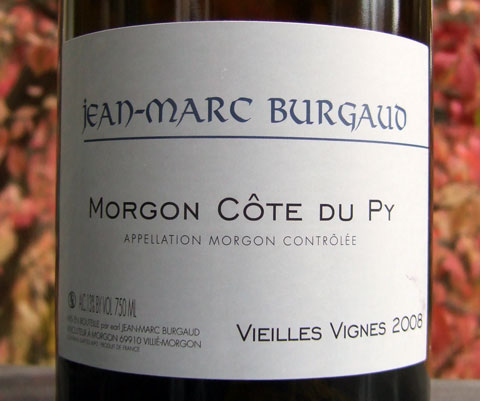
Morgon Côte du Py "Vieilles Vignes," Jean-Marc Burgaud 2008 
$16.  13% alcohol.  Cork.  Importer: Free Run, Seattle, WA.
Here's a wine that shows the '08 vintage character in spades—lean, taut, somewhat unyielding—yet all the components are in place.  Jean-Marc Burgaud's Morgon "Côte du Py" is yet to show the elegance already displayed by Lapierre's Morgon but it's also not showing any of the unattractive characteristics of under-ripeness or chaptalization so common in the 2008 vintage in Beaujolais.  I've somewhat accidentally amassed a three-year vertical ('07-'09), so I'll give this a rest and give them all a revisit at a later date.

Côte de Brouilly "Cuvée Zaccharie," Château Thivin (Claude Geoffray) 2007
$39.  12.5% alcohol.  Cork.  Importer: Kermit Lynch, Berkeley, CA.
and
Côte de Brouilly "Cuvée les Ambassades," Domaine du Pavillon de Chavannes 2009 
$19.  12.5% alcohol.  Cork.  Importer: Vintage '59, Washington, DC.
I may be comparing apples to oranges in the vintage department with this pairing but we're definitely talking oranges to oranges when it comes to the wines.  Both showed intense concentration and the kind of scale, in terms of body, color and texture, that one does not typically associate with Beaujolais.  Both also show a marked oak influence, especially Thivin's "Cuvée Zaccharie," which sees 10% new barrique and isn't shy about it.  These are unquestionably well made wines but their, I'll say it again, intense concentration is hard for me to get my arms around.  These are both wines that, if I had unlimited space (and budget, in the case of the Thivin), I'd like to put away not just for a little while but for a few years.  But I don't....

PS: In spite of the poor color rendering in my photos of the labels from Château Thivin and Domaine du Pavillon de Chavannes, it's hard not to notice that they look practically identical.  The intertwined history of the two estates is a typically French story of marriage, inheritance, birth, death and separation; it's not easy to follow but you'll find a good telling of the story on the Vintage '59 website.

Saturday, September 25, 2010

Parker Rants at Bibou's Expense

Consider a recent statement from a regarded critic:

"...the food was as great a bistro fare as one can imagine...the snail ragout, boudin noir, terrine en crout, out-of-this-world beef marrow bones as well as superb stuffed pig's feet with foie gras over a bed of black lentils had me in Rabelaisien Nirvana."

Then consider this:

"...better yet [there was] no precious sommelier trying to sell us some teeth enamel removing wine with acid levels close to toxic, made by some sheep farmer on the north side of his 4,000-foot foot elevation vineyard picked two months before ripeness, and made from a grape better fed to wild boar than the human species....we all know the type-saving the world from drinking good wine in the name of vinofreakism."

Seems kind of hard to believe they were uttered by the same person yet they were, by none other than the wine advocate himself, Robert Parker. Apparently, Parker dined a few nights ago at one of my favorite restaurants in Philadelphia, Bibou. That's him in the photo (above right), arms draped over the couple behind Bibou, Charlotte and Pierre Calmels. You can view the photo and quotes above, along with a laundry list of what Parker drank, in their original context at Philadelphia Inquirer columnist Michael Klein's blog, The Insider.

What really strikes me about the above diatribe is not so much the obvious case of diarrhea of the mouth but rather the fact that Robert Parker found it necessary to turn a simple moment — a photo op and a chance to send some much deserved praise the way of an excellent neighborhood bistro — into a self-serving opportunity to protect his own crumbling hegemony. What he's trying to protect against, lest I've left you scratching your head, is from what he obviously views as the culprit of his seemingly waning influence: the conversely increasing influence, erosive as Parker apparently views it, of independently voiced — and often freely disseminated — current trends in wine thought. Clearly, the emperor is piling on the moth balls in his own defense.

I could easily see someone thinking, "Okay, McDuff, you're just taking this as your own Parker-like opportunity to put a spin on things, to self-promote." But I have no such illusions of grandeur. If Parker was thinking of any one person, it may have been Alice Feiring, true-wine advocate extraordinaire and author of "The Battle for Wine and Love: or How I Saved the World from Parkerization." However, I think what Parker was actually having a meltdown over is, again, the ever increasing influence of an ever increasing number of voices being publicly expressed in the wine world. Bloggers, writers, sommeliers, retailers, bulletin board subscribers, distributors and importers, heck, maybe even collectors....

It's not really about what Parker called "vinofreakism." Rather, there is an undeniable backlash, though it's hardly universal, against what another wine critic, Eric Asimov, has coined "the tyranny of the tasting note." In this context, perhaps it's even more appropriate to think of as the tyranny of the wine rating system. Parker, like many of his peers at other major wine publications, has built his empire upon it and he is now clearly feeling the pinch.

* * *
On a more grassroots, more down-to-earth level, what I'm just as galled by is the possibility that Parker's diatribe might actually turn-off some true wine and food lovers to the idea of dining at Bibou. What a nasty case of guilt-by-association that would be.

Parker was right about at least a few of the things he was quoted as saying in Klein's article. The food at Bibou is indeed top-notch, an example of French country/bistro cuisine at its finest. And, as I pointed out in my original review of Bibou, everything about the BYOB, from the ease of its food to the quality of stemware and service, makes it a great place to take a broad variety of wines, be they classic or adventurous, heavy-hitters or simple pleasures.


The very same dish of foie-gras stuffed pig's trotters over a bed of lentils, mentioned by Parker, was a highlight of my last visit. Rich it was but over-the-top, as it might sound, it was not. All its elements were in harmony.

On that same August trip, the 2007 Chablis of Gilbert Picq showed much better than Nicolas Joly's Savennières "Les Clos Sacrés" 2005.

Likewise, Coudert's 2007 Fleurie "Clos de la Roilette Cuvée Tardive" was in a prettier spot than the 2006 Arbois Poulsard "Vieilles Vignes" from Tissot.


The real star of the lineup, though, was a bottle of 1997 Château Musar, eloquently expressive and a delight with the pig's foot and lentils.


So, I hope my point in this second half of my own little diatribe is even more obvious than that expressed in part one. Go to Bibou. Take good wine. Enjoy the company of good friends. Eat well. And leave the agenda where it belongs.


Bibou
1009 South 8th Street
(between Carpenter and Washington)
Philadelphia, PA 19147
215-965-8290
Bibou on Urbanspoon

Tuesday, September 21, 2010

Fleurie "Clos de la Roilette," Coudert 2009

As if I don't have enough of a backlog already, ranging from producer visits in Piedmont all the way back in May through to yet to be covered trade tastings in New York last week, I'm headed back into the fray today. Back to New York, for the last handful of the September onslaught of portfolio presentations. (If it's quiet here for a couple of days, you'll know why.) Something tells me the following wine is likely to make an appearance; if not, it'll be missed.

Fleurie “Clos de la Roilette,” Coudert Père et Fils 2009
$20. 13% alcohol. Cork. Importer: Louis/Dressner, New York, NY.
Enjoyed with grilled sausages and salad on Sunday, again with pizza — the "omnivore" from my local parlor — last night. Coudert's 2009 "Clos de la Roilette" is drinking beautifully on point. Fresh, bright and finely detailed red fruits — like wild strawberries, firm little raspberries and ever so slightly tart red cherries — combine with lively acidity and gentle but balancing tannins to deliver a truly fine expression of Fleurie from this estate and this vintage. Quite the trifecta. This should develop gracefully over the next several years but it's drinking so well right now that I may not manage to save any.

Wednesday, October 21, 2009

IDSK Volume 3

After briefly alluding in my last post to a recent IDSK collaborative dinner, I realized I’d been remiss in not posting at least a little detail about the event. But first, for those that missed my report on Volume 2 back in July, a quick injection of background information seems in order. IDSK is an acronym for the recent collaborative efforts between Alexander Talbot of Ideas in Food and Shola Olunloyo of StudioKitchen. These are two chefs – one a long time Philly resident, the other a recent transplant – who both approach their craft with passion and intensity. If you’re into culinary artistry, the nuts and bolts of molecular gastronomic technique, or simply enjoy ogling near daily doses of some pretty high zoot food porn, their blogs both deserve to be on your reading list.

The theme at this recent outing was a combination of the exploration of subtlety of flavor coupled with malleability of form and textural contrast. Though I found the evening’s food somewhat less delicious overall than at IDSK2, there was still no lack of pleasure to be found in the moment. As always, the experience was helped along by a charming cast of dining companions, which by bizarre coincidence on this night included Tesco Vee's old college roommate, with whom I partook in a little reminiscing about the DC hardcore scene of the early-to-mid 80s.

It’s been long enough now (the dinner was held back on October 2) that I won’t belabor this post with intricate details of each course. Instead, I’ll just let Shola’s photos do the talking; you’ll see what I meant by my above food porn reference.

Hiramasa
broken icicle radishes, crab applesauce


Peanut Pumpkin
roasting jus, dona engracia


Matsutake Mushrooms and Bartlett Pears
hot and cold, raw and cooked


Chestnut Soup
gala apples, bacon bits


Warm Hiramasa
vadouvan, eggplant


Russet Potato Gnocchi
parsley, tender garlic, powdered raclette


Twice Cooked Scallop
chorizo, black cabbage, beef fat consomme


Whey Poached Beef Strip Loin
braised shank, red cabbage: raw and cooked


Adelegger 17 Month
yellow tomato jam


Apple Pie and Coffee


* * *

In the old days at StudioKitchen – these dinners are BYOB – Shola had always presented a menu long enough in advance to allow for specific wine pairings. He and Alex have more recently taken to fine tuning their final menu right up to the last moment. As such, they encourage their guests to bring whatever they’d like to drink. For me, that means packing up a wide range of wines with an eye toward versatility and food friendliness. Of course, they’re all things I’d like to drink as well. On this night, I ended up sharing just about everything I’d brought with my fellow diners. No pictures to do the talking this time, so some quick notes seem in order.

Jochen Ratzenberger’s 2003 Bacharacher Kloster Fürstental Riesling Sekt showed the ripeness of the vintage in its rounder, bigger mouthfeel than in more typical years but was still a delicious way to start the evening.

As is my friend Bill, I’m convinced that one could very successfully pair Riesling with nearly everything that Shola cooks. So, for the first course or two, Riesling it was. Johann Peter Reinert’s 2005 Wiltinger Schlangengraben Spätlese halbtrocken, to be exact, which showed a whiff of sulfur when first poured but was also beginning to develop some lovely mineral pungency. Great, cleansing acids and lots of yellow plum and green apple fruit, as well. Excellent food wine. As I’ve said here before, Reinert’s wines are super under-appreciated.

That all-Riesling fest will have to wait until next time, as next up was the 2004 Viré-Clessé from André Bonhomme. This was much more developed than I’d have hoped or expected, showing some premox character in its slightly oxidized entry, followed up by poached pear and walnut on the palate. It improved as its temperature rose but not enough to make anything near a full recovery.

A bottle of 2006 Coudert Fleurie “Clos de Roilette” was screamingly good, showing amazing, even atypical levels of richness but still full of focus. Totally on point, though it’s got years ahead of it, and a great match with the garlic-potato-parsley combo in the gnocchi course.

Last up was a 1998 Gigondas from Château du Trignon, which gave the “Roilette” a serious run for its money. I’ve been disappointed with some other ’98 Southern Rhônes I’ve opened over the past year or two, as they’d either not gone anywhere or already begun to fade. This, though, was a lovely expression of Grenache, all crushed red fruits and garrigue, with the elegance that comes to wines like this only with age.

Finally, some music with which to bring things to a close. It’s not quite the same Meatmen mayhem as 20+ years ago but, even if you didn’t follow the link earlier on, I know you were just dying to see Tesco Vee in action.

Monday, October 27, 2008

The Louis/Dressner 20th Anniversary Portfolio Tasting

It’s been a week now since I made the trek up to New York for the grand tasting events of both Terry Theise and Louis/Dressner (LDM) Imports. There was a moment en route, trying to remain positive while stuck in a New Jersey Transit NE Corridor commuter train that was stopped dead on the tracks just south of Secaucus, that I thought I was going to end up missing one if not both of the events. Even though I’d hardly say that luck was with me that day, after a few hesitant lurches forward the train finally did make its way into Manhattan. Once I’d made the jump from Penn Station to Tribeca for my first stop, the challenge quickly switched from simply making it to the events to how to manage time and energy in such a way as to do either of them justice.

In contrast to the dressed for success crowd and well organized flow at the Theise portfolio show, the vibe at Louis/Dressner’s tasting was more one of casual chaos. The event space was a refreshing change – a sunny, airy, whitewashed room in LDM’s offices perched on the sixth floor of an office building near Astor Place. With 21 tables (few of them manned by this point in the afternoon), a less obvious traffic flow and an even less obvious rationale to the arrangement of wines, it was really up to the attendee to form a plan or make sense of it all. And with over 270 wines in the room, I can’t imagine there were more than a handful of endurance tasters that actually ran the gamut. Maybe Alice Feiring, who I had the pleasure of meeting as I was arriving and she was leaving, bicycle helmet tucked under her arm. If so, she was hiding the effects awfully well. Me? Looking back on Dressner’s tasting guide and my notes, I managed to spend some time with about one-third of the wines on offer. A bit of a disappointment from my self-critical perspective but, I suppose, not really that bad considering the time constraints and logistics of the day.

With nothing more than a quick sandwich and a quicker walk in the break after leaving the Theise tasting, jumping right back into bubbly seemed the most obvious way to resume.

Starters – A Few Bubblies from the LDM Portfolio:

Skipping the familiar (and wonderful) sparkling Vouvray and Montlouis of François Pinon and François Chidaine respectively, and intending to come back to the cidres of Julien Frémont (which I never managed to do), I started off with one of the few wines I’d yet to try from Thierry Puzelat. His 2006 “Pétillant Naturel,” I have to say, is an encapsulation of the fact that natural wine does not always equal good wine. This bottle was just in a weird place, all yeast and reductivity with little else to offer.

A non-vintage pétillant Saint-Péray from Les Champs Libres, a joint effort between Hervé Souhaut and René-Jean Dard (of Dard et Ribo) was pleasant in comparison. Albeit a bit aromatically neutral and coarsely textured, its forward fruit would make it an enjoyable quaff.

The Champagnes of Larmandier-Bernier were delicious across the board, from the fine and richly textured Blanc de Blancs Premier Cru NV to the steelier, more finely chiseled “Terre de Vertus” Blanc de Blancs Premier Cru Non-Dosé. I somehow missed L-B’s rosé but the “Vieille Vigne de Cramant” Extra Brut Blanc de Blancs Grand Cru 2004 more than made up for that. Tightly wound but lovely, lovely wine that’s just in need of some tender care in a cool cellar until it’s ready to really unfurl.

An extremely briny, mineral Blanc de Blancs Extra Brut from Ulysse Collin topped things off. As my description implies, I’d love to sit down with this and a platter of shellfish. Though not vintage dated, the fruit is all from the 2004 growing season.

On to the Beaujolais:

As much as it pained me, I leapfrogged past the wines of Jean-Paul Brun’s Terres Dorées and headed straight for Roilette, Tête and Descombes. In a tough crowd, the wines of Clos de la Roilette stood out. Their 2007 Fleurie was a thing of sheer beauty, extremely sappy at its core and built on a lean, tannic frame while the ’07 “Cuvée Tardive” showed similar sap with much more brooding, intense structure. These will both reward cellaring, especially the “Tardive.”

One of the great pleasures of the day was getting to taste, at least here and there, alongside my pal and blogging cohort, Neil, aka Brooklynguy (or is it Brooklyn Guy?). Sometimes you can learn more about someone’s tastes from what they don’t like than what they do. In that context, I think I’m beginning to get my arms around Neil’s preferences in Beaujolais, as he liked Michel Tête’s wines less than did I. In contrast to Roilette and Descombes, they’re softer and fruitier yet also more herbal in style, though the 2006 Juliénas “Cuvée Prestige” does take on a nice firm spine from the structure provided by 100-year-old vines.

Georges Descombes2007 Regnié was a delicious contrast, at once funky and brambly, with really juicy, exuberant fruit. Befitting of the cru, his wines from Morgon brought another level of intensity, apparent in the basic 2006 Morgon and framed even more clearly in the 2005 and 2006 “Vieilles Vignes” bottlings. Both were tightly wound, especially the darker ’05, but both showed real potential.

You Are So… Variable – The Wines of Nana, Vins et Cie (Domaine le Briseau) and Domaine de la Sansonnière:

Nana, Vins & Cie is the négociant business started in 2005 by Christian and Natalie Chaussard of Domaine le Briseau. Their wines, very natural and edgy, fall squarely into what many would call the hipster camp. Their labels vary between cute, minimal or simply indecipherable. And, at least on this day, the wines showed their quality to be quite variable.

In spite of the name, I really dug “You Are So Nice,” a blend of two-thirds Côt and one-third Gamay. The nose and palate both reeked of middle-Loire Côt, like a corned beef/pastrami sandwich finished off with a little wild raspberry jam. Relatively soft, it would make for a tasty picnic wine. “La Dérobée,” a Coteaux du Loir blend of Pineau d’Aunis and Côt, was not dissimilar from “Nice,” though with firmer backbone and a more guttural expression of earthiness.

I was less enamored with the whites. “You Are So Fine,” a Vouvray elevated in old barrels, showed intense wood influence with what little fruit there was being dominated by fermentation-derived aromas. And their Touraine Sauvignon called “You Are So Cool,” intensely minty and confectionery, was marred by a rubbery blast on the finish.

As much as I liked the 2005 Anjou Blanc “La Lune” from Mark Angéli’s Domaine de la Sansonnière when last I tasted it – coincidentally, it was also with Brooklynguy – it’s now gone into a very bad place, tasting of pomace and paint thinner. Just a phase, I hope. From the same vintage, his Anjou Rouge “Jeunes Vignes Les Gélinettes” was tannic – severely tannic – and weedy, in need of a hunk of roast beef to stand even a chance of being palatable.

Some More Wines I Did Like:

Lest you think I’m being a nasty cuss or naysayer, there were plenty of wines I did like. The whole lineup from Château d’Oupia was delicious, from the great value VdP “Les Hérétiques,” lean and full of barky fruit, to their top wine, Minervois “Cuvée les Barons” 2006, which drank like a magnified version of the “Tradition,” with greater richness but similarly wild, chunky fruit.

There was a delicious 2006 Mondeuse du Bugey from Franck Peillot, bright and juicy, and a very attractive if somewhat atypical 2006 Saint-Joseph Blanc from Dard et Ribo that might have fooled me for Chenin Blanc in a blind tasting.

I did take the opportunity to revisit a couple of old friends in new vintages. The couple of ‘06s I tasted from François Chidaine’s estate in Montlouis were showing great. “Clos du Breuil” was surprisingly rich, with really pure honeysuckle character. “Les Tuffeaux,” Chidaine’s multi-vineyard demi-sec cuvée, displayed the earthier, more mineral side of Montlouis and was showing a bit more structure than “Breuil.”

The Chinons of Bernard Baudry also showed well – big, boisterous and delicious across the board. The 2007 “Les Granges” displayed Baudry’s wild side in its fruity, animal nose. His top wine, the 2006 “La Croix Boissée,” was a monster on the palate, with a beautiful nose of red earth, sycamore and brambly fruit. Olga Raffault’s 2005 “Les Picasses” represented the more old-school side of Chinon, more feminine and delicate than Baudry’s expressions, with higher-toned aromas and a much more assertive acid profile.

It may come as no surprise – at their prices, it shouldn’t – but the showstoppers when it comes to Cabernet Franc were the 2004 Saumur-Champigny bottlings from Clos Rougeard. The “Clos” cuvée was lush and cuddly, full of cassis and eucalyptus, while “Les Poyeux” showed a more modern oak profile with fantastic structure. “Le Bourg” was simply rocking, coming across as more classic than “Poyeux,” with fantastic delineation of flavor and structure, fine balance and truly lovely fruit.

The 20th Anniversary Table:

By the time I found my way over to the table of wines from the 1988 vintage, being poured in celebration of Louis/Dressner’s twentieth year in the biz, I was too late to catch the ’88 versions of Clos Rougeard “Le Bourg” and Breton’s Bourgueil “Perrières,” as well as the ’88 Muscadet “Clos des Briords” from Domaine de la Pépière.

A trio of fantastic Loire Chenin Blancs helped to ease the disappointment.Back to Chidaine again, his 1988 Montlouis was redolent of tuffeaux terroir, with an intensely mineral nose. Showing aromas of fennel and pickling spices, François Pinon’s 1988 Vouvray Moelleux “Cuvée de Novembre” was complicated and lovely. Rounding out the threesome, Domaine du Closel’s Savennières “Clos du Papillon” may just have been my wine of the day. At the very least, it had the most beautiful nose of the day, rich with scents of aged goat cheese and limestone. Like Sainte-Maure in a glass.

As the close of business ineluctably approached, I wanted to believe that I’d overcome the challenges posed by the day’s doubled-up agenda. Deep down, though, I knew that the Dressner tasting had gotten short shrift. By around 3:30, I’d hit the wall, pure and simple. I found myself wandering the room. I’d gone from any sort of methodical tasting approach to looking around rather randomly for things that struck my fancy or cried out to be sampled. Serendipitously, though, just as I thought I’d have to throw in the towel, I wound up at a table of wines that helped bring things back into focus.

Happy Endings – the Whites of Stanislao Radikon:

Given the scarcity and relatively high prices of Radikon’s wines, it was a real treat to finish the day with a serious look at his whites. Stanko Radikon is an extreme naturalist, both on the farm and in the winery. I won't go into a ton of detail regarding their approach here but you'll find plenty of good information, albeit in Italian, at Radikon's website.

His 2003 “Jakot” (Tokaj spelled backwards), a varietal expression of Friulano, shows most clearly the funky side of Radikon’s natural winemaking, with a nose full of wild yeast, cider and damp minerality.

His other whites more clearly display his approach in the cellar. 30 days or more of maceration on the skins endowed his 2003 Ribolla Gialla with an energetic spiciness and tannic finish. 2003 “Oslavje,” a blend of 40% Chardonnay, 30% Pinot Grigion and 30% Sauvignon, shone a beautiful tone of orange, like a California sunset in a glass. Its flavor profile, with a hint of spearmint on the finish, was sweet and ripe.

2001 Ribolla Gialla was in a much more mature state, with a nose full of dried herbs, apricot and citrus confit and less primary fruit on the palate; the ’01 Oslavje was fresher on the nose and still a bit more direct.

With the 1997 library releases, though, the tables were turned. The 1997 “Oslavje Riserva Ivana” was a bit of a paradox, lighter in color than the younger versions and very oxidative in style – interesting but not delivering much pleasure. Radikon’s 1997 Ribolla Gialla “Riserva Ivana,” on the other hand, was just singing. The wine of the bunch for me, with a great nose and rich, vinous texture, laced with cidre, thyme and candied orange.

These are not wines for every day pleasures. Rather, they’re profound wines, at once incredibly idiosyncratic yet also pure. While I can’t say Radikon’s line-up brought me back to spring daisy state, it certainly opened my eyes and provided a much-needed centering before saying my goodbyes and hitting the streets.
Blog Widget by LinkWithin