Friday, November 26, 2010
Red Bourbon and Breton: Brief Scenes from a Thanksgiving Table
Posted by
David McDuff
0
comments
@
Labels: Bourgogne, Catherine and Pierre Breton, Chinon, Fabrice Gasnier, Giacomo Conterno, Langhe Nebbiolo, R. Lopez de Heredia, Ratzenberger, Rioja, Thanksgiving Wine
Monday, February 1, 2010
Winter at Talula's Table

Four guys (including me behind the lens), representing three time zones and four regions of the country, formed the core group of the weekend's revelers. You may recognize the man of honor, Steve Litvin (at right), from my fall adventures in Northern California. Steve came all the way from Monterey, where he is a postdoctoral researcher at Stanford University's Hopkins Marine Station, to celebrate his impending nuptials. Joining us were his old college water polo pals Carleton Yoder (at left), who's now based in Vermont, and Todd Dolan, who flew in the day before from Denver, Colorado. Carleton and Steve had both eaten with me at Django when it was under the purview of Talula's owners, Aimee Olexy and Bryan Sikora, but Todd was a virgin diner.
While the rest of the weekend may have revolved primarily around some of Philly's best spots for beer, tonight it was all about good food and wine. Though late in January 2010, the Winter 2009 menu at Talula's was (and still is, as of this writing) in full swing.

Hors d'oeuvre
with
Vouvray Brut, Foreau (Clos Naudin) NV
Since my last visit, the kitchen has changed things up just a bit, sending out a series of small bites to the diners lingering in the market area rather than plating a single amuse bouche at the dinner table. I'd left my camera back in the kitchen, so you'll have to do without pics, or any real details for that matter, of the three nibbles we were served. Suffice it to say they were as tasty, artful and soulful as is most everything done at Talula's. With them, we toasted a fine start to the evening with Foreau's Vouvray Brut, which, though not on the same plane as Huet's vintage Vouvray Pétillant, was still pretty darn good.

Short Stack, House-Smoked Smoked Trout, Shaved Pickled Carrots, and Pennsylvania Maple Syrup
with
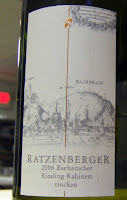
Mittelrhein Bacharacher Riesling Kabinett trocken, Ratzenberger 2006
There seems to be a mini-movement of late to pair fish eggs with something sweet. It may sound odd but it works on the same principle of "sweet and salty" that makes chocolate covered pretzels so good. And, when done right, it works. Here, the sweetness was delivered ever-so-subtly by the essence of maple syrup that permeated the "short stack" of tiny little pancakes. Along with excellent quality smoked trout, this was a standout first course — even if the Vermonter among us was perturbed that it included maple syrup from PA — that paired quite nicely with Ratzenberger's dry Riesling.

Winter Kale Soup, Burgundy Snail Tortellini, Toasted Garlic, Rich Tomato Fondue
with
Touraine "Les Trois Chênes," Domaine Ricard 2008
The snails may have hailed from Burgundy but the combination of hearty greens, garlic and tomato made me think of Sauvignon. So, with no St. Bris in hand, to the Touraine we went. The wine was delicous, tropical at first whiff then quickly morphing toward citrus oil-laced, sappy fruit and an intensely mineral finish; a real head-turner for Carleton and Todd who are primarily red drinkers. The soup was in turn delicious, the kale preparation itself taking center stage, cooked, as Steve put it, in such a way as to retain all of the kale's flavor while subduing its bitter, tough tendencies.

Winter Squash Crème Brulée, Cranberry Influence, Chocolate Dipped Chester County Bacon
with
Coste della Sesia Rosato "Rosa del Rosa," Proprietà Sperino 2007
Reactions to this course were mixed, a couple of the guys listing it among their faves while I wasn't so sure. The squash soufflé was delicious in and of itself, but I wasn't entirely sold on the chocolate covered bacon. I know it's another iteration of the sweet and salty principle but, for me, it can be too much of a good thing. There's no question that it was done well, though.
As for the wine, I've been thinking, since it was first produced a few years back, that Proprietà Sperino's rosato should hold up to a little cellaring. While this was hardly old, at two-years plus of age it was indeed showing very well, still full of the watermelon rind essence of its youth but also having developed a rich core of cured meat and vanilla cream flavors, along with a classically Nebbiolo-driven nose of rose petals. Very vinous, too.

Saffron Marinated Monkfish, Lemon Scented White Beans, Chorizo and Fried Herb Panada
with
Touraine "Le Clos de Vauriou," Domaine Ricard 2008
Yes, it's that wine. Again. Blame it on Chef Sikora, who brought it out and insisted on sharing it with us when he saw we'd brought another wine from Vincent Ricard. It was hardly a natural match with the food (the rosato might have been the way to go) but it's a versatile enough wine that things still worked out just fine. The fish dish was another of my favorite courses of the night, not just for the deliciousness of the monkfish itself but even more so for the interplay between the white and black beans, the chorizo, the fish, the saffron overtones and the way that the dish's seasoning, handled incredibly adeptly, tied everything together.

Confit of Canadian Goose, Cider Glaze, Cheddar Polenta, Smoked Onions, and Goose Juice
with
Chinon "Les Picasses," Catherine et Pierre Breton 2004
Though not the evening's last savory course, this was without doubt the heavy hitter of the evening, full of rich, heady, meaty flavors. The polenta is from Anson Mills, the cheese crisp topping made with Cantalet.
I got a kick out of Brooklynguy's recent potluck post and thought he was dead-on when associating good Chinon with the rich, fatty, salty flavors of confit (duck, in his case). The Bretons' 2004 "Les Picasses" was, for me, the most natural, satisfying pairing of the night, its own richness offset by the naturally vibrant acidity and tongue-cleansing texture of well-structured, well-balanced Chinon. I'd planned to save this, my last bottle, for several more years but the bachelor of honor has been on a C&P Breton groove ever since I turned him on to both versions of "La Dilettante" at Terroir back in the fall and I wanted him to try one of their more intensely structured wines. Hey, why save when you can share?

Venison Tenderloin, Potato-Turnip Purée, Caramelized Brussel Sprouts, Raisin-Red Wine Sauce
with
Alexander Valley Marlstone Vineyard, Clos du Bois 1995
Another killer course. I've probably said it here before, in fact I'm sure I have so I'm not even going to go back and look... Bryan has a gift when it comes to cooking game. The venison was meltingly tender and incredibly flavor intensive, infused with the exotic influence of pâté spices and balanced by the subtle sweetness of the wine reduction sauce. Those brussel sprouts didn't suck, either.
The wine? This one might surprise some of my regular readers. Yes, it was highly polished and not loaded with clear sense of place, but at 15 years, Clos du Bois' Marlstone Vineyard cuvée, a Bordeaux blend, was still fresh and vibrant. Plenty of life left to go, in fact. I don't have much experience with more recent bottlings, so I can't say where the wine has headed since, but this was made back in that turning point era between 1994-97, when California Cabs were just starting the leap into their high alcohol, high extract, not-so-food-friendly era. At 14.2%, this was balanced and played just fine with the deer.

Got Goat? A Goat Cheese Collection with Roasted Chestnut Jam
with
Coteaux du Layon "Cuvée S," Château Soucherie (Pierre-Yves Tijou) 2001
In the last few months, the cheese course at Talula's has moved away from the traditional tri-milk mixture toward a single-milk theme, still with a classic progression from mild to more pungent flavors. Soucherie's "Cuvée S" was still a baby. Very fat and honeyed. Even though delicious with the cheese, it turned out to be a better match with the dessert course.

Organic Champlain Triple from Champlain Valley Creamery
On top of being an all-around great guy and huge beer and wine lover, our friend and fellow diner Carleton Yoder is the owner and head cheese(maker) at Champlain Valley Creamery. Though he started his business with a focus on producing fresh cream cheese, which is still one of his primary products, his triple cream cow's milk cheese has quickly become his best seller over the past couple of years. We brought along a few discs of it for the crew at Talula's to try and Kate Stroh, Talula's resident sous-cheese monger, plated one up for us as a surprise course.

Clementine Chibouste, Lemon Curd, Citrus-Champagne Sauce
and
La Colombe espresso
After such a hearty, wintry meal, it was a smart choice to serve a dessert course that was only lightly sweet, its focus more on tangy, refreshing seasonal flavors. That light hand with the sugar helped it to pair so well, as mentioned above, with the sticky Loire Chenin from Soucherie. The coffee was just a digestive. Decaf for me, as I can't handle caffeine much past noon any more, that is unless I want to be staring at the ceiling at 4:00 AM.... As the espresso cup indicates, Philly-roasted La Colombe is now the coffee of choice at TT.
C'est tout! Thanks, Steve, Carleton and Todd, for providing the impetus for such a great meal. See you again in March, my friends.
Talula's Table102 W. State Street
Kennett Square, PA 19348 [map]
610-444-8255
Previous visits:
Posted by
David McDuff
7
comments
@
Labels: Catherine and Pierre Breton, Clos du Bois, Domaine Ricard, Foreau, Proprietà Sperino, Ratzenberger, Restaurant Report, Soucherie, Talula's Table
Sunday, November 29, 2009
A Few Good Wines

Vouvray "Clos du Bourg" Sec, Huet 2005
A really glorious bottle. Redolent of wet wool and damp clay when first opened then growing ever rounder and more honey and herb laced as the bottle grew emptier. I need to drink Vouvray more often... and I really need to drink Huet more often.
Nuits-St.-Georges "Les Grandes Vignes," Domaine Daniel Rion 2001
When last I tasted this, it provided a much needed breath of fresh air. The better part of two-and-a-half years later, it's continued to develop and continues to surprise, taking on greater weight with its slumber in the cellar. Rich red fruit laced with dark spice notes and beautifully ripe, round tannins. The wines of Domaine Daniel Rion are made in a very reductive style that can render them ungiving when young but, when all things are right, they can develop very nicely given a few years of patience.
Bacharacher Kloster Fürstental Riesling Brut Sekt, Weingut Ratzenberger 2000
This proves to be maturing more rapidly than the 1998, 1999 or 2001 versions of Ratzenberger's Sekt. Perhaps that's not surprising given the wet conditions in the fall of 2000. In any event, this has gone very much toward the truffle and oily end of the mineral spectrum, leaving behind much of the bright citrus and orchard fruits of this wine's youth. Still damn tasty but it's definitely time to drink up now.
Morgon "Côte du Py," Jean Foillard 2008
I thought it was fun. My wife thought it was serious. You know what? We were both right. Foillard's wines combine airy grace and delicacy with a depth that can be explored or simply accepted as fits the moment. The '08 may still be lacking something at its core but I think it's only a matter of time before everything settles into place. Even now it's delicious, with pure small red berry fruit allied to an earthy savor that made it a great match on the Thanksgiving table, especially with the turkey and the sourdough/shiitake/sage stuffing. (PS: Guilhaume published a neat photo essay at The Wine Digger a couple of weeks back on his visit with Foillard.)
Posted by
David McDuff
2
comments
@
Labels: Beaujolais, Daniel Rion, Huet, Jean Foillard, Mittelrhein, Morgon, Nuits-Saint-Georges, Ratzenberger, Vouvray
Wednesday, October 21, 2009
IDSK Volume 3
The theme at this recent outing was a combination of the exploration of subtlety of flavor coupled with malleability of form and textural contrast. Though I found the evening’s food somewhat less delicious overall than at IDSK2, there was still no lack of pleasure to be found in the moment. As always, the experience was helped along by a charming cast of dining companions, which by bizarre coincidence on this night included Tesco Vee's old college roommate, with whom I partook in a little reminiscing about the DC hardcore scene of the early-to-mid 80s.
It’s been long enough now (the dinner was held back on October 2) that I won’t belabor this post with intricate details of each course. Instead, I’ll just let Shola’s photos do the talking; you’ll see what I meant by my above food porn reference.
Hiramasa
broken icicle radishes, crab applesauce

Peanut Pumpkin
roasting jus, dona engracia

Matsutake Mushrooms and Bartlett Pears
hot and cold, raw and cooked

Chestnut Soup
gala apples, bacon bits

Warm Hiramasa
vadouvan, eggplant

Russet Potato Gnocchi
parsley, tender garlic, powdered raclette

Twice Cooked Scallop
chorizo, black cabbage, beef fat consomme

Whey Poached Beef Strip Loin
braised shank, red cabbage: raw and cooked

Adelegger 17 Month
yellow tomato jam

Apple Pie and Coffee

In the old days at StudioKitchen – these dinners are BYOB – Shola had always presented a menu long enough in advance to allow for specific wine pairings. He and Alex have more recently taken to fine tuning their final menu right up to the last moment. As such, they encourage their guests to bring whatever they’d like to drink. For me, that means packing up a wide range of wines with an eye toward versatility and food friendliness. Of course, they’re all things I’d like to drink as well. On this night, I ended up sharing just about everything I’d brought with my fellow diners. No pictures to do the talking this time, so some quick notes seem in order.
Jochen Ratzenberger’s 2003 Bacharacher Kloster Fürstental Riesling Sekt showed the ripeness of the vintage in its rounder, bigger mouthfeel than in more typical years but was still a delicious way to start the evening.
As is my friend Bill, I’m convinced that one could very successfully pair Riesling with nearly everything that Shola cooks. So, for the first course or two, Riesling it was. Johann Peter Reinert’s 2005 Wiltinger Schlangengraben Spätlese halbtrocken, to be exact, which showed a whiff of sulfur when first poured but was also beginning to develop some lovely mineral pungency. Great, cleansing acids and lots of yellow plum and green apple fruit, as well. Excellent food wine. As I’ve said here before, Reinert’s wines are super under-appreciated.
That all-Riesling fest will have to wait until next time, as next up was the 2004 Viré-Clessé from André Bonhomme. This was much more developed than I’d have hoped or expected, showing some premox character in its slightly oxidized entry, followed up by poached pear and walnut on the palate. It improved as its temperature rose but not enough to make anything near a full recovery.
A bottle of 2006 Coudert Fleurie “Clos de Roilette” was screamingly good, showing amazing, even atypical levels of richness but still full of focus. Totally on point, though it’s got years ahead of it, and a great match with the garlic-potato-parsley combo in the gnocchi course.
Last up was a 1998 Gigondas from Château du Trignon, which gave the “Roilette” a serious run for its money. I’ve been disappointed with some other ’98 Southern Rhônes I’ve opened over the past year or two, as they’d either not gone anywhere or already begun to fade. This, though, was a lovely expression of Grenache, all crushed red fruits and garrigue, with the elegance that comes to wines like this only with age.
Finally, some music with which to bring things to a close. It’s not quite the same Meatmen mayhem as 20+ years ago but, even if you didn’t follow the link earlier on, I know you were just dying to see Tesco Vee in action.
Posted by
David McDuff
2
comments
@
Labels: Alexander Talbot, André Bonhomme, Blogs of Note, Coudert, Fleurie, Gigondas, Ideas in Food, Johann Peter Reinert, Ratzenberger, Shola Olunloyo, StudioKitchen, Tesco Vee, Trignon, Viré-Clessé
Monday, December 22, 2008
Drinking Unseasonably: Tasty Alternatives to Sauvignon Blanc

Vin de Pays des Côtes de Gascogne “Reserve Selection – Cuvée Gros Manseng,” Domaine des Cassagnoles (Janine & Gilles Baumann) 2007
$11. 13% alcohol. Screwcap. Importer: Weygandt-Metzler, Unionville, PA
Domaine des Cassagnoles consistently produces some of the best values in white wine from Southwest France. Their “normal” Vin de Pays des Côtes de Gascogne, a blend of Colombard, Sauvignon and Ugni Blanc, can still be found for around nine bucks a bottle. For about two dollars more, though, you can have this, their “Reserve Selection,” a varietal expression of Gros Manseng.
Though it lacks the sauvage character and underlying complexity of the best whites made at least in part from Gros Manseng in AOCs such as Irouléguy and Jurançon, this is still juice to take seriously. Snappy and visceral, it delivers flavors of golden raisins and orange oil with a cardamom tinged finish. Minerality and medium-high acidity add both balance and structure enough to marry well with anything from sheep’s milk cheeses to roasted fish to herb-crusted white meat dishes.

Mittelrhein Bacharacher Rivaner trocken, Ratzenberger 2007
$14.50. 13% alcohol. Nomacorc. Importer: Petit Pois, Moorestown, NJ.
The great British wine writer Jancis Robinson is at her smarmy and pointed best when writing about Müller-Thurgau, which she describes as a “decidedly mediocre but gruesomely popular German crossing developed in 1882 for entirely expedient reasons by a Dr. Hermann Müller, born in the Swiss canton of Thurgau…”. Robinson cites Müller-Thurgau as a cross between Riesling and Sylvaner, or perhaps Riesling and another clone of Riesling. More recent research suggests it’s actually the result of a crossing between Riesling and Chasselas. In any event, one goal among many was to produce a vine that would grow and ripen in spots where Riesling would not. That, at least, is Jochen Ratzenberger’s raison d’être for growing Müller-Thurgau. He prefers to call it Rivaner, one of several synonyms for M-T, believing the name to carry fewer negative connotations. It may be a moot point here, as neither Müller-Thurgau nor Rivaner are household varieties on the US wine market.
Planting Rivaner on the lower slopes and flatter portions of his property, Ratzenberger is able to utilize land that might otherwise lay fallow. Farming those vines to low, healthy yields enables him to produce a wine that, though simple, bucks the stereotype of flabby, industrial Müller-Thurgau and might even appeal to Ms. Robinson. Soft on the front-palate and explosively floral on the nose, this brims with yellow peach and white apple fruit. Its acid profile is much softer than the Riesling grown further up the hill, and there’s much less of a terroir imprint – none of the distinctly pungent minerality that’s found in Ratzenberger’s Rieslings. But served cold, when its herbal finish is refreshing rather than vegetal (which it can become if served too warm), it’s a pleasure to drink, whether alone or alongside light fish, vegetable and poultry dishes.
Posted by
David McDuff
2
comments
@
Labels: Cassagnoles, Côtes de Gascogne, Gros Manseng, Mittelrhein, Müller-Thurgau, Ratzenberger, Rivaner
Saturday, December 6, 2008
Riesling on Repeal Day

Young Frank Schönleber (pictured above), in his second year holding the winemaking reins at Emrich-Schönleber, is already demonstrating that he has a great grasp of the terroir in his slice of the Nahe. His 2007 Monzinger Halenberg Riesling trocken is just beginning to show its stuff. Beautiful fruit, intense minerality and fine filigree are all balanced by depth and muscle that hint at a fine future to come.
Jochen Ratzenberger and Andreas Laible, both a bit tired after their long and interrupted trans-Atlantic flight, were nonetheless happily sharing their wines in great spirits.It was a true pleasure to sip the 2007 Bacharacher Riesling Kabinett trocken of Jochen Ratzenberger. However, it was his 2005 Steeger St. Jost Riesling Großes Gewächs that stole the show, demonstrating that the best German wines from top quality sites can possess every bit as much richness and profundity as the top whites of the Côte de Beaune and Chablis, while also showing a level of bundled nerve and fruit expression that similarly priced white Burgundies rarely achieve.
I also really enjoyed meeting Andreas Laible for the first time. Though the focus at his estate is on Riesling, he was kind enough to diversify the evening’s slate by opting to pour examples of his other varietal wines. Though I’d find greater day-to-day flexibility in his lovely Weißer Burgunder Kabinett trocken, it was his 2007 Baden Ortenau Durbacher Plauelrain Traminer Spätlese trocken that begged for attention, its decadent nose of flowers, herbs and citrus oil balanced by fine acidity and rich, prickly texture.
Spending a little bit of time with the three of them yesterday – along with thinking about the wines as I write about them now – made me pine for a return trip to Germany. There’s so much more to explore….
Posted by
David McDuff
8
comments
@
Labels: Andreas Laible, Baden, Emrich-Schönleber, Gewurztraminer, Mittelrhein, Nahe, Pinot Blanc, Ratzenberger, Riesling
Thursday, September 4, 2008
One for Porterhouse, More for Fun
Mittelrhein Bacharacher Kloster Fürstental Riesling Sekt Brut, Ratzenberger 1998$20 on release. 13% alcohol. Cork. Importer: Petit Pois, Moorestown, NJ.
The occasion seemed to call for an aperitif – something fizzy, perhaps. After pouring Ratzenberger’s 2003 Sekt in the context of my sparkling wine seminar last week, I thought it would be cool to check in on a bottle with a little age under its belt. There’s some lovely stuff starting to develop here, yet it’s still drinking incredibly young. Just the slightest whiff of white truffles. Pale, the color of slightly green straw. The mousse looked large in the glass but felt fine and tiny on the tongue. The wine’s creamy texture was followed by a very persistent, acid driven finish. Very stony and finely detailed. It seemed to correspond in weight and texture to a Spätlese halbtrocken, one lifted afloat on a bubbling brook. The palate delivered flavors of apricot skin and lemon oil, plus loads of mineral extract. With air it became even creamier than at first, taking on a faintly dairy aspect that reminded me, somehow, of Délice de Bourgogne. I’m having a hard time describing it any better than that. But I’d love to try the pairing sometime.
Nahe Monzinger Frühlingsplätzchen Riesling Kabinett trocken, Emrich-Schönleber 2004$21 on release. 12% alcohol. Cork. Importer: Petit Pois.
Schönleber’s lighter trocken wines – the basic QmP and Kabinett level bottlings – often take longer to show their goods than their richer counterparts. Three years after release, this is still painfully young, just not as searingly so as when it first hit the market. It’s just starting to broaden out enough to show the breed that’s inherent to all of Werner and Frank’s wines. A lovely, red-spiced mineral character, with fruit tones that ranged from grapefruit to peaches, finished off on a dark, serious note, just shy of stern. Pretty damn tempting now but, if you have any of this, I’d recommend continuing to hold for at least another couple of years. (NB: As of the 2007 vintage, Schönleber has come completely in line with the VdP program and no longer produces wines labeled as Kabinett trocken.)
Toscana IGT "Cepparello," Isole e Olena 2000$51 on release. 13.5% alcohol. Cork. Importer: Petit Pois.
When Bill told me he’d picked up a couple of dry-aged porterhouse steaks from Harry Ochs, I immediately thought of something Tuscan for accompaniment. Even if he wasn’t giving them the full-on “Bistecca alla Fiorentina” touch, there’s something about good Sangiovese that marries just beautifully with porterhouse.
Cepparello is one of the few wines I ever collected. Yes, collected. I put an end to the habit a few years ago as its price started to creep ever higher and as my tastes evolved. But I still have a nice little vertical going in the cellar, from 1997 up through 2002. What better time to check in on a bottle? I picked the 2000 because of the softer, less structured characteristics typical of the vintage. It turned out to be a solid choice, as this bottle was in a very good place. Showing some maturity, it had developed a slightly port-like nose, further perfumed with aromas of dried cherries, cinnamon bark and animal hide. As expected, both its tannins and acids have softened up more quickly than in a more classic vintage. While I expect this should remain solid for at least another five years, there’s no reason not to start enjoying it now. Oh yeah, it was pretty kickin’ with the steaks.
Savennières "Trie Spéciale," Domaine des Baumard 2003$30. 13% alcohol. Cork. Importer: Ex Cellars, Solvang, CA.
We seem to have gotten into the habit at these get-togethers of following dinner with something Loire, something Chenin. Come to think of it, we did have a little cheese course…. I had always assumed that Baumard’s “Trie Spéciale” was exactly what its name implies: a cross-section of the estate’s best fruit, selected on multiple passes (tries) through the vineyards. A quick look at their website, though, suggests that it’s actually a single vineyard wine, produced from a plot situated between “Clos du Papillon” and “Roche aux Moines.” Those technicalities aside, this surprised me given the vintage. I would have expected either a little RS or at least a full degree higher alcohol. But no, this was dry – not bone dry, but certainly dry – and even a touch on the delicate side. It gave off a big whiff of boiled wool and quince right up front, while the palate delivered white peach, gooseberries and a lightly honeyed touch. An intensely fruit-driven example of Savennières, and quite yummy.
Porto Late Bottled Vintage, Quinta de Santa Eufêmia 1997$20. 19.5% alcohol. Cork. Importer: MHW, Manhasset, NY.
A year and a half into this blog and this is the first time I’ve ever written up a Port? It’s kind of hard to believe, I know, as I actually do like Port. Then again, I hardly ever drink the stuff anymore – especially not in August – so it kind of makes sense. However, given that Bill Jr. whipped up a mean batch of chocolate chip cookie sundaes – made with what we’ve come to call “Crack Cookies,” the addictive goodies from Famous 4th Street Cookie Company in the Reading Terminal Market – it seemed to make perfect sense. Weather be damned. Now, on to the wine.
My notes were nonexistent on this one so I’ll just provide some basic impressions. An LBV from a small, very traditional house located in the Cima Corgo. Bottled without filtration, this is holding up very well. Indeed, there are some late bottled Ports out there that can stand up to cellaring, at least in the mid-term. I remember this being quite decadent yet really well balanced upon release. It’s now shed what few rough edges it had four or five years ago and has reached a very mellow state. Christmas plum pudding and rich black cherry notes dominate. The finish is soft and reasonably long, the alcohol entirely integrated. Not a bad finish to the evening.
Posted by
David McDuff
3
comments
@
Labels: Baumard, Chenin Blanc, Emrich-Schönleber, Isole e Olena, Mittelrhein, Nahe, Porto, Ratzenberger, Riesling, Sangiovese, Santa Eufêmia, Savennières, Tuscany
Friday, August 29, 2008
Bubbly Bubbly Notes

Bugey Cerdon VDQS, Raphaël Bartucci NV (L07)
Very direct Bugey, both in its fruitiness and unabashed sweetness. Pure macerated strawberries with just a whiff of spicy earth. Perfect picnic wine and a fun way to lead off class.
Prosecco Montello e Colli Asolani, Bele Casel NV
Crisper, brighter and not as creamy as the Prosecco di Valdobbiadene from the same producer. A nice mineral tingle on the finish, too. Very peachy up front. Extra Dry in style but drinks no sweeter than an awful lot of Brut wines. Very tough after the Bugey, though, as the sweet red fruits left on the palate tended to wash out the Prosecco, which isn't shy on fruit in its own right.
Bacharacher Kloster Furstental Riesling Sekt Brut, Weingut Ratzenberger 2003
2003 remains the fruitiest rendition of Ratzenberger's Sekt that I've ever tried. Some time in bottle since last I drank it, though, has allowed the fruit to settle a bit. In turn, that's letting its hallmark mineral and floral notes emerge more clearly and it's tasting more like the Traditionelle Flaschengärung (traditional method) wine that it is. The intensity of its fruit nonetheless had a few attendees thinking it was sweeter than the Prosecco (which it's not).
Vouvray Pétillant Brut, Domaine Huet 2002
Amazingly different than when last tasted, so much so that I at first thought I was dealing with a bad batch. The corks had no spring-back and initial aromas were intensely mushroomy and otherwise mute. It turned out that patience was all that was needed. After about an hour of open air, this turned into a beauty, though still surprisingly more developed than only two months earlier. Loads more Chenin character. Rich, wildflower honey and quince with just a touch of dried biscuit. Plenty dry but plenty generous and truly pétillant, showing just a subtle trace of bubbles when poured in a white wine glass.
Champagne Blanc de Blancs Brut, Diebolt-Vallois NV
This is an old friend, warm and welcoming. Like any old friend, it's sometimes neglected but it's always good to get reacquainted. When this wine is young, like the bottles opened this night, it just brims with creamy lemon curd flavors and aromas, carried on a light, nervy frame. Delicious Blanc de Blancs that might have unduly suffered from being sandwiched between two more intense wines.
Champagne Extra Brut Réserve, Bereche et Fils NV
This was the showstopper, kind of as expected. Muscular, grippy Champs, loaded with dark red fruits and displaying plenty of depth. Really finely balanced. This is a serious food wine, one I'd love to drink with a meal starting with a platter of oysters and moving on to chicken breasts with a thyme infused cream sauce and fresh morels. Real vinous extract. Even a little tannic on the finish. I expect this should age quite nicely.
Moscato d'Asti, G.D. Vajra 2007
If the Bugey makes for a perfect lunchtime quaff, this makes an ideal breakfast wine. A vibrant expression of Moscato Bianco. Fresh, grapey and intensely perfumed, it's totally refreshing and a real joy to drink. Vajra makes one of the most concentrated examples out there. A good way to finish class on a light, happy note.
Posted by
David McDuff
7
comments
@
Labels: Bele Casel, Bérèche et Fils, Bugey Cerdon, Champagne, Diebolt-Vallois, GD Vajra, Huet, Moscato, Prosecco, Raphaël Bartucci, Ratzenberger, Riesling, Sparkling Wine
Wednesday, May 7, 2008
Old World Riesling for WBW #45
Call it cheating if you will. I prefer to think of it as synchronicity. Today’s edition of Wine Blogging Wednesday, hosted by Tim Elliott at Winecast, follows just one day after my class on German wines at Tria Fermentation School. And this month’s theme – Old World Riesling – falls right into the core of last night’s curriculum. So, as much as I was tempted to go for the relatively obscure and track down an Italian Riesling or two, it seems much more appropriate to answer the call of chance and write up the German Rieslings that I selected for yesterday’s course.My objective for the class was to showcase the diversity of wine styles, vines and regions of Germany, and to provide a basic foundation for understanding the terminology found on German labels as well as the regulations that govern and influence contemporary German viticulture. All, mind you, within the context of a 90-minute class. We started off with a Spätburguner from the Mittelrhein, a Rheinpfalz Weißer Burgunder and a Scheurebe from Baden. The rest of the evening was spent exploring the beauty of what I consider to be the world’s most noble white vine – Riesling – grown in the country where it reaches its pinnacle of quality and expression.
Monzinger Frühlingsplätzchen Riesling Kabinett trocken, Weingut Emrich-Schönleber 2006Werner Schönleber and his son Frank are widely considered to be, along with Dönnhoff, at the top of the game in the Nahe. In recent years, the portfolio of wines they produce has been in constant evolution. At the dry and off-dry ends of the spectrum, they’ve been reducing their number of bottlings and instead focusing on fewer but stronger statements about the terroir of their two estate vineyards: Halenberg and Frühlingsplätzchen. The Kabinett and Spätlese halbtrockens from both vineyards, as well as their basic QbA halbtrocken, already went by the wayside a few years back, replaced by a single wine called “Lenz” (archaic German for Spring). And it appears that 2006 was the last vintage for this, the Kabinett trocken from Frühlingsplätzchen. Going forward, at least for now, they’ll continue to produce their basic QbA trocken, adding a trocken wine called “Mineral” and further consolidating their vineyard designated dry Rieslings. The Pradikat (Kabinett, Spätlese), and presumably the QmP designation, will be dropped and they will produce Frühlingsplätzchen Riesling trocken and Halenberg Riesling trocken. Großes Gewächs wines will continue to be produced from both vineyards, vintage conditions allowing. Confused yet? Or beginning to understand the challenge of cramming an overview of German wines into an hour-and-a-half?
Now, on to the tasting note: this was the most challenging wine of the night, as it is clamped pretty tightly shut at the moment. Lots of lemon zest and grapefruit, along with bright, tingly minerality and a hint of green apples, are carried on a bone dry frame. High acidity is at the forefront, decidedly making this a wine for the dinner table – or for holding for a couple of years. Experience with past vintages has shown this cuvée to evolve positively with a few years in the cellar, unfurling to show broader texture and finer balance. However, the 2006 may be a bit narrower than other recent vintages. $28. 12% alcohol. Natural cork. Importer: Petit Pois, Moorestown, NJ.
Riesling trocken “von der Fels,” Weingut Keller 2006This was one of two non-QmP wines and the only wine from the Rheinhessen included in the lineup. Keller and Schönleber are both members of the Verband Deutscher Prädikats (VdP), a quality, peer-based organization that’s focused on changing the German wine laws of 1971 and returning to the importance of site. Its members are simultaneously working within the QmP system and selectively eschewing its definitions and its prioritization of ripeness levels over vineyard sites. “von der Fels” – literally, from the rocks – is Klaus-Peter Keller’s statement name for this wine, which is meant to reflect the limestone rich terroir which he seeks out and farms. It is a selection of fruit from the lower slopes of all four of his Großes Gewächs (great growth, Grand Cru) vineyard sites, generally harvested at ripeness levels equating to Spätlese. It is fermented to dryness and labeled simply as Riesling trocken, along with Keller’s “von der Fels” designation.
In contrast to the Kabinett trocken from Schönleber, Klaus-Peter’s 2006 “von der Fels” is all about generous fruit and round, polished texture. Partly, that stems from the wine’s greater degree of ripeness. There’s also a difference in terroir at work, as Keller’s flatter vineyard and slightly warmer setting yield consistently different textures than wines from the steep slopes in the Nahe. But my mouth tells me there’s something else at work: a subtle touch of sweetness. This year’s iteration of “von der Fels” would seem to run toward the upper half of the trocken scale, which allows for up to nine grams of residual sugar per liter. Peach, golden apples and unmistakably limey minerality abound, supported by medium-acidity and some serious flesh on the palate. Nice long finish, too. $30. 12.5% alcohol. Natural cork. Importer: Petit Pois, Moorestown, NJ.
Bacharacher Kloster Fürstental Riesling Sekt Brut, Weingut Ratzenberger 2003This is the other non-QmP wine of the night and the one and only sparkling wine. I waffled with where to place it in the progression, considering it as an aperitif, as the first Riesling and even in the final position, as a palate cleanup hitter so to speak. I finally opted to slot it in between the dry and fruity/noble style Rieslings, as a wake-up call and to demonstrate another element of Riesling’s versatility. Jochen Ratzenberger is also a member of the VdP. His Sekt is a long standing favorite of mine. It’s made in the Méthode Traditionelle – Traditionelle Flaschengärung in German – and entirely by hand, right down to the remuage. Many of the bottles bear a brushstroke of white paint in the punt, a marker used by Ratzenberger to remember where he left off when called away from his duties as riddler.
2003 was a hot year, even in this normally chilly area of the Mittelrhein around the town of Bacharach. The extra degree of ripeness fostered by the growing season shows, as this is richer, riper and creamier in flavor and texture than in typical years. That doesn’t stop it from being terribly tasty. It’s also more intensely fruity, less noticeably yeasty than in cooler vintages. Yet it’s still a great food wine, though I might be more inclined to pair it with a richer, mid-meal course rather than serving it with more delicate dishes. A fine mousse lights up its medium-golden color. Peaches and cream, a hint of apricot and slate spiciness linger, buoyed by medium acid and fine balance. The down side is the dollar. This baby’s price is up over 25% since the previous vintage. $32. 13% alcohol. Natural cork. Importer: Petit Pois, Moorestown, NJ.
Kanzemer Altenberg Riesling Spätlese “Lot 1902,” Weingut Johann Peter Reinert 2001
If the Kabinett trocken from Schönleber was the most difficult wine of the night, this just may have been the biggest “Wow!” wine of the night. Classic, fruity style Saar Riesling. Low alcohol, totally delicate and graceful, yet profound in its depth of flavor. White peaches, baked apples, mace and an intense slate minerality all last for ages on the palate. It was the nose, though, that first got everyone’s attention, redolent of the bouquet that comes to German Rieslings, particularly from the Mosel-Saar-Ruwer, only with age. Call it what you will – diesel, kerosene, petrol – but, combined with the wine’s beautiful fruit and nervy acidity, it makes for an intoxicating little package. I’d pour it as an aperitif just as happily as I’d pair it with poached salmon or pan seared scallops. Reinert, a member of the Bernkasteller Ring (his area’s answer to the VdP), makes some great, unknown and underappreciated Rieslings, in dry, off-dry, fruity and nobly sweet styles. This Spätlese should continue to develop in interest for at least another decade and then hold steady for another. At its price, it would be more than worth stowing away a few bottles for a rainy day. $25. 8% alcohol. Natural cork. Importer: Petit Pois, Moorestown, NJ.
Bacharacher Wolfshöhle Riesling Auslese Goldkapsel, Weingut Ratzenberger 1997Even though he’s increasingly recognized as one of the best producers in the Mittelrhein – if not the best – Ratzenberger does not get the same level of global buzz as producers like Keller and Schönleber. One of the lucky side effects of that relative obscurity is that he still has some old wines to sell. And he’ll release some of them to the market, in small lots, as he feels they’re ready to be appreciated.
At a little over ten years of age, this is definitely ready to be appreciated. Jochen’s plot of the Wolfshöhle vineyard is perfectly suited to the production of Spätlesen, Auslesen and, when vintage conditions permit, Beerenauslesen and Trockenbeerenauslesen. As with many other producers, Ratzenberger uses a Goldkapsel to indicate a very special bottling, most likely a declassified Beerenauslese in this case. The tropical and musky characteristics of this Auslese – pineapple, citrus confit, orange oil, clove and mango – definitely suggest at least a moderate percentage of botrytis affected fruit. An intense flavor of apricot preserves, a signature of the Wolfshöhle terroir, is present from start to finish. 1997 was a relatively low acid year, which shows in the wine’s fairly rich, somewhat oily texture. However, its texture also has a crystalline character that, along with the wine’s racy, confectionery sweetness, helps to keep things alive in the mouth. It lacks the structure and acidity for long term aging, but it’s easy to like now. So drink. And enjoy. $40 (500ml). 8% alcohol. Natural cork. Importer: Petit Pois, Moorestown, NJ.
Related posts:
- Weingut Emrich Schönleber: Putting Monzingen on the Map
- Weingut Keller: Shining Star in the Rheinhessen
- Weingut Ratzenberger: Pearl of the Mittelrhein
Producer websites:
Posted by
David McDuff
8
comments
@
Labels: Emrich-Schönleber, Johann Peter Reinert, Keller, Mittelrhein, Nahe, Ratzenberger, Rheinhessen, Riesling, Saar, Wine Blogging Wednesday