
Friday, July 9, 2010

TDF 2010 Stage 6: Montargis to Gueugnon

Today's stage coverage and photos come to us courtesy of Jim Budd, a freelance drinks journalist, regular contributor to both "Decanter" and Hugh Johnson's "Pocket Wine Guides," and author of the aptly titled Loire-centric wine blog, Jim's Loire. Jim splits his time between London and the Touraine. Like me, he's a big cycling fan; you'll find his daily thoughts on Le Tour at Jim's Loire.

The longest stage of this year’s Tour (227.5 km) takes the riders deep into the heart of rural France. The route skirts some of the Central Loire vineyards and the hilly Morvan before ending near the famous Charolais beef country.

Pouilly-sur-Loire marks the halfway point of La Loire. Sign on the bridge over the river.

Officially described as flat this stage will be much more undulating than the previous two stages and includes four 4th category climbs – nothing difficult but less obviously a sprinters’ stage. It may also be a stage where a breakaway manages to stay away as the peloton conserves its energy for the Alpine stages that start on Saturday, especially given the current heat.

The stage starts in Montargis, which is about 70 miles south of Paris. Known in part for the production of saffron but also for its waterways in the centre of the old town. It is sometimes called the Venice of the Gatinais, a region of forests and flat agricultural land.

Unlike last year the 2010 Tour will not traverse any of the Loire’s vineyards apart from a brief and flying glimpse of some of Vouvray’s vineyards as the riders hurtle north to Paris on the TGV (high speed train) after the time trial through the Médoc vineyards. Otherwise Stage 6 is the only one that passes relatively close to any of the Loire’s vineyards. Today’s route runs parallel to the Loire.

Pouilly and La Loire.

Firstly it travels a little to the east of the small appellation of Coteaux du Giennois, whose whites are made from Sauvignon and whose best reds by rights ought to be made from 100% Pinot Noir. Unfortunately, due to an unfathomable and insane doctrine, minor Loire appellations around here have to blend some Gamay with their Pinot Noir. Who's ever heard of a really good wine made from a blend of Gamay and Pinot Noir? The appellation takes it name from the town of Gien on the Loire, more famous for its porcelain than the wine.

The route also passes fairly close (about 12 miles to the east) to the Coteaux Charitois, a vin de pays based around the two hamlets of Chasnay and Saint-Lay. This was a quite important vineyard before the arrival of phylloxera just before the First World War. Then it virtually disappeared until being revived some 30 years ago. Serge Dagueneau, the well-known producer in Pouilly, has long had some vines here including Pinot Noir, so he is able to make some red. Alphonse Mellot is now the largest producer here with a Chardonnay and a Pinot Noir branded Les Pénitents having bought some 18 hectares here in 2005.

Alphonse Mellot.

Their Chardonnay is a reminder that Sancerre and Pouilly are actually considerably closer to Chablis and the vineyards of the Yonne than they are to those of Touraine. Indeed Pouilly is administratively part of Burgundy. When the race passes through Saint-Fargeau, one of the stages Mark Cavendish won last year, the riders will be just 40 miles west of Chablis.

I have to admit that I don’t know the area that much of today’s route passes through and I suspect that this may well be equally true for many French people. I have briefly visited the Morvan but that must be some 30 years ago It tends to be a forgotten region. Although he wasn’t born here the late French President, François Mitterrand, put the area of the map as he was the Mayor of Château-Chinon for many years. Incidentally there is no connection here with AC Chinon. As far as I know there aren’t any vines in the Morvan as the climate is too harsh.
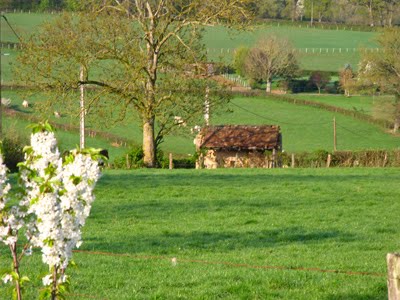
There's beauty to be found in the little known Brionnais countryside...

Gueugnon, where the stage finishes, is on the River Arroux, a tributary of the Loire, which is around 10 miles away. It is also only some 25 miles from Charolles home of France’s Charolais beef. Unfortunately the riders won’t have time to tarry but the area around Charolles and the associated Brionnais region has much rural charm, is well worth exploring and is little known.

...and fantastic beef.

Those not intending to race up into the Alps on Saturday should enjoy a juicy Charolais steak along with a bottle of 2005 Sancerre Rouge from a top producer such as Alphonse Mellot, the Vacherons, Vincent Pinard or Lucien Crochet. Santé et bon appétit!

Up next: Into the Jura.

Thursday, July 8, 2010

TDF 2010 Stage 5: Épernay to Montargis

I'm getting a rather late start on today's Tour report, just having watched the prime time coverage of today's stage. Continuing the inevitable march southward toward the Alps, the riders departed from the heart of Champagne this morning, riding roughly parallel to the Côte de Sézanne on a SSW path toward the stage finish in Montargis, birthplace of the praline as I learned tonight, in the Loiret Department. Today's relatively flat stage profile seemed tailor made for another field sprint finish, which indeed turned out to be the case.


The beginning kilometers of today's race saw the peloton roll down the beautiful Avenue de Champagne in the heart of Épernay. If we're lucky, we may just have a bit more detail on that leg of today's stage in the days to come. For now, though, just a pretty photo (below, courtesy of communes.com.)


As obviously adrenalin pumping and exciting as a sprint finish can be to watch, there are many other aspects of Tour spectating that I'm sure prove befuddling to many. Six hours spent in the saddle, sometimes seemingly just riding along in a pack until that final 5k throw down, is only part of it. There's a ton of strategy and teamwork that's quite difficult to understand until you've actually participated in the sport. Then, there are also certain unwritten rules of conduct that can be unique to cycling. Take the entire pack's agreement not to contest the finish at the end of the crash-riddled Stage 2 — not something you're likely to witness in too many other sports, at least not that I can think of.

Another such gesture of sportsmanship occurred on today's stage, one of a simpler nature and one that will continue to occur throughout the race, as Épernay resident John Gadret, riding for the French Ag2r squad, was given the freedom to roll ahead of the pack on the way out of town to stop and visit his family, who were out spectating along the race route. It's always a touching moment, one that shows there's still an old-school, gentlemanly side to the sport.

As I alluded to yesterday and in my race preview, there's really no such thing as too much Champagne. Perhaps Gadret's family celebrated the passage of the race with bottle or two of something like this.

Champagne Brut Réserve, Bérèche et Fils NV
$45. 12% alcohol. Cork. Importer: Petit Pois, Moorestown, NJ.
I must agree with Peter, at least within my somewhat limited experience with the range of Champagnes produced by Raphael Bérèche, that it's the Extra Brut Réserve that is the most expressive, complex and complete. That said, it's Bérèche's regular Brut Réserve in which I take easier and more regular pleasure. Part of that is price point, of course, but it also has more than a little to do with the enchanting, engaging fruit richness combined with a clear sense of soil expression that bursts forth from this wine. An unmistakable streak of red fruit, backed by notes of brioche and crunchy minerality, all of it in a fresh, very easy to drink style.

The current release is based primarily on fruit from the 2007 vintage: a blend of 25% Pinot Meunier, 25% Chardonnay and 20% Pinot Noir, along with 30% reserve wines from 2006 and 2005. About 20% of the wine is barrel fermented, with the balance done in enamel lined tanks, all of it undergoing its primary fermentation on native yeasts. There's plenty more information to be found on Bérèche's newly redesigned website, should you desire it.

I noticed for the first time in several years of enjoying this wine that a recent shipment included disgorgement data on the rear label. Actually, that's the bottom portion of the rear label used in France, allowed to show beneath the American importer's label that was pasted over the remaining body of the French rear étiquette. The stamped style is a little tough to read — you may have to click on the above pic for an enlarged view in order to see it clearly — but I make this batch out to be L71209, which I take to mean disgorged on the 7th of December, 2009.

Tough to decipher or not, I hope it's a trend in the making as I'd love to see this info appear on all of Raphael's wines, on all Champagne for that matter. Is that really too much to ask?

Up next: today Champagne, tomorrow the Loire... or is it Burgundy?

Wednesday, July 7, 2010

TDF 2010 Stage 4: Cambrai to Reims

After three straight days of utter chaos on the roads of Holland, Belgium and Northern France, would Stage 4, from Cambrai in the Nord Pas de Calais to Reims in the Marne, finally prove safe passage for the riders of the professional peloton?

I don't want to break my own rule, to divulge the name of the winner to anyone who's not yet had the chance to watch today's race coverage, so I'll only answer my own question. Yes. One or two men hit the deck, of course. I wonder if there's ever been an entirely crash-free stage of Le Tour...? But it was overall a day of clear sailing, in spite of a tricky run in to the city center of Reims, a day that finished in a classic bunch gallop to the line and proved the resurgence of the old guard is no joke.

I could devote today's post to the coronation of kings, to Jeanne d'Arc, to brioche and game tarts, to the history of gothic architecture and stained glass. But I'm guessing you all know what's coming, for Reims is home to more than just one of France's most impressive cathedrals; it's the mercantile capital of the Champagne region.

I'm also guessing that today's stage victor celebrated on the podium by taking a swig and then spraying the crowd with something from one of the Reims-based négoce houses or co-ops. I celebrated for him with Champagne of a different ilk, paired with that most untraditional of Champenoise delicacies: veggie pizza.

Champagne Brut Nature "Les Béguines," La Closerie (Jérôme Prévost) (2005)
$80. 12.5% alcohol. Cork. Importer: Potomac Selections, Landover, MD.
As is often the case with unusual and/or profound wines (and, in this case), the last few drops in the glass were the most aromatic, the most compelling, the most revealing. Caramel dipped apples, marzipan, Lopez de Heredia blanco, golden wheat, peach compote, coffee crumb cake.... I kind of hate to go on like that but this is the kind of wine that easily compels one to conjure such lists. There was just a ton going on, constantly shifting and morphing from beginning to end.

Like the wines of his friend and mentor, Anselme Selosse, Prévost's Champagnes are fermented and aged in small- to medium-sized oak barrels. Though the wood combined with the intense physiological ripeness of Prévost's fruit adds unmistakable roundness, color and vinosity to the wine, the wood itself seemed otherwise transparent. Right down to the last sip, that is, when my nose picked up an aroma reminiscent of walking into the barrel aging room at a winery, a soulful smell if ever there was one.

By the way, "Les Béguines," though not vintage dated, is always a single vintage wine, in this case from the 2005 harvest as indicated by the "LC05" lot number that appears on the lower part of the front label. It's also produced almost entirely from Pinot Meunier, as all but two-tenths of a hectare of Prévost's 2.2 hectares are planted exclusively to 40 year-old Meunier vines.

Deliciously different stuff. And yes, it was a good match.

Tomorrow: would anyone refuse another visit to Champagne?

Tuesday, July 6, 2010

TDF 2010 Stage 3: Wanze, Belgium to Arenberg, France

Stage 3 of the 2010 Tour de France saw the peloton depart, for the first time in the history of the race, from Wanze, Belgium. Finally, the race made its way into its namesake country, crossing the border from Belgium into France, destined for the forest of Arenberg in the Nord Pas de Calais. The field will travel some of the same ferociously cobbled farm roads traversed in the spring classic, Paris-Roubaix, aka "L'Enfer du Nord."

Today's post comes courtesy of Dan Shelton, one of the two frères behind Shelton Brothers, the US's preeminent importer of French farmhouse beers. From this rough country, as Dan will tell you, come the most distinctive beers of France. Lead on, Mr. Shelton.

The Nord-Pas-de-Calais – which is about the size of Connecticut – is almost surely the most ethnically scuffed-up region in France. You can tell by the names of the towns you pass through when you're lost somewhere in the web of little roads that wind through the countryside – places like Volckerinckhove, Le Steent'je, Godewaersvelde, Spreuwkoot, Zermezeele, Socx.... Most visitors just assume that these words are randomly chosen letters perversely arranged to be unpronounceable, and refuse to give their French tormentors any satisfaction by even trying to pronounce them. Actually, these names are Flemish, a variant of Dutch, reflecting heavy immigration from West Flanders, in Belgium. Those immigrants have left the clearest cultural mark here, but countless other groups have passed through or stayed over the years: Irish and Welsh, Poles, Czechs, Italians, Portuguese, North Africans, Greeks, Slovaks, and most recently Chinese and Vietnamese. To make things more confusing, the region has proved to be a major military crossroads, and has seen invasion from all directions for centuries, beginning with the Romans and ending, one hopes, with the Germans in the 20th Century.

Today's stage ends in Arenberg, within the Parc Naturel Régional Nord-Pas-de-Calais, where the fiercest skirmishes of the day will be fought on cobbled roads like those above.

The Nord Pas is in most parts perfectly rural, with beautiful rolling fields broken up by small forests and countless stone or brick farmhouses. (Other, admittedly less beautiful, parts of the Nord-Pas have been given over to industry, especially mining in the southwest.) The region is mostly flat, with just a few striking hills here and there. The big city in this part of France is Lille, a sprawling, bustling city with a charming historic center to rival any in Europe. But at its edges, the city turns instantly to countryside. It is the farming country that truly gives the Nord-Pas its dominant feel and spirit.

Unlike nearly every other region in France, there is no wine to speak of made in the Nord-Pas. The local drink here is the beverage of choice of serious bikers everywhere: beer. Much of the barley and hops used in the brewing are grown locally, and the history of brewing in the region is long and distinguished, beginning with the Gauls, whose love of beer is documented at least as far back as the 4th century B.C. Somewhat more recently, the people of the Nord-Pas, in rustic conditions on farms across the countryside, were busy creating France's only indigenous beer style – Bière de Garde, or "beer for keeping."

Brasserie Thiriez, located in the Nord Pas de Calais, is one of the many producers of traditional French Bières de Gardes .

Bière de Garde is probably better described as a family of beers rather than a style. In the 18th and 19th centuries, certainly, all sorts of beers were made under that general name. The common element was the method of their production. In the farmhouses of the Nord-Pas, brewing was an essential aspect of farm life, carried out in rhythm with the seasons. Working in primitive conditions, and, initially, without any knowledge of yeast (until Louis Pasteur, a Frenchman, identified and cultured yeast in the mid-1800's), farmer-brewers only made beer in the cold months, when wild yeasts that could easily infect a beer were naturally subdued. Hearty beers were cooked up in the late winter and early spring, and siphoned unfiltered into heavy champagne bottles, which were stored in the cellar, to be drunk in the warmer months when brewing was impossible. With live yeast in the bottles, this "beer for keeping" continued to ferment in the cellar for months. When it was finally brought out and opened up as refreshment for the workers in the field, it was refreshing indeed: spritzy as champagne, very dry (highly "attenuated," as brewers say), and pleasingly, but not overly, alcoholic.

This bucolic life of farming and beer-drinking should rightly have gone on forever, but for the unfortunate strategic location of the Nord-Pas. There were slightly more than 2000 breweries in this region in 1900. Two world wars, and German invasion nearly put an end to it. The First World War reduced the number of breweries by half. At the end of the Second, there were only twenty breweries left. Stories abound of beautiful copper brewing installations being taken by German soldiers and melted down to make munitions. And these few remaining breweries had almost nothing to work with – no malt, no hops. Beers made with anything that would ferment were usually struggling to exceed 1% alcohol. Soon, the tradition, and the taste, of Bière de Garde were forgotten.

An old postcard featuring a scene in the village of Jenlain.
(Image courtesy of Cartes et Patrimoine.)

The good news is that one of the survivors – the Brasserie Duyck, in the little town Jenlain, not far from Lille – undertook in the 1970's to reinvent Bière de Garde. Their Jenlain Ambrée has become the benchmark for the modern Bière de Garde, but the brewery has been happy to lend its famous local yeast to other small breweries, and it is possible to find many variants around the region. A renaissance of sorts is happening now. Small breweries, many of them with connections to old, extinct breweries in their towns, and an appreciation of their own brewing history, are popping up. The number has climbed over fifty, on its way to a hundred no doubt. Not the good old days, of course, but a good start.

No one really knows what a Bière de Garde tasted like one hundred years ago, sadly, but sitting with a big corked bottle of beer from the Nord Pas, catching the complex, champagne-like yeast aroma, and drinking in the local flavors of sweet, wholesome malt, offset by a tinge of hop bitterness, it is easy to feel a part of the long trail of brewing history.

TDF 2010 Stage 1 Revisited: Le Tour de Crash

The following post, a look back at Sunday's Stage 1 from Rotterdam to Brussels, comes to us much better late than never from guest blogger Jeff Appeltans. Jeff is co-owner of GoCycling and is one of the top masters category road and cyclocross racers in the Mid-Atlantic region. As you may figure out while reading, he's also a huge fan of Belgian beer. Take it away, Jeff....

It was nice of David to offer me a chance to blog about the first stage of this year’s Tour. Of course I promptly lost what I had written prior to the start but had to get to bed since I was racing my bike on Sunday morning. So here’s my recap of Stage 1 - Le Tour de Crash.

This stage in particular is close to my heart since my mom’s from Rotterdam and my father is from the small village of Kerkom Belgium, located about an hour east of Brussels and home to the small artisan Brewery Kerkom, makers of Bink beer . Marc’s Bloesem Bink is a favorite of mine that uses local honey and pear syrup and is made during spring and summer.

Obviously, bikes and beer are in my blood.

One of the most lasting memories I have of Rotterdam is visiting Zadkine’s sculpture, The Destroyed City, when I was a child. It stands as a symbolic memorial to the city when it’s heart was destroyed just over 70 years ago during WWII . Perhaps that anniversary had some influence on why the Tour started here this year.


I'm actually glad I didn't get to watch the stage as it would have been painful to witness all the carnage. Early on it must have been beautiful as they crossed the Deltaworks, a series of dams and operational barriers littered with huge windmills that protect the delta lowlands from North Sea storms. Well worth the trip if you ever get the chance to travel over this engineering marvel. [You can view an image of the peloton racing through the area here.]

Good thing it was a nice day as this section is usually subject to bad weather with stiff crosswinds. But as you may know, even on the nicest days, le Tour can still be treacherous and this first stage confirmed that with crashes too numerous to count.

After they cut inland the stage went through the town of Hoogerheide where they have a longstanding tradition of hosting cyclocross World Cups as well as the recent 2009 World Cyclocross Championships. I’m sure several riders would have preferred an hour on that course over what awaited them on their ride into Brussels, Lars Boom being one in particular.


Once inside Belgium there’s no doubt the majority of folks watching were enjoying lots of Belgian beer especially as the peloton passed through Antwerp, home of the Kulminator, a great bar with an extensive selection of vintage beers. Sign their guest book and they’ll send you a card on your birthday, which is good for a free beer. You only have a few months to use it though, so unless you already have a trip planned it’s a bit of a tease.

If I had to pick a place to watch the race, I would have headed down the road to Mechelen where the crowds were just a bit smaller. Brewery Het Anker would be my destination, to enjoy a couple Gouden Carolus beers or a Lucifer. Their Noel is a great Christmas beer but a bit too rich and heavy for this time of year at 10.5%. If you get to drinking more than a couple of their higher gravity beers you don’t have to go far since they have a restaurant and hotel on the premises.

After seeing the prologue results I had high hopes that Tyler Farrar would win the sprint into Brussels, bringing him closer to the yellow jersey, but it was not to be thanks to a bad move in the final 100 meters by Lloyd Mondory of AG2R that left Farrar with a broken rear derailleur. He couldn’t help but create some controversy in a post race interview when he used the Flemish word kikker (translation “frog”) to describe Mondory’s ridng style; not a word the French take kindly to.

With three crashes in the final 3K, the first of which was caused by the erratic maneuvers of Cavendish (not unlike what he did a few weeks ago in the Tour de Suisse), Petacchi once again showed his skill by staying upright and avoiding the ensuing chaos to win. These opening sprints are always hairy no matter how strong the lead-out team.

Nerves must be frayed but that always seems to be the case during the first couple stages which are made more difficult each year by increasing traffic furniture (circles & islands) throughout Europe.

If I had been there to watch the nerve racking finish I would have made a trip to Mort Subite to wind down. As it’s name implies a glass of “silent death” only seems right after today’s finale. I haven’t been there in many years but from looking at the website they’ve added a larger selection of beers in addition to the six standards: Gueuze, Faro, Kriek, Peche, Framboise and Cassis. The crisp, sour gueuze is a personal favorite of mine.

Unfortunately the riders will get no such relief, no wasted calories on beer which is too bad considering they’re in one of the best beer cities in the world. Of course a select few will enjoy a little Champagne along the way but when in Belgium how can one resist some liquid bread. With the majority of the peloton hitting the deck at some point, most everyone endured a stinging shower from all the scrapes and cuts. A good meal prepared by the team chef and a massage is as much relief as they’ll get before a restless nights sleep.

My heart goes out to these guys as they each struggle to complete yet another epic Tour. It’s hard to imagine how difficult it is to ride just one stage with all its mayhem let alone 20 of them without the reward of a beer or two.

Now that I think about it, it’s good to be an amateur, weekend warrior if only to gain a better understanding of the suffering involved. It makes those creature comforts we all enjoy that much more appreciated.

No matter who did what in previous Tours, I can only hope this edition does not get any uglier then it has been so far.

So enjoy what is undoubtedly the hardest physical challenge in sport over the next three weeks and raise a glass to these incredible athletes. May the best man win!

Monday, July 5, 2010

TDF 2010 Stage 2: Brussels to Spa, Belgium

Today's post comes to us courtesy of Greg Gaughan, a cycling, beer and wine lover, a new reader here at MFWT, and a recent returnee to the Philly area after a three-year stint as an expatriate living in working in Luxembourg. Check out his site, Blogging Luxembourg, for tales of his travels in and around the Benelux countries.

Stage 1 of the 2010 Tour de France ended in Brussels and Stage 2 picks up in Brussels on the way down to Spa, Belgium. Although the Tour often passes through Belgium during the month of July due to the wonderful rolling hills of Flanders and the Ardennes, some were probably surprised when it was announced that the Tour would pass through Brussels and the surrounding area as it is almost completely flat. After watching Stage 1 pass through Belgium on Sunday and seeing the great passion that Belgians have for cycling, plus taking into consideration that Brussels is the home town of the greatest cyclist of all time, Eddy Merckx, it was a no-brainer to involve Brussels and the surrounding area in the Tour.


Brussels is the capital, both politically and culturally of Belgium, a country I have come to know very well and love over the past three years. My wife and I recently returned from a three-year period of living and working in Luxembourg and during this time we spent a good amount of time in Belgium and more specifically we made around a dozen trips to Brussels to soak up the culture… mainly the food and beer.

Beer is to Belgium as wine is to France and Brussels is the heart of beer culture in Belgium but it is often overlooked by travelers as some consider it too touristy and not worthy of a visit on a trip to Belgium but I could not disagree more. How can you not love a city that has as a symbol the Manneken Pis, a little statue of a boy peeing just off the Grand Place.

There are many great cafes and restaurants in Brussels at which to enjoy some typical Belgian food and to sip some of the finest ales that Belgium has to offer. If you happen to be lucky enough to be visiting Brussels during the Tour de France, or at any other time, here are some of my favorite places to enjoy while in this fine city:


Brasserie Cantillon – When it comes to Belgian beer, the oldest and most interesting style has to be lambic, a beer that is very unique in that it goes through a period of spontaneous fermentation by being exposed to the micoflora in the air at night. Many years ago there were several traditional lambic brewers within the city limits of Brussels and several more in the surrounding countryside but today Brasserie Cantillon is the only lambic brewery remaining in the city of Brussels and is a must visit for any beer lover, history lover and even some wine lovers as these beers are as close to wine as beer can get. Lambic beers are aged in old wine and spirits barrels and Cantillon has a massive amount of barrels filled with lambic aging throughout the brewery that can be seen up close on a visit.


It is often hard to visit craft breweries in Belgium without advanced notice or a large group as these breweries are often small and family run but Cantillon is open to the public 6 days a week for self guided tours and tastings. Cantillon has been run by the same family for about 110 years and is world renowned for their top notch lambics that include the addition of fruits such as raspberries, cherries, apricots and even several different varieties of red and white wine grapes.

After working up an appetite learning more about lambic at Cantillon, I often head back into the heart of Brussels for a lunch of traditional Belgian food which usually consists of pomme frites (not French fries please) and mussels (moules) or some other seafood that may be fresh at the time of year. On almost any corner of Brussels you can get a cone or little container of frites to go with a sauce of your choice, although mayo is usually the sauce of choice.


After lunch in Brussels it is always a good idea to take in the sites of the Grand Place in the center of town as it is great for people watching and there is usually something going on here like a TV show being filmed, a beer festival, a market or many other interesting events or performances. Every other year the Grand Place is turned into a huge flower carpet for a week in the month of August. My wife and I were lucky enough to be in Brussels in August 2008 when the carpet was up and got some great views of this beautiful display. The Grand Place also has a nice selection of museums that are worth a visit. Although we have not visited all of the museums, we have enjoyed the Brussels city museum for their cool collection of outfits that the Manneken Pis statue has worn over the years. There is also a cool little comic strip museum just off the Grand Place that serves beer.


To continue on in your Belgian cultural immersion, there are several bars that I would suggest visiting that are all within a 5 minute walk of the Grand Place. My favorite bar in Brussels is Chez Moeder Lambic (Fontainas). The Fontainas location of Moeder Lambic opened in October 2009 and is the second Moeder Lambic in Brussels but the easiest to get to without having to get on a Metro train. Although both Moeder Lambic locations feature a great selection of bottled and draft beers and a selection of fine cheeses, the Fontainas location has a massive setup of 40+ beers on tap which is unusual for Belgium as most bars stock a large number of bottled beers but a limited number of draft beers. Moeder Lambic Fontainas always features at least 4 traditional lambic beers on tap from Cantillon, Drie Fonteinen and other lambic producers and so many other Belgian beers on tap that anyone that wanders through the front door is sure to find something they will like. Each month they also feature a few special beers from a different country. On my visits I have been there to see Italian, Swiss and German beers featured.


Although you could spend all day at Moeder Lambic, there are many other nice bars that are worth a visit including Poechenellekelder which is right next to the Manneken Pis statue. Although the name is hard to pronounce, it is not hard to find a beer to try on their menu that lists well over 100 bottled beers and also a nice menu of snacks and light food that can help extend your stay. In the warmer weather they have a nice patio at the front of the bar that puts you in a great position to watch all the tourists snapping pictures in front of the Manneken Pis statue.

A few other bars that we enjoyed from time to time include La Becasse that features lambic beers served from ceramic jugs; Toone which has a decent selection of beers but the main drawn is the puppet theatre upstairs; and Morte Subite which has the feel of a grand Parisian café.

After a long day of visiting the best bars in Brussels, there are many great restaurants to have dinner at. You can get lost in the center of Brussels with all the restaurant options you have, many of which are geared towards tourists so they focus on low prices rather than quality. If you do just a little bit of research and don’t mind walking a few minutes out of the center of town, you will find it worth the effort. One of the best restaurants we have visited for dinner is the Bier Circus. This restaurant features a beer menu of over 200 bottled beers and a food menu that is just as impressive for its quality. Most of the food is prepared with beer and they can suggest the right beer to go with each course you order.

If you still have time left on your visit and you want to get out of the hustle and bustle of downtown Brussels, then it is worth a day trip to the area surrounding Brussels as there is much more to discover. Just a few miles outside of Brussels you will find an area referred to as the Payottenland which is home to the remaining traditional lambic brewers in Belgium.

In the town appropriately named Beersel you will find another fine lambic brewer and blender, Drie Fonteinen (the 3 fountains). Drie Fonteinen up until recently brewed their own lambics that are highly regarded but more than one year ago they had a tragic thermostat failure that ruined tens of thousands of lambic bottles that were aging in a storage facility. Today Drie Fonteinen only blends lambic they purchase from other lambic brewers in the Payottenland but they do it very well. There is also a lambic tasting café at Drie Fonteinen that is a must if you happen to be in the area on a weekend. Drie Fonteinen is also known for their restaurant that is highly regarded in Belgium as one of the best.

Another standout food and beer destination for me is De Heeren Van Liederkercke in Denderleeuw, a restaurant that would be worth a visit even if they did not serve an ounce of beer but the fact that they have one of the best vintage beer cellars in Belgium and the rest of the world makes it a must visit. De Heeren is a family run restaurant that takes pride in offering fine Belgian cuisine such as stoemp, waterzooi, Flemish beef stew, frites and several other dishes worthy of a try. My wife and I have often driven the 2 and ½ hours or so from Luxembourg just to have lunch at De Heeren before returning back home in the evening.


No visit to Brussels is complete without having a Belgian waffle to end the evening. There are two main waffle varieties: Brussels and Liege. The Brussels style remind me of Eggo waffles so I prefer to stick with the sweeter Liege waffle with no toppings but you can put nearly every topping imaginable on top of your waffle if you choose to.


In De Verzekering Tegen De Grote Dorst in Eizeringen is a little café that could only exist in Belgium. They feature lambic beers almost exclusively, including several hard to find vintage lambic and gueuze beers. Although this café is well known in the beer world for their lambic beer selection and beer festivals, I think the most unique thing is that they are only open on Sundays from about 10 am to 1pm for the church crowd and after funerals.

These are just a few of the places I have visited in Brussels but there are many more spots to have a fine Belgian ale or some traditional Belgian food. You will have to come to Brussels yourself to see how wonderful of a city it is.

Sunday, July 4, 2010

TDF 2010 Stage 1: Rotterdam to Brussels

Two countries in as many days, and the race is just getting started. One of the great spectacles of Le Tour is seeing it run through neighboring countries, seeing the huge crowds that come out to embrace the race as if it were their own. The riders who happen to hail from those guest countries often take particular pride in giving it a go on the day, whether it's riding ahead of the field to stop and greet friends and family, or whether it's taking a flier from the starting gun and taking a chance on the start-to-finish breakaway.

Dutchman Lars Boom did just that today, displayed his nerve, attacking from the drop of the starter's flag and staying out front, with just a couple of breakaway companions, for nearly the entirety of today's 223km Stage 1. Displays of nerve defined today's stage in other ways as well, with crashes -- an omnipresent risk in bike racing but especially prevalent in the early days of a big race -- peppering what theoretically should have been one of the more straightforward stages of this year's Tour. Three crashes in the last 2k of the race, one of them among the largest mass pileups I've ever seen, made for an unpredictable (and rather scary) finale.

As much as I'd prefer to have seen a clean finish, I'd love to have been there to witness the mayhem in person. Had I been, as I've said here before, there's little doubt where I would have headed after the finish....

Saturday, July 3, 2010

TDF 2010 Prologue: Rotterdam

It's 9:00 PM here on the East Coast. It's tomorrow in France. I'm just now sitting down to watch the prime time coverage of today's Tour de France prologue. Don't tell me who won, please. I still don't know. For years now, I've struggled not to learn the results until I've had a chance to actually watch the race. Such is my situation at the moment.

So, for tonight you'll just get a teaser of a post. It's actually rather fitting, as the prologue essentially serves as the amuse bouche of the Tour, the appetizer before the twenty course meal to follow.


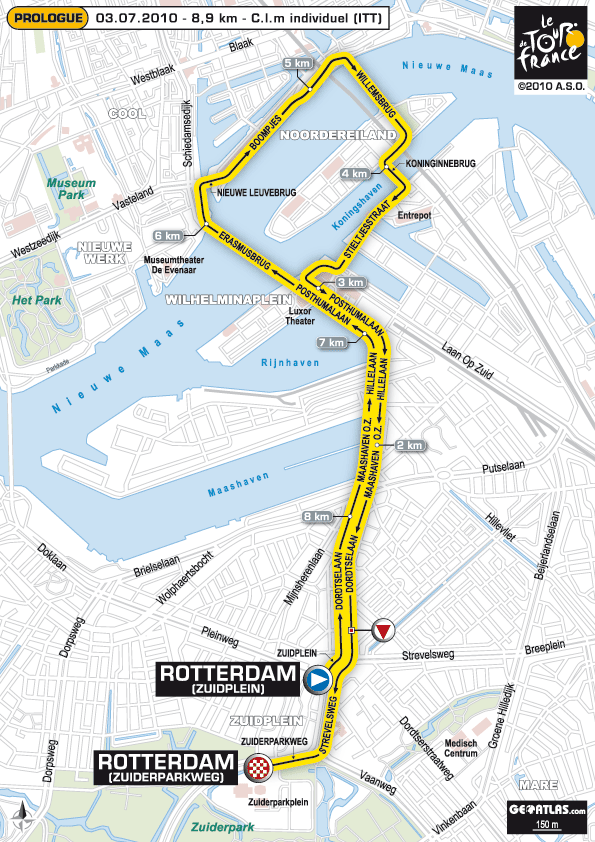
This year's course, through inner-city Rotterdam (click on the map above for an enlarged view of the course), is long by prologue standards at just under 9km. It's rare that the prologue has proved to be a meaningful stage in the overall picture but it's still an incredibly prestigious stage. It's a chance for the fast men, the bike handlers, the powerhouses and the anaerobic performers to stencil their names into the list of stage winners. More importantly, it's a chance, in just a few minutes, to stake an early claim to the leader's yellow jersey. The maillot jaune. The symbol, almost universally recognized now, of Tour leadership.

I don't know the results yet, but I have watched enough to know that the conditions for a fast, technical stage like this are far from ideal. Rain. Inner city streets. Oil. Painted stripes and sharp corners. A recipe for road rash and disappointing finishing times. All of that said, my call for the stage still goes out to Fabian Cancellara, one of the true strong men of the professional peloton who's made a specialty of stages like this over the last several years. Time has already told, but I will see over the course of the next hour or so....

In the coming days, I hope to provide content that covers both the Tour and the wine and food culture of the areas through which it passes. For today, not so much. Remember, this is just a teaser stage. I could tell you that Rotterdam is one of the ten largest cities in Europe. But I've never been there....

So I'd rather tell you that I celebrated the opening of the race with friends over dinner tonight at an excellent little Japanese restaurant, Masamoto, in the strip mall suburbs of the Brandywine Valley. A pair of 2007's – Keller's Westhofener Kirchspiel Riesling Spätlese "R" and François Chidaine's Montlouis "Les Tuffeaux" – provided most excellent pairing experiences.

And I'll tell you that in the days to come there will be much, much more action. So, thanks as always for reading, for watching, and for not telling me who won.

Friday, July 2, 2010

True Wine: Cappellano, Serralunga d'Alba

Today's post is a continuation of my travelogue from a springtime trip to Piedmont and, more to the point, is my contribution to Cory Cartwright's 32 Days of Natural Wine. Be sure to check it out there in its Saignéed form, and to follow along with the full 32 days of action.

Over the course of ten days wandering the Langhe hills this spring, little was spoken about natural wine, at least not with intention. Plenty was spoken about wine, of course. And plenty of wine was tasted, drunk and enjoyed, some of it over the course of visits with dozens of producers, some of it under more clinical circumstances, and some of it, most enjoyably, over meals with friends, some of them with those very same producers.... Whoever it was that first said that Northern Italians are "cold" clearly hadn't spent much time in Piemontese wine country.

Looking back on the contents of the notebooks I filled during the trip, I can't help but notice certain patterns emerge. For some winery visits, there are pages and pages of notes, from tasting impressions to details about vinification, to the specifics of a given blend or harvest. For others, there's surprisingly little, just some basic impressions, or a curious detail here and there. (Heck, there's always at least some detail; it was me asking the questions and taking the notes, after all.)

Maybe the name of a cat....

Marta

Or the provenance of an unusual piece of equipment....

The rather foreboding basket press still used by Augusto Cappellano was originally "rescued" by Augusto's father, Teobaldo "Baldo" Cappellano (who passed away in February 2009), when he spotted it at the local recycling/smelting center and offered a couple of cases of wine in trade for permission to take it home.

Looking back on those notes, I can't help but realize that sometimes the visits where I wrote the least were those that I enjoyed the most, that flowed the most naturally.

No matter how strictly you choose to define it, I'm increasingly convinced that making natural wine — when it's done right, I prefer to think of it as growing wine — is more about following the rhythms of and respect for life and the land than it is about following any dogma, be it a "natural" or more technically proscribed formula.

When I asked Augusto Cappellano, who's now seen 37 years of age, when he got his start at the family winery, he responded that he'd been helping out since he was born (and doing it full-time since 2003). For him, wine growing was simply a natural first step and has continued, over the years, to be a natural progression.

One could argue that my visit, late on a Saturday morning, was a disruption to that natural rhythm. Hail had struck Cappellano's vineyards in Serralunga the day before, damaging as much as 30% of the set (pre-flowering) clusters. Later that same day, Augusto's mother, Emma Orsi, had fallen down a flight of stairs, breaking a tooth and suffering a mild concussion. Yet there was Augusto, pulling up to the winery gate in his muddy-tired SUV just moments after I'd arrived. I was still wondering if I was in the right place but he was ready to roll. For a winegrower, seeing guests is just another part of the natural, daily rhythm, and Augusto takes it well in stride.

Perhaps Augusto inherited that gift for dealing with natural events from his father. In 1989, after a mud slide took out a significant portion of Cappellano's Barolo vineyards in the Gabbuti cru of Serralunga d'Alba, Baldo decided to replant the roughly one-hectare plot with own-rooted vines of Nebbiolo Michet. That's ungrafted vines: "pie franco" or "french footed" as they're often called in Italy and as they're referred to on the label of the Barolo produced from their fruit. Twenty-plus years later those vines are still thriving, unaffected by phylloxera, even though the soil composition in the vineyard (only about 10-15% sand, along with 30% clay and 50% limestone/calcareous) suggests that it should never have worked, at least not for so long.

The pie franco vines, by the way, produce smaller leaves and berries than do their grafted rupestris cousins, yet the pips are the same size. Augusto therefore removes the seeds from the pie franco must after the first three to four days of maceration to avoid over-extraction.

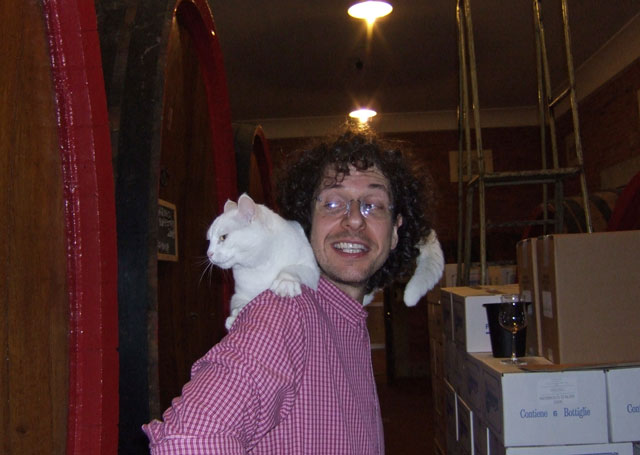
Marta guards the cellar with her life, making sure the mice don't make off with any more of the wine than mother nature already accounts for through evaporation.

Just as there was little acute talk of natural wine making throughout the trip, most producers were also not particularly predisposed to touting the merits of any particular approach when it came to cellar practices. What was practiced and believed would simply emerge, through the course of observation and discussion. At some estates, it was necessary to read between the lines or to probe for detail; at others, not at all.

Though I don't remember the word ever once being used during our visit, the cellar practices at Cappellano fall clearly and firmly in the traditional spectrum. Only a few wines are produced, all of them varietal.

The wines ferment on their native yeasts in a combination of steel, cement and wood tanks and generally undergo a two-to-three week maceration.


Both of the Baroli as well as the Barbera then spend at least three years, usually more along the lines of four to four-and-a-half, aging in old botti grandi, such as the 50hl casks pictured above.


Lest we overly fetishize the big old cask, though, it's important to remember that at a tiny estate such as Cappellano, with only 3.7 hectares of vineyards under vine, flexibility is key. There's not enough fruit produced in that single hectare of pie franco Nebbiolo, where yields naturally average only 16 or 17 hectoliters/hectare, vintage in and vintage out, to fill one of those 50hl casks. So you'll see botti grandi in the cantina, as well as smaller botti, both round and oval. You'll see foudres. And yes, you'll even see small inox tanks and barriques. Sometimes a barrique really is just a barrique, nothing more than a 225 liter vessel made from wood.

Likewise, farming on the property is entirely organic but Augusto still chooses, as did his father before him, to spray copper and sulfur in the vineyards when needed to defend against rot and mildew, both constant threats through much of the growing season in the Langhe.

Every year brings new challenges and new approahes. In 2009, Augusto took a different approach than usual with his Barolo "Rupestris." All of the wine went through its usual two week fermentation and maceration in steel. After two weeks, he moved half the juice from tank to large wooden fermenters (pictured above), put in a cap of skins, let that cap partially submerge, and then continued maceration with no pumping over for sixty more days. Malolactic fermentation occurred immediately following the primary ferment for the two-week batch but didn't occur until a month after the two-week-plus-two-month lot completed its fermentation and maceration.

As my visit drew to a close, we drank a little Barbera and Barolo, including a beautiful 2004 Barolo "Rupestris," poured from a bottle that had been sitting un-stoppered on the tasting table for two days.

And we finished with a vertical tasting of Barolo Chinato — originally invented by Augusto's ancestor, Dottore Giuseppe Cappellano, in the late 19th Century — going back to the 1905.

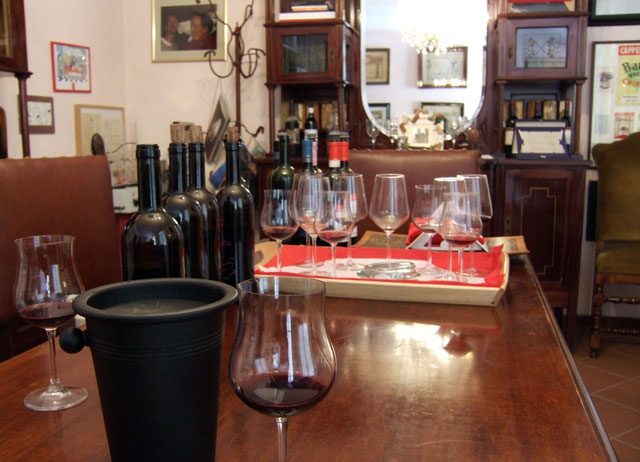
Hey, I had to sneak a little humor in there somewhere. Really, we just tasted the current "blue label" release; the rest of the bottles Augusto brought out, one at a time and with both loving care and a sense of fun, from the china cabinet in the winery's decidedly old school tasting parlor.


As always, there were things to be understood from the barrel and bottle, but much more was learned about wine, an entirely human endeavor, through spending a couple of hours with a man and his cat.
Blog Widget by LinkWithin